Stock Analysis · Global Partners LP (GLP)
Overview
Global Partners LP is an energy distribution and logistics partnership focused on moving, storing, blending, and selling refined petroleum products and renewable fuels. In simple terms, it operates the infrastructure and commercial network that helps gasoline, diesel, heating oil, jet fuel, and related products reach gas stations, commercial customers, and wholesalers, mainly in the Northeast and Mid-Atlantic United States. The partnership also owns and supplies gasoline stations and convenience stores through a mix of company-operated, leased, and supplied locations.
Its business is organized around three main operating segments. Based on the latest annual filing, revenue is heavily concentrated in fuel sales rather than fee-based storage or terminal income, which is important because it makes reported sales very large while margins remain naturally thin.
- Wholesale segment: approximately 75% to 85% of revenue. This is the largest activity and includes the sale of gasoline, distillates, residual oil, renewable fuels, crude oil, and related products to distributors, retailers, and commercial customers.
- Gasoline distribution and station operations segment: approximately 15% to 25% of revenue. This includes fuel sales through branded and unbranded stations, convenience retail operations, and related real estate arrangements.
- Commercial segment: typically a small single-digit percentage of revenue. This includes gasoline blending, logistics, and other commercial activities tied to terminals and fuel optimization.
One useful way to think about Global Partners is that it is not primarily an oil producer betting on commodity discoveries. It is more of a fuel-handling and distribution platform. That can create steadier demand than exploration businesses, but it does not fully remove commodity exposure because the company still works with products whose prices and margins can swing sharply.
The business flow also shows a structural pattern common in fuel distribution: very high revenue, very high product costs, and a much smaller profit pool left after transportation, operating, and interest costs. Over the last several years, revenue has moved up and down with fuel prices and volumes, while gross profit has been far more modest and net income has been volatile.
Key Figures
| Metric | Value | Sector ⓘ |
|---|---|---|
| Date | Oct 17, 2026 | |
| Context | ||
| Sector | Energy | |
| Industry | Oil & Gas Midstream | |
| Market Cap ⓘ | $1.68B | |
| Beta ⓘ | 1.11 | |
Value (Cheapness) | ||
| P/E Ratio ⓘ | 10.10 | 15.44 |
| P/B Ratio ⓘ | 2.21 | 1.73 |
| FCF Yield ⓘ | 11.91% | 8.20% |
| Dividend Yield ⓘ | 6.22% | 3.59% |
| EBIT / EV ⓘ | 7.34% | 7.46% |
| PEG ⓘ | 6.18 | |
Growth (Business expansion) | ||
| Revenue Growth ⓘ | 46.80% | 26.90% |
| RPS Growth (5Y CAGR) ⓘ | 8.84% | 6.90% |
| EPS Growth (5Y CAGR) ⓘ | -23.31% | -15.73% |
| BVPS Growth (5Y CAGR) ⓘ | 6.27% | 6.07% |
| Margin Growth (5Y Trend) ⓘ | 0.20% | 0.58% |
| FCF Growth (5Y CAGR) ⓘ | N/A | 1.86% |
| DPS Growth (5Y CAGR) ⓘ | 8.39% | 16.79% |
Quality (Business durability) | ||
| ROIC (Latest) ⓘ | 11.15% | 11.40% |
| ROA (Latest) ⓘ | 4.47% | 6.06% |
| ROIC (5Y Median) ⓘ | 11.31% | 10.30% |
| ROA (5Y Median) ⓘ | 2.98% | 5.42% |
| Net Debt / EBIT (Latest) ⓘ | 7.47 | 1.64 |
| Net Debt / EBIT (5Y Median) ⓘ | 8.08 | 1.83 |
| Net Debt / EBITDA (Latest) ⓘ | 4.86 | 1.08 |
| Net Debt / Assets ⓘ | 49.34% | 17.29% |
| EBITDA / Interest ⓘ | 3.02 | 9.64 |
| Operating Margin (Latest) ⓘ | 1.24% | 16.27% |
| Operating Margin (5Y Median) ⓘ | 1.45% | 20.39% |
| Debt to Equity (Latest) ⓘ | 269.96% | 54.76% |
| Profit Margin (Latest) ⓘ | 0.81% | 8.82% |
| Free Cash Flow (Latest) ⓘ | $199.43M | |
Momentum (Price trend) | ||
| 3Y Return ⓘ | +89.96% | +67.38% |
| 12M Return (excl. last month) ⓘ | +4.44% | +49.19% |
| 6M Return ⓘ | +8.07% | +7.07% |
| Price vs. 200-Day MA ⓘ | +3.18% | +9.56% |
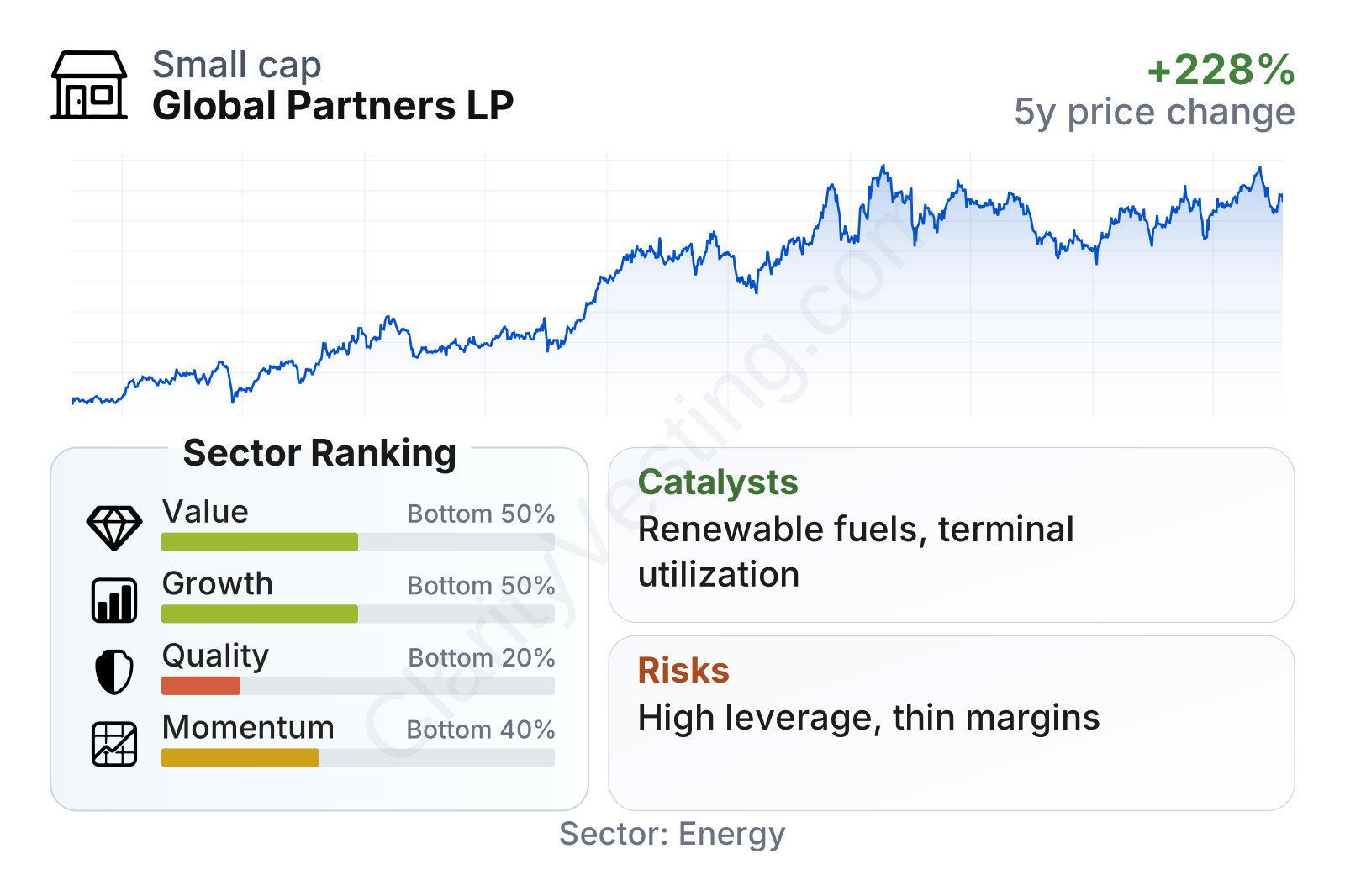
Global Partners is a relatively small public energy company by market value, with a share price history that has been much stronger over the last several years than in the period before 2022. The metrics table gives a mixed picture. On one hand, the earnings multiple is below the sector median, free cash flow yield is above the sector median, and the cash distribution yield is also higher than many peers. On the other hand, overall quality ranks weakly versus the sector because leverage is high, interest coverage is modest, and margins are thin. Growth metrics are also uneven: revenue growth has been solid recently, but earnings-based measures have been less convincing over longer periods.
This combination matters. The stock does not look expensive on simple earnings and cash flow measures, but the discount is connected to a balance sheet and profitability profile that is less robust than many other energy names.
Growth
The sector itself is mature rather than high growth. Demand for transportation fuels is not expanding like software or semiconductor markets, and over very long periods the energy transition may slowly pressure some traditional fuel volumes. Still, fuel distribution, terminaling, and blending remain essential functions, especially in densely populated regions with complicated supply chains. That gives Global Partners exposure to a necessary part of the energy system even without being in a fast-growing industry.
Its strategy for future growth is sensible within that context. The partnership has built a broad logistics and marketing footprint, and that network can support additional volume, renewable fuel blending, and retail optimization. Scale matters in this business because a larger terminal and station network can improve purchasing, routing, storage flexibility, and customer reach. Global Partners has also kept expanding its station and distribution footprint over time, which can strengthen local density in its core markets.
Recent revenue growth has accelerated sharply again after a choppy period. That rebound suggests stronger volumes, improved pricing conditions, or both. However, investors looking at revenue alone should be careful: in fuel distribution, sales can rise quickly when product prices rise, even if underlying profit does not increase at the same pace. For this company, the more important question is whether higher volumes and broader network utilization can translate into steadier operating income.
Free cash flow has also been volatile, moving from strongly positive to negative and back to positive. That is not unusual in fuel businesses because working capital can swing significantly as inventory values and product prices change. The recent return to positive free cash flow is encouraging because it supports debt service, distributions, and reinvestment, but the pattern still points to a business where cash generation can vary meaningfully from year to year.
A notable catalyst is the continued role of renewable fuels and blending economics. Global Partners already participates in renewable fuels distribution and blending, and regulatory fuel programs can create opportunities for companies with the right terminal, storage, and compliance capabilities. Another practical catalyst is simple execution: if the partnership keeps improving utilization across terminals, wholesale channels, and station operations, even a low-margin model can produce better absolute earnings.
Recent company communications in 2026 have continued to emphasize network operations, fuel marketing, and capital discipline rather than a dramatic strategic shift. That points to a company trying to compound through operating execution and regional scale, not through speculative expansion.
Risks
This article is for informational purposes only and does not constitute financial advice. Some content is AI-generated. See Disclaimer


