Stock Analysis · Golar LNG Limited (GLNG)
Overview
Golar LNG Limited is a maritime energy infrastructure company focused on liquefied natural gas, or LNG. Instead of producing gas itself, it mainly develops and operates floating LNG assets. These are specialized vessels or offshore units that can either turn natural gas into LNG for export or store and regasify LNG so it can be delivered into local gas markets. In simple terms, Golar sits in the middle of the LNG chain and tries to earn recurring fees from long-term infrastructure contracts.
The company’s business model has become more concentrated in floating liquefaction, especially after reshaping its portfolio over the last few years. Its flagship growth platform is FLNG, short for floating liquefied natural gas, where offshore units process gas from upstream fields and convert it into LNG near the source. This is a niche market with high technical barriers, limited global capacity, and long project lead times.
Based on recent company reporting, Golar’s revenue mix is now heavily centered on FLNG operations and related vessel services, with a smaller contribution from corporate and other items. Exact line-by-line percentages can move from quarter to quarter because the company has a compact asset base, but the broad picture is clear:
- Floating LNG operations and services: about 80% to 90% of revenue. This includes income from FLNG units such as Hilli Episeyo and contracts linked to liquefaction services, vessel operation, and associated fees.
- Shipping, management, and other operating revenue: about 10% to 20% of revenue. This can include technical management, reimbursements, and legacy or support activities that are much smaller than the core FLNG business.
One important feature of Golar is that accounting profit can look volatile because some periods include gains, fair-value movements, or project-related swings. The underlying business is easier to understand when viewed through long-term contracted cash generation from a small number of large LNG assets.
Over the last several years, revenue has not moved in a straight line, but the operating profile improved materially by 2025, with revenue rising to roughly $394 million and operating income climbing well above earlier levels. That suggests the portfolio is becoming more focused and commercially productive, even if cash flow remains uneven because of project spending and debt needs.
The business has become more profitable at the operating level than it was in 2021 and 2023, with a much larger share of revenue now flowing through to operating income. At the same time, interest expense and project investment still matter, which helps explain why accounting results and cash flow do not always move together.
Key Figures
| Metric | Value | Sector ⓘ |
|---|---|---|
| Date | Oct 17, 2026 | |
| Context | ||
| Sector | Energy | |
| Industry | Oil & Gas Midstream | |
| Market Cap ⓘ | $4.90B | |
| Beta ⓘ | 0.12 | |
Value (Cheapness) | ||
| P/E Ratio ⓘ | 32.88 | 15.44 |
| P/B Ratio ⓘ | 2.77 | 1.73 |
| FCF Yield ⓘ | -5.57% | 8.20% |
| Dividend Yield ⓘ | 2.08% | 3.59% |
| EBIT / EV ⓘ | 4.35% | 7.46% |
| PEG ⓘ | 7.69 | |
Growth (Business expansion) | ||
| Revenue Growth ⓘ | 72.40% | 26.90% |
| RPS Growth (5Y CAGR) ⓘ | 13.10% | 6.90% |
| EPS Growth (5Y CAGR) ⓘ | -8.70% | -15.73% |
| BVPS Growth (5Y CAGR) ⓘ | 0.30% | 6.07% |
| Margin Growth (5Y Trend) ⓘ | 47.99% | 0.58% |
| FCF Growth (5Y CAGR) ⓘ | N/A | 1.86% |
| DPS Growth (5Y CAGR) ⓘ | 77.78% | 16.79% |
Quality (Business durability) | ||
| ROIC (Latest) ⓘ | N/A | 11.40% |
| ROA (Latest) ⓘ | 3.27% | 6.06% |
| ROIC (5Y Median) ⓘ | 2.77% | 10.30% |
| ROA (5Y Median) ⓘ | 1.20% | 5.42% |
| Net Debt / EBIT (Latest) ⓘ | 6.08 | 1.64 |
| Net Debt / EBIT (5Y Median) ⓘ | 10.06 | 1.83 |
| Net Debt / EBITDA (Latest) ⓘ | 5.13 | 1.08 |
| Net Debt / Assets ⓘ | 33.79% | 17.29% |
| EBITDA / Interest ⓘ | 4.43 | 9.64 |
| Operating Margin (Latest) ⓘ | 56.70% | 16.27% |
| Operating Margin (5Y Median) ⓘ | 35.88% | 20.39% |
| Debt to Equity (Latest) ⓘ | 137.68% | 54.76% |
| Profit Margin (Latest) ⓘ | 31.27% | 8.82% |
| Free Cash Flow (Latest) ⓘ | -$272.80M | |
Momentum (Price trend) | ||
| 3Y Return ⓘ | +108.82% | +67.38% |
| 12M Return (excl. last month) ⓘ | +29.33% | +49.19% |
| 6M Return ⓘ | -12.27% | +7.07% |
| Price vs. 200-Day MA ⓘ | -5.42% | +9.56% |
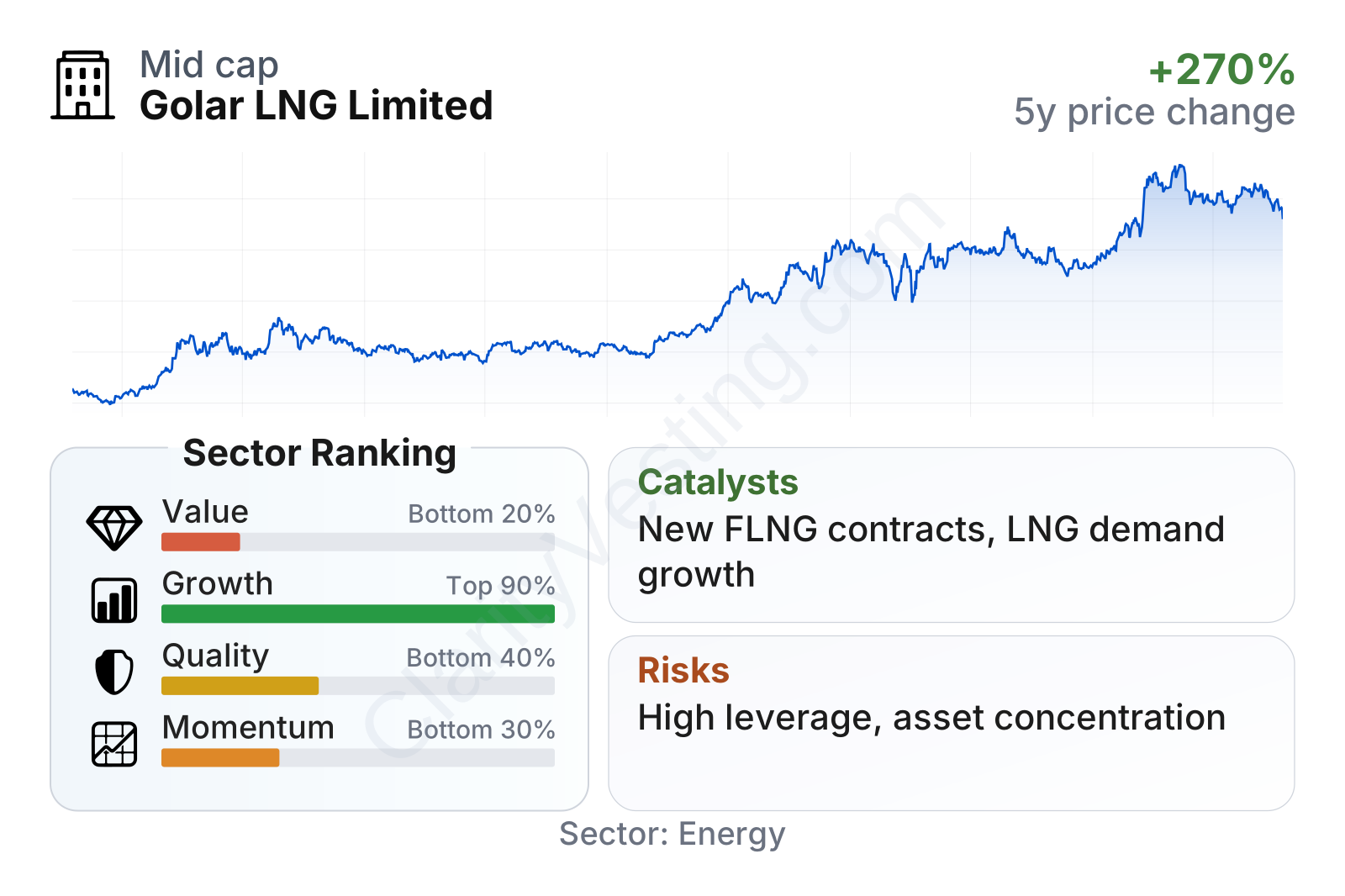
Golar stands out for strong growth metrics relative to most midstream energy peers, but the balance is mixed elsewhere. Valuation metrics look weak versus the sector, with a higher earnings multiple, a higher book multiple, and a negative free cash flow yield. Quality is also mixed: operating and profit margins are strong, yet leverage is high and returns on assets remain modest. The stock’s long-term share price performance has been strong, but shorter-term momentum has cooled.
In size terms, Golar is a mid-sized listed energy infrastructure company rather than a giant diversified operator. Another unusual point is its very low beta reading, although that can be less informative for a niche company with project-driven moves.
Growth
Golar operates in a sector with long-term structural support. LNG continues to benefit from rising global gas trade, the need for flexible energy supply, and growing demand for import and export infrastructure outside traditional pipeline systems. Floating LNG is especially relevant where onshore terminals would be too slow, too expensive, or too politically difficult to build. That gives Golar exposure to a part of the market that can expand even if broader energy conditions stay uneven.
The company’s strategy is straightforward and broadly logical: focus capital and management attention on a small number of high-value floating liquefaction assets, sign long-duration contracts, and reuse technical know-how across future projects. This matters because FLNG is not a commodity shipping business with dozens of interchangeable vessels. Each project can be large, specialized, and capable of generating meaningful earnings once fully contracted.
Recent revenue growth has accelerated sharply. After a weak patch in 2024, year-over-year growth moved decisively higher through 2025 and remained strong into 2026, with the latest reading above 70%. That places Golar well ahead of the sector median and supports the idea that its current portfolio is entering a more productive phase.
The main caution is that free cash flow is still negative on a trailing basis. That is not unusual for a project-heavy infrastructure business, but it means growth is currently being built through capital deployment rather than self-funding cash generation. For long-term analysis, this makes contract quality and project execution more important than short-term cash flow alone.
A major catalyst is the company’s development pipeline around additional FLNG capacity. Golar has highlighted opportunities to redeploy existing assets, advance new liquefaction projects, and expand its contracted earnings base. Public company updates in 2026 also point to progress on commercial discussions and execution around future FLNG work, which is significant because each contract can materially change the earnings profile of a company this size.
Another supportive factor is the industry backdrop. Countries seeking energy security and gas monetization are increasingly interested in faster, modular infrastructure. If that trend continues, Golar’s specialized fleet and engineering experience give it a credible seat at the table for projects that larger, more diversified peers may not prioritize in the same way.
Risks
This article is for informational purposes only and does not constitute financial advice. Some content is AI-generated. See Disclaimer


