Stock Analysis · GCI Liberty Inc (GLIBA)
Overview
GCI Liberty Inc is the parent company of GCI, a telecommunications provider focused on Alaska. The business sells wireless, broadband internet, video, and enterprise connectivity services to households, small businesses, large companies, and government customers. In practical terms, it operates as a regional telecom operator in a market where geography makes reliable infrastructure especially valuable and difficult to replicate.
The company’s revenue is mainly generated from recurring communication services rather than one-time product sales. Based on recent company reporting, the business mix is centered on subscription-driven telecom activity, with consumer and business connectivity making up the large majority of sales.
- Wireless services: approximately 35% to 45% of revenue. This includes mobile voice and data plans, device-related service revenue, and associated customer fees.
- Data and broadband services: approximately 25% to 35% of revenue. This covers consumer internet access, dedicated data transport, and related connectivity products.
- Business and wholesale telecom services: approximately 15% to 25% of revenue. This includes enterprise networking, managed solutions, backhaul, and services sold to other carriers or institutional customers.
- Video and other services: approximately 5% to 15% of revenue. This includes traditional video offerings, equipment-related activity, and miscellaneous telecom revenue.
That structure matters for long-term analysis because recurring telecom subscriptions tend to be more stable than many other communication businesses. At the same time, GCI Liberty is far less diversified than national telecom groups, since its economic exposure is heavily tied to one state and a limited number of service categories.
The operating picture had been improving through 2024, with revenue rising modestly and operating income expanding. However, the 2025 flow shows a sharp break: revenue increased, but gross profit and operating income deteriorated significantly, pointing to a major cost shock, accounting charge, or business mix shift that materially changed profitability. That makes it important to separate revenue growth from profit quality when assessing the company.
Key Figures
| Metric | Value | Sector ⓘ |
|---|---|---|
| Date | Oct 31, 2026 | |
| Context | ||
| Sector | Communication Services | |
| Industry | Telecom Services | |
| Market Cap ⓘ | $922.60M | |
| Beta ⓘ | N/A | |
Value (Cheapness) | ||
| P/E Ratio ⓘ | N/A | 18.47 |
| FCF Yield ⓘ | 2.38% | 14.23% |
| Dividend Yield ⓘ | N/A | 2.78% |
| EBIT / EV ⓘ | 7.75% | 4.73% |
| PEG ⓘ | N/A | |
Growth (Business expansion) | ||
| Revenue Growth ⓘ | N/A | 6.10% |
| RPS Growth (5Y CAGR) ⓘ | 21.31% | 4.57% |
| EPS Growth (5Y CAGR) ⓘ | N/A | -17.96% |
| Margin Growth (5Y Trend) ⓘ | N/A | 1.32% |
| FCF Growth (5Y CAGR) ⓘ | N/A | 5.75% |
| DPS Growth (5Y CAGR) ⓘ | N/A | 5.19% |
Quality (Business durability) | ||
| ROIC (Latest) ⓘ | N/A | 9.19% |
| ROIC (5Y Median) ⓘ | N/A | 8.24% |
| Net Debt / EBIT (Latest) ⓘ | 5.80 | 1.92 |
| Net Debt / EBIT (5Y Median) ⓘ | N/A | 2.88 |
| Net Debt / EBITDA (Latest) ⓘ | 1.88 | 1.22 |
| Net Debt / Assets ⓘ | 21.91% | 18.63% |
| EBITDA / Interest ⓘ | 9.79 | 8.36 |
| Operating Margin (Latest) ⓘ | 13.37% | 15.68% |
| Operating Margin (5Y Median) ⓘ | -6.05% | 13.39% |
| Debt to Equity (Latest) ⓘ | 73.08% | 59.65% |
| Profit Margin (Latest) ⓘ | -32.53% | 8.74% |
| Free Cash Flow (Latest) ⓘ | $22.00M | |
Momentum (Price trend) | ||
| 3Y Return ⓘ | N/A | +46.16% |
| 12M Return (excl. last month) ⓘ | -28.48% | +1.26% |
| 6M Return ⓘ | -37.26% | 0.00% |
| Price vs. 200-Day MA ⓘ | -24.16% | +0.87% |
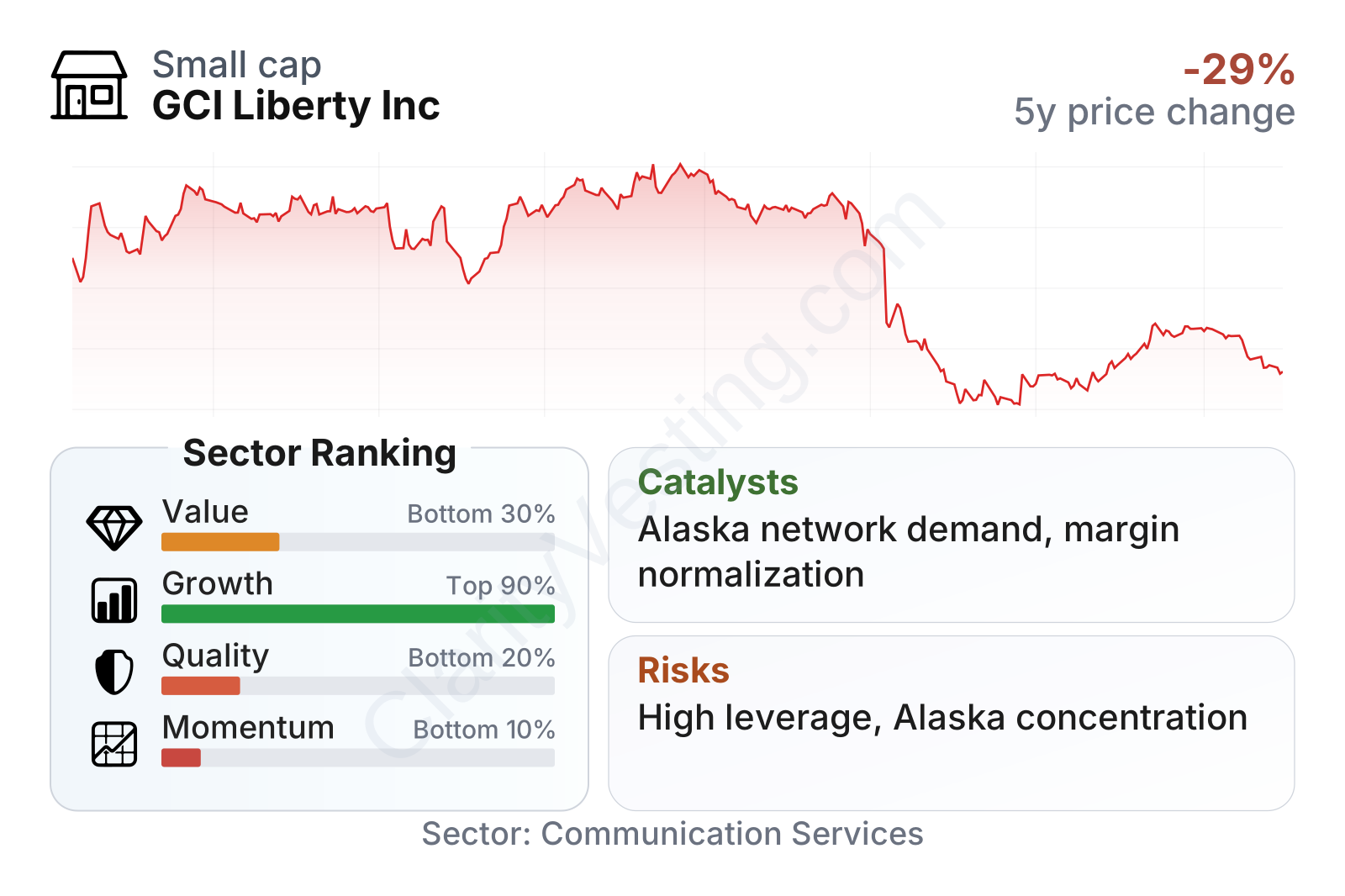
GCI Liberty is a small-cap telecom company within the Communication Services sector. The overall profile is mixed. Growth measures rank near the top of the sector, helped by a strong five-year revenue-per-share trend, but value, quality, and momentum are much weaker. Profitability and balance-sheet metrics are less attractive than many peers, while the share price trend has been notably weak over the last year. Free cash flow remains positive, but the cash yield is modest relative to the sector, which limits the margin for error if operating conditions become less favorable.
Growth
The company operates in a sector that is structurally important and still relevant for long-term demand. Wireless data use, broadband consumption, cloud connectivity, and the need for reliable communications in remote areas all support ongoing telecom investment. In Alaska specifically, connectivity can be even more essential because of distance, weather, and limited infrastructure alternatives. That gives regional network owners a clearer role than in some more crowded mainland markets.
GCI Liberty’s strategy makes sense in that context. A regional telecom provider can build durable customer relationships by owning network assets, bundling wireless and broadband services, and serving both residential and institutional customers. The company also benefits from barriers to entry created by Alaska’s geography and high deployment costs. Those characteristics can help protect revenue even if growth is not rapid every year.
One of the more encouraging points in the financial profile is the company’s longer-term revenue-per-share expansion, which has been substantially stronger than the sector median over five years. That suggests the asset base has supported meaningful top-line growth over time, even though more recent year-over-year revenue growth has been flat. In other words, the long-term direction has been constructive, but the near-term pace has clearly slowed.
A potential catalyst is operational normalization after the sharp earnings disruption visible in 2025. If the steep profitability decline came from unusual charges, transition costs, or temporary margin pressure rather than a permanent deterioration in the business, earnings could look materially better once those effects roll off. Another positive factor is the continued importance of rural and enterprise connectivity, where network reliability can matter more than simple price competition.
Recent company updates have also continued to emphasize network investment, service quality, and connectivity expansion across Alaska. For a business like GCI, the main opportunity is not explosive customer growth on a national scale, but steady monetization of a hard-to-replace local network in a market where dependable telecom service is mission-critical.
Risks
This article is for informational purposes only and does not constitute financial advice. Some content is AI-generated. See Disclaimer


