Stock Analysis · Great Lakes Dredge & Dock (GLDD)
Overview
Great Lakes Dredge & Dock is a specialized marine construction company. Its core job is dredging: removing sediment from waterways, ports, harbors, and channels so ships can move safely and coastal areas can be maintained or protected. The company also performs coastal protection and land reclamation work, such as beach nourishment, shoreline stabilization, and related projects. In simple terms, it operates large vessels and equipment that help keep U.S. maritime infrastructure working.
The business is concentrated in a niche where scale, equipment, safety performance, and experience matter. Great Lakes describes itself as the largest provider of dredging services in the United States, with a fleet that serves both public and private customers. A large share of demand comes from federal, state, and local government agencies, especially the U.S. Army Corps of Engineers, which is an important buyer of dredging work.
Revenue is mainly generated from a small number of business lines, with dredging clearly dominant. Based on recent company filings, the mix is approximately the following:
- Capital, coastal protection, and maintenance dredging: about 85% to 90% of revenue. This includes deepening and widening shipping channels, port expansion, beach nourishment, coastal resilience, and routine harbor maintenance.
- Environmental and remediation-related dredging: about 5% to 10% of revenue. This includes sediment cleanup and specialized projects with environmental requirements.
- Offshore energy services and other marine construction: still small, generally below 10% at this stage. This area includes subsea rock installation and support work tied to offshore wind development, where the company has been building capabilities.
The financial profile has improved materially since 2023. Revenue, operating income, and net income recovered sharply in 2024 and expanded further in 2025, suggesting that better vessel utilization and a healthier project mix translated into stronger profitability rather than revenue growth alone.
Key Figures
| Metric | Value | Sector ⓘ |
|---|---|---|
| Date | Oct 17, 2026 | |
| Context | ||
| Sector | Industrials | |
| Industry | Engineering & Construction | |
| Market Cap ⓘ | $1.14B | |
| Beta ⓘ | 1.37 | |
Value (Cheapness) | ||
| P/E Ratio ⓘ | 15.74 | 22.10 |
| P/B Ratio ⓘ | 1.18 | 1.97 |
| FCF Yield ⓘ | 8.76% | 6.38% |
| Dividend Yield ⓘ | N/A | 1.94% |
| EBIT / EV ⓘ | 9.09% | 4.79% |
| PEG ⓘ | 1.26 | |
Growth (Business expansion) | ||
| Revenue Growth ⓘ | 26.50% | 9.30% |
| RPS Growth (5Y CAGR) ⓘ | 4.60% | 7.81% |
| EPS Growth (5Y CAGR) ⓘ | N/A | -13.06% |
| BVPS Growth (5Y CAGR) ⓘ | 6.12% | 6.14% |
| Margin Growth (5Y Trend) ⓘ | 1.55% | 0.88% |
| FCF Growth (5Y CAGR) ⓘ | N/A | 11.01% |
| DPS Growth (5Y CAGR) ⓘ | N/A | 9.48% |
Quality (Business durability) | ||
| ROIC (Latest) ⓘ | 11.53% | 10.84% |
| ROA (Latest) ⓘ | 5.74% | 5.41% |
| ROIC (5Y Median) ⓘ | 8.36% | 9.38% |
| ROA (5Y Median) ⓘ | 4.74% | 4.95% |
| Net Debt / EBIT (Latest) ⓘ | 3.10 | 2.08 |
| Net Debt / EBIT (5Y Median) ⓘ | 4.79 | 2.27 |
| Net Debt / EBITDA (Latest) ⓘ | 2.38 | 1.39 |
| Net Debt / Assets ⓘ | 33.57% | 19.28% |
| EBITDA / Interest ⓘ | 4.33 | 9.58 |
| Operating Margin (Latest) ⓘ | 16.16% | 10.50% |
| Operating Margin (5Y Median) ⓘ | 11.63% | 10.29% |
| Debt to Equity (Latest) ⓘ | 88.58% | 65.48% |
| Profit Margin (Latest) ⓘ | 8.27% | 6.67% |
| Free Cash Flow (Latest) ⓘ | $99.45M | |
Momentum (Price trend) | ||
| 3Y Return ⓘ | +13.17% | +61.68% |
| 12M Return (excl. last month) ⓘ | -31.82% | +12.58% |
| 6M Return ⓘ | +21.56% | 0.00% |
| Price vs. 200-Day MA ⓘ | -16.47% | +0.02% |
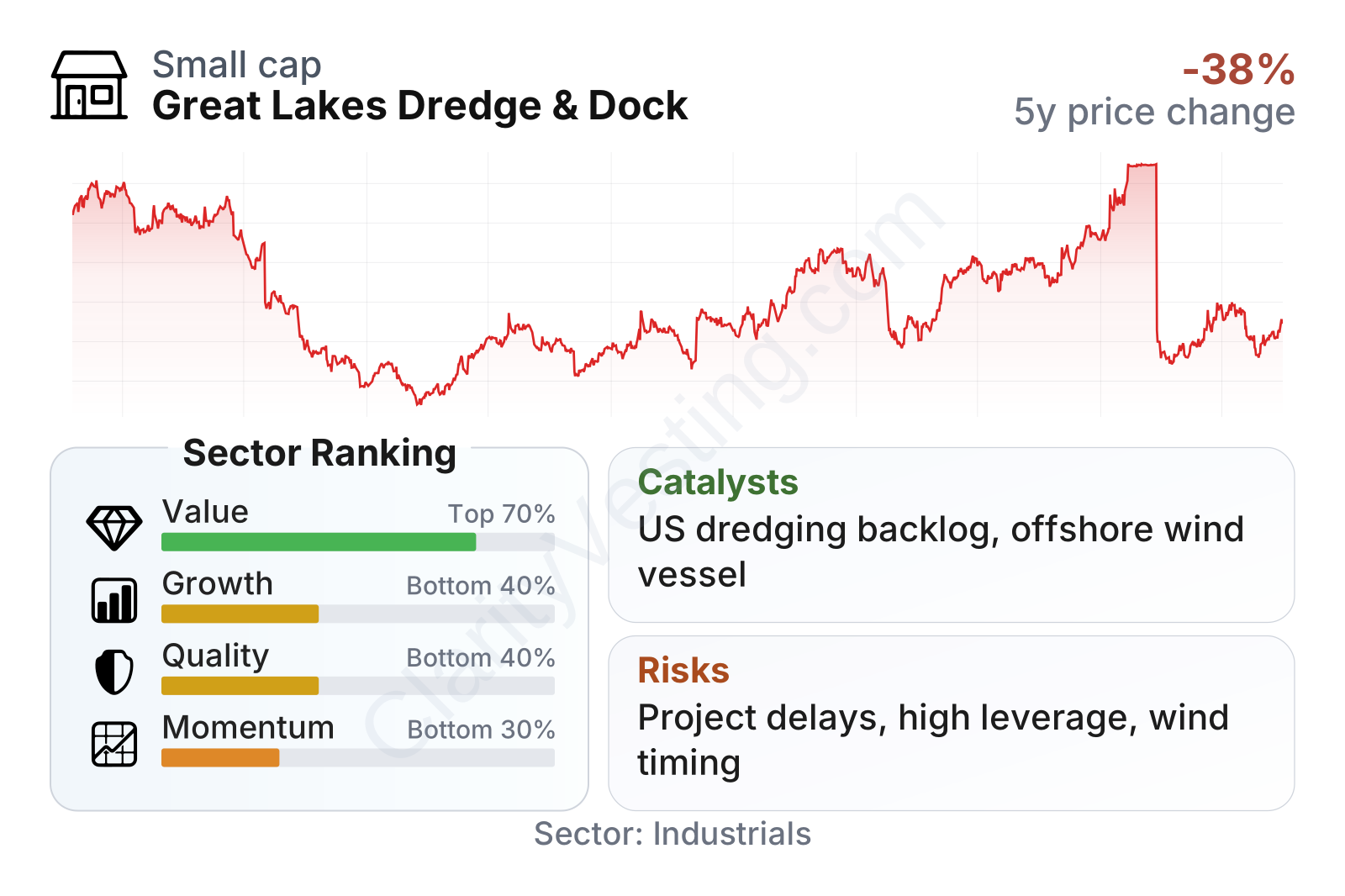
Great Lakes is a small-cap industrial company with a stock that has been volatile over the last several years. The recent share-price pattern shows sharp swings rather than a smooth upward trend, which is typical for project-driven businesses. In the latest metrics, valuation appears lighter than the sector on earnings, book value, and free-cash-flow yield. At the same time, growth and quality rankings are less impressive on a sector-relative basis because the company is coming off a cyclical recovery and still carries above-average leverage. Profitability has improved meaningfully, but the market has not rewarded the stock with strong long-term momentum so far.
Growth
Great Lakes operates in a part of infrastructure that has durable long-term support. U.S. ports require ongoing maintenance dredging, larger vessels require deeper channels, and coastal protection needs are increasing because of storm damage, erosion, and sea-level pressure. These are not short-lived themes. They are tied to trade flows, public infrastructure budgets, and resilience spending, which gives the sector a long runway even if annual awards remain uneven.
The company’s strategy also has a logical growth angle. Its traditional dredging business benefits from a strong domestic position, while offshore wind opens a potential second leg of growth. Great Lakes has invested in a subsea rock installation vessel intended to support U.S. offshore wind projects. If that market develops as expected, the company could expand beyond its established dredging niche into a higher-value marine infrastructure category.
Recent revenue trends show a clear rebound after the weaker 2022-2023 period. Year-over-year growth turned strongly positive through 2024 and remained positive in 2025, with the latest annual growth rate well above the broader sector median. That matters because it indicates more than a one-quarter bounce: the business has been rebuilding activity over several reporting periods.
Another useful point is backlog. Great Lakes has repeatedly highlighted a large dredging backlog in its filings and investor communications, which gives better visibility than many construction businesses. In this industry, backlog is important because vessels are expensive assets; when the fleet is booked on solid projects, revenue and margins can improve quickly.
Cash generation needs a more careful reading. Free cash flow has been negative at several points because this is an asset-heavy company that periodically spends heavily on vessels and equipment. That does not automatically signal weakness, but it does mean growth comes with meaningful capital requirements. The current free-cash-flow profile looks much better on a trailing basis than it did during the investment-heavy period, which is a positive sign if profitability remains firm.
A significant recent opportunity is the combination of stronger U.S. coastal resilience spending and the eventual buildout of domestic offshore wind infrastructure. Even if offshore wind develops unevenly, Great Lakes already has a solid base business in dredging, and any successful ramp in offshore services could add an additional source of revenue rather than replace the existing one.
Risks
This article is for informational purposes only and does not constitute financial advice. Some content is AI-generated. See Disclaimer


