Stock Analysis · Globe Life Inc (GL)
Overview
Globe Life Inc is a U.S. life and health insurer focused on middle-income households. Its business model is fairly easy to understand: it collects premiums from policyholders, invests part of that money, pays claims when covered events happen, and keeps the difference after expenses. The company is also unusual in that it relies heavily on direct-to-consumer marketing and captive distribution systems rather than broad, independent agent networks. That gives it a more focused operating model than many large diversified insurers.
The company reports business mainly through life insurance, supplemental health insurance, and investments. Based on recent annual reporting, revenue is led by insurance premiums, while investment income remains an important secondary contributor.
- Life insurance premiums — approximately 55% to 60%: individual life insurance policies are the largest business line. These products generally include whole life and term life coverage sold to families looking for affordable protection.
- Health insurance premiums — approximately 30% to 35%: mostly supplemental health products such as accident, cancer, critical illness, Medicare supplement, and other limited-benefit coverage.
- Net investment income — approximately 10% to 15%: income earned on the insurer’s investment portfolio, mainly from bonds and other fixed-income securities that support policy liabilities.
- Other income — low single-digit share: policy fees and smaller miscellaneous items.
Over the last several years, total revenue has trended upward from a little above $5.1 billion to roughly $6.0 billion, while net income has also moved higher. That combination suggests that Globe Life has not only grown its premium base but has also preserved solid profitability through the cycle.
The broad picture is one of steady expansion: revenue, operating earnings, and net income have generally improved over time, although insurance accounting can create occasional year-to-year noise in expense presentation.
Key Figures
| Metric | Value | Sector ⓘ |
|---|---|---|
| Date | Oct 03, 2026 | |
| Context | ||
| Sector | Financial Services | |
| Industry | Insurance - Life | |
| Market Cap ⓘ | $12.73B | |
| Beta ⓘ | 0.46 | |
Value (Cheapness) | ||
| P/E Ratio ⓘ | 11.02 | 12.60 |
| P/B Ratio ⓘ | 2.15 | 1.23 |
| FCF Yield ⓘ | 9.68% | 10.16% |
| Dividend Yield ⓘ | 0.72% | 2.96% |
| EBIT / EV ⓘ | 10.46% | 7.77% |
| PEG ⓘ | 1.30 | |
Growth (Business expansion) | ||
| Revenue Growth ⓘ | 8.00% | 9.50% |
| RPS Growth (5Y CAGR) ⓘ | 10.61% | 12.10% |
| EPS Growth (5Y CAGR) ⓘ | -3.86% | -9.45% |
| BVPS Growth (5Y CAGR) ⓘ | -3.09% | 5.01% |
| Margin Growth (5Y Trend) ⓘ | 8.47% | -4.07% |
| FCF Growth (5Y CAGR) ⓘ | -2.71% | 4.96% |
| DPS Growth (5Y CAGR) ⓘ | 8.23% | 8.79% |
Quality (Business durability) | ||
| ROIC (Latest) ⓘ | 15.14% | 9.60% |
| ROE (Latest) ⓘ | 20.47% | 13.84% |
| ROA (Latest) ⓘ | 3.90% | 1.53% |
| ROIC (5Y Median) ⓘ | 9.22% | 7.86% |
| ROE (5Y Median) ⓘ | 20.59% | 12.20% |
| ROA (5Y Median) ⓘ | 3.59% | 1.29% |
| Net Debt / EBIT (Latest) ⓘ | 1.64 | 0.91 |
| Net Debt / EBIT (5Y Median) ⓘ | 1.88 | 0.74 |
| Net Debt / EBITDA (Latest) ⓘ | 4.26 | 0.97 |
| Operating Margin (Latest) ⓘ | 26.42% | 22.12% |
| Operating Margin (5Y Median) ⓘ | 19.11% | 24.39% |
| Debt to Equity (Latest) ⓘ | 47.81% | 60.37% |
| Profit Margin (Latest) ⓘ | 19.58% | 26.62% |
| Free Cash Flow (Latest) ⓘ | $1.23B | |
Momentum (Price trend) | ||
| 3Y Return ⓘ | +56.82% | +89.23% |
| 12M Return (excl. last month) ⓘ | +24.11% | +17.35% |
| 6M Return ⓘ | +18.58% | +10.00% |
| Price vs. 200-Day MA ⓘ | +5.67% | +3.73% |
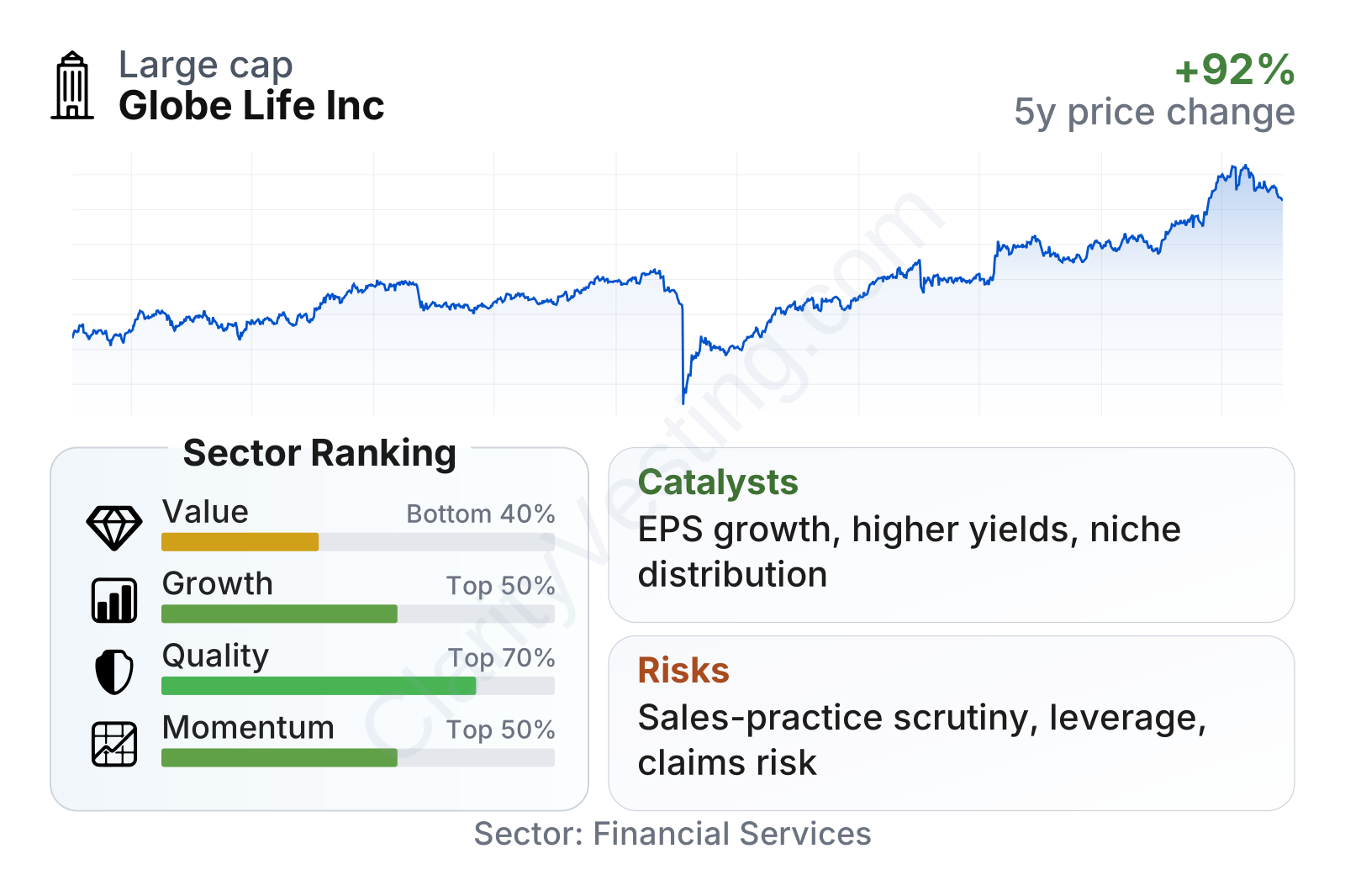
Globe Life stands out as a mid-sized insurer with a relatively calm trading profile, reflected in a low beta. Profitability metrics are strong versus much of the sector, with return on equity around 20% and return on assets near 4%, both clearly above industry medians. Growth is more mixed: recent revenue growth has been positive, margins have improved over time, and earnings momentum has been solid, but longer-term book value and free cash flow trends have been less impressive. On valuation, the shares look inexpensive on earnings relative to many financial companies, but less cheap on book value, which matters for insurers.
The stock price history also shows that the market has become more constructive again after a sharp decline in 2024. The recovery to new highs into 2026 signals improved confidence, but it also means part of the re-rating has already happened.
Growth
Life and supplemental health insurance are not fast-changing industries in the way software or semiconductors are, but they are durable and supported by long-term needs. Families continue to need income protection, final-expense coverage, and supplemental policies that help with medical out-of-pocket costs. That makes Globe Life’s sector more defensive than many other parts of the market, with demand tied to demographics and household financial planning rather than consumer trends.
Globe Life’s strategy for future growth is logical within that setting. It keeps a narrow focus on middle-income customers, emphasizes underwriting discipline, and uses targeted marketing across brands and channels. This approach can support gradual policy count growth and pricing power, especially if management continues to control acquisition costs and claims experience. Higher interest rates also help insurers over time because new money can be invested at better yields, supporting future investment income.
Earnings per share have risen strongly over the last several years, moving from the mid-$6 range in 2021 to the mid-$14 range in 2025. That is a meaningful improvement and suggests that the company has been able to combine premium growth, pricing discipline, investment income support, and share repurchases into per-share earnings expansion.
Book value per share dropped sharply in 2022 but has recovered steadily since then. For an insurer, that matters because book value reflects the capital base supporting the business. The rebound is encouraging, although the longer-term trend is still less clean than the earnings trend, which helps explain why the market continues to weigh the stock more heavily on profitability than on asset value growth.
A notable catalyst in recent periods has been continued operating improvement after earlier volatility tied to regulatory and reputational pressure. As that uncertainty faded, the market began to refocus on underwriting results, cash generation, and capital returns. If Globe Life keeps posting steady premium growth and strong earnings conversion, that operating consistency itself can remain an important driver.
Risks
This article is for informational purposes only and does not constitute financial advice. Some content is AI-generated. See Disclaimer