Stock Analysis · Glaukos Corp (GKOS)
Overview
Glaukos Corp is a medical technology company focused on ophthalmology, especially diseases that affect eye pressure, vision, and the surface of the eye. It is best known for developing minimally invasive devices and drug-delivery products used by eye surgeons and specialists. Its core areas today are glaucoma, corneal health, and retinal disease.
The business has gradually evolved from being centered on glaucoma implants into a broader eye-care platform. That matters for long-term analysis because glaucoma devices created the company’s original niche, while newer products in corneal care and retina are intended to expand its addressable market beyond a single procedure category.
Based on recent company disclosures, revenue is mainly generated from product sales across three operating categories. Approximate revenue mix is as follows:
- Surgical glaucoma: about 49% of 2025 revenue. This includes micro-invasive glaucoma surgery products such as iStent technologies used during cataract procedures to reduce eye pressure.
- Corneal health: about 42% of 2025 revenue. This is largely driven by products for keratoconus and post-refractive corneal disorders, including photrexa drug formulations used with the iLink procedure.
- Retinal disease and other: about 9% of 2025 revenue. This includes retinal drug-delivery activities and other smaller lines that are still developing.
The overall business model is straightforward: Glaukos invests heavily in research, gains regulatory approvals, trains physicians, and then earns recurring revenue as its devices and ophthalmic pharmaceutical products are adopted in clinics and surgical settings.
One notable financial pattern is that revenue has accelerated strongly in recent years, but operating expenses have also climbed quickly, especially selling costs and research spending. Gross profit has expanded with sales, yet the company remains loss-making because it is still funding commercial buildout and pipeline development at a high level.
Key Figures
| Metric | Value | Sector ⓘ |
|---|---|---|
| Date | Oct 24, 2026 | |
| Context | ||
| Sector | Healthcare | |
| Industry | Medical Devices | |
| Market Cap ⓘ | $10.43B | |
| Beta ⓘ | 0.69 | |
Value (Cheapness) | ||
| P/E Ratio ⓘ | N/A | 25.42 |
| P/B Ratio ⓘ | 15.12 | 3.08 |
| FCF Yield ⓘ | -0.12% | 3.12% |
| Dividend Yield ⓘ | N/A | 1.85% |
| EBIT / EV ⓘ | -2.11% | 0.56% |
| PEG ⓘ | 1.64 | |
Growth (Business expansion) | ||
| Revenue Growth ⓘ | 49.50% | 7.50% |
| RPS Growth (5Y CAGR) ⓘ | 8.80% | 8.60% |
| EPS Growth (5Y CAGR) ⓘ | -40.14% | -17.73% |
| BVPS Growth (5Y CAGR) ⓘ | -2.41% | 3.72% |
| Margin Growth (5Y Trend) ⓘ | N/A | -0.57% |
| FCF Growth (5Y CAGR) ⓘ | N/A | 0.96% |
| DPS Growth (5Y CAGR) ⓘ | N/A | 6.69% |
Quality (Business durability) | ||
| ROIC (Latest) ⓘ | -21.04% | 3.17% |
| ROA (Latest) ⓘ | -19.59% | 2.98% |
| ROIC (5Y Median) ⓘ | -12.04% | 4.56% |
| ROA (5Y Median) ⓘ | -13.37% | 1.87% |
| Net Debt / EBIT (Latest) ⓘ | N/A | 1.34 |
| Net Debt / EBIT (5Y Median) ⓘ | N/A | 1.86 |
| Net Debt / EBITDA (Latest) ⓘ | N/A | 1.00 |
| Net Debt / Assets ⓘ | -1.27% | 5.06% |
| EBITDA / Interest ⓘ | N/A | 9.55 |
| Operating Margin (Latest) ⓘ | -30.58% | 9.25% |
| Operating Margin (5Y Median) ⓘ | -35.35% | 7.33% |
| Debt to Equity (Latest) ⓘ | 15.07% | 26.68% |
| Profit Margin (Latest) ⓘ | -30.69% | 3.34% |
| Free Cash Flow (Latest) ⓘ | -$12.20M | |
Momentum (Price trend) | ||
| 3Y Return ⓘ | +157.72% | +51.61% |
| 12M Return (excl. last month) ⓘ | +88.92% | +19.90% |
| 6M Return ⓘ | +45.24% | +10.10% |
| Price vs. 200-Day MA ⓘ | +27.31% | +6.44% |
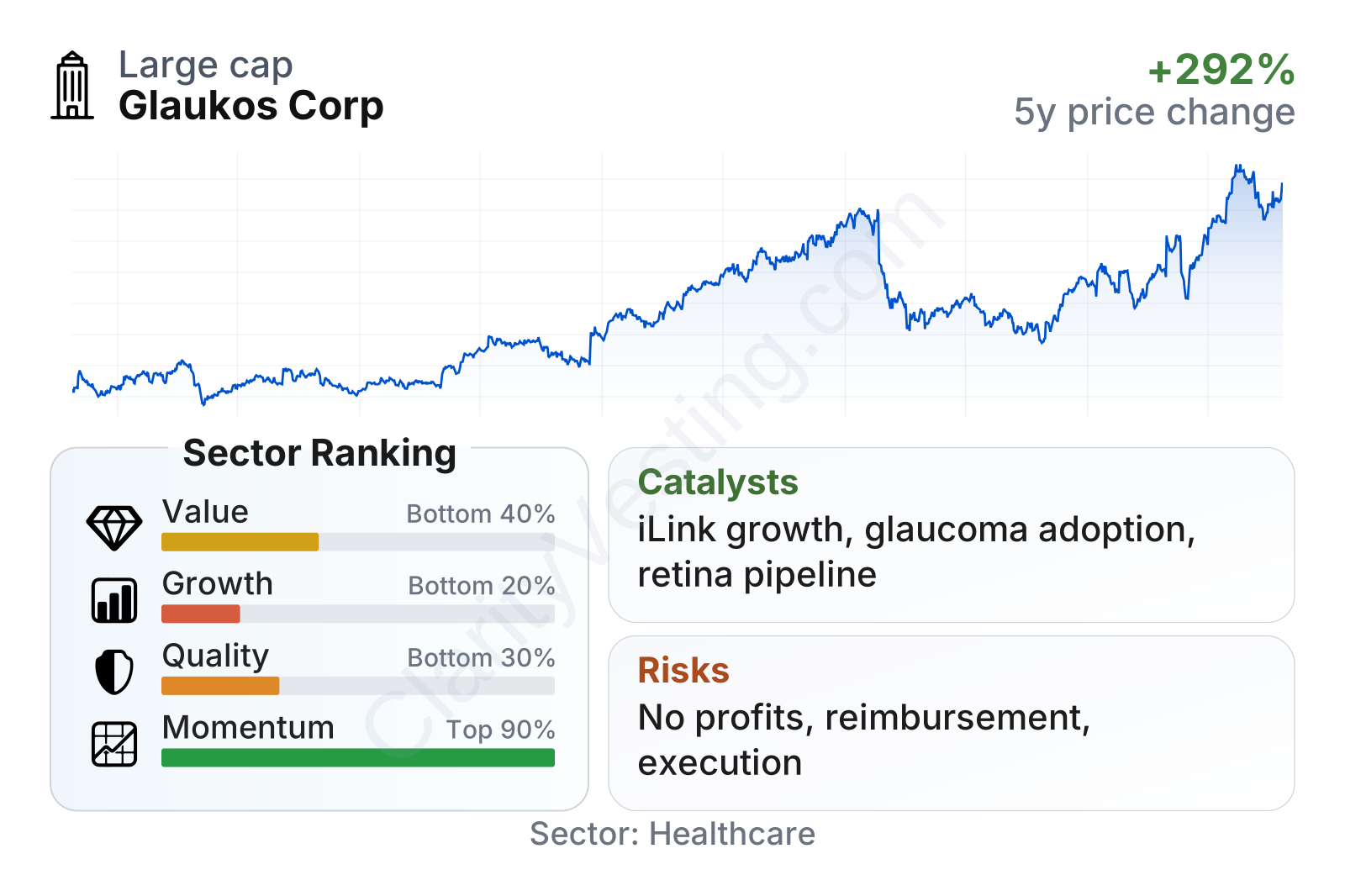
Glaukos is now a large mid-cap healthcare company with a stock that has been much stronger than most of its sector over the last year, six months, and three years. At the same time, the quality and value metrics remain weak versus the healthcare median because profitability is still negative and cash generation is not yet consistently positive. Growth is a mixed picture: recent sales expansion is very strong, but earnings trends over longer periods still reflect a business in investment mode rather than a mature profit engine.
Growth
Glaukos operates in an attractive part of healthcare. Eye disease is supported by long-term demand drivers such as aging populations, wider diagnosis rates, and a clinical shift toward earlier intervention. Glaucoma, keratoconus, dry-eye-related procedures, and retinal disease all represent areas where patients often need treatment over many years, which gives ophthalmology companies room to build durable franchises.
The company’s strategy broadly makes sense for future expansion. Instead of relying only on its original glaucoma implant line, it has built a three-part platform across glaucoma, corneal therapy, and retina. That lowers dependence on one product family and gives the company several paths to growth. Corneal health has become especially important because it adds a pharmaceutical-procedure combination that can scale through specialist adoption, while retina could become more meaningful if its pipeline and delivery programs advance successfully.
The recent top-line trend is clearly strong. Revenue growth moved from low or negative levels in 2022 to solid double-digit gains in 2023 and 2024, then accelerated further into 2025 and 2026, reaching roughly 50% year-over-year most recently. That is far above the sector median and suggests Glaukos is benefiting from both broader product adoption and a more diversified revenue base than it had a few years ago.
Cash flow has also been improving, even if it is still slightly negative. Over the last several years, free cash flow moved from deeply negative territory toward near break-even. That does not yet mean the business has crossed into self-funding mode, but it does show that commercial scale is beginning to offset part of the company’s investment burden.
Recent company updates have also pointed to continuing momentum in core franchises, particularly corneal health and the glaucoma portfolio. For Glaukos, the most important catalyst is not one single headline but the combination of rising adoption, broader physician reach, and a pipeline that could add new indications and new treatment settings over time. If management can keep converting clinical innovation into reimbursed procedures and product usage, the runway remains significant.
Risks
This article is for informational purposes only and does not constitute financial advice. Some content is AI-generated. See Disclaimer


