Stock Analysis · General Mills Inc (GIS)
Overview
General Mills is a large packaged food company that sells branded products across grocery aisles, freezers, and pet food shelves. Its portfolio includes cereal, snack bars, yogurt, baking mixes, meals, ice cream, and pet food, with well-known brands such as Cheerios, Häagen-Dazs, Betty Crocker, Pillsbury, Nature Valley, Blue Buffalo, and Old El Paso. The business is built around everyday food categories that tend to be resilient because consumers keep buying staple products even during weaker economic periods.
Based on the company’s latest annual reporting structure, revenue comes mainly from the following operating segments:
- North America Retail: about 61% of revenue. This is the core grocery business in the U.S. and Canada, including cereals, snacks, meals, baking products, yogurt, and frozen items sold through retail stores.
- Pet: about 13% of revenue. This segment is mainly the Blue Buffalo pet food business, focused on premium dog and cat food and treats.
- North America Foodservice: about 12% of revenue. This includes products sold to restaurants, schools, hospitals, and convenience outlets.
- International: about 11% of revenue. This covers retail and foodservice activity outside North America, including Europe, Australia, Asia, and Latin America.
- Asia & Latin America export and other activities: the remaining share is relatively small and varies by reporting detail, including joint ventures and other corporate items.
General Mills also has meaningful category diversification. North America Retail remains the largest earnings engine, but pet food has become strategically important because it typically carries stronger growth potential than traditional center-store packaged food. Over the last several years, the company’s revenue base has stayed large, but the mix has shifted as management has leaned more heavily on premium brands, convenience, and pet nutrition.
Looking at the flow of revenue into profit over time, the broad pattern is mixed. Sales rose into fiscal 2023, then softened in fiscal 2024 through fiscal 2026. Gross profit held up better than revenue for a while, showing pricing power and cost discipline, but operating income and net income came under heavier pressure more recently as selling costs and interest expense increased. That combination helps explain why the market has become more cautious despite the company’s defensive profile.
Key Figures
| Metric | Value | Sector ⓘ |
|---|---|---|
| Date | Oct 17, 2026 | |
| Context | ||
| Sector | Consumer Defensive | |
| Industry | Packaged Foods | |
| Market Cap ⓘ | $17.02B | |
| Beta ⓘ | 0.02 | |
Value (Cheapness) | ||
| P/E Ratio ⓘ | N/A | 17.88 |
| P/B Ratio ⓘ | 2.30 | 1.29 |
| FCF Yield ⓘ | 9.08% | 12.39% |
| Dividend Yield ⓘ | 7.60% | 2.85% |
| EBIT / EV ⓘ | 8.08% | 6.43% |
| PEG ⓘ | 17.23 | |
Growth (Business expansion) | ||
| Revenue Growth ⓘ | -2.80% | 4.10% |
| RPS Growth (5Y CAGR) ⓘ | 2.07% | 6.18% |
| EPS Growth (5Y CAGR) ⓘ | -41.54% | -13.59% |
| BVPS Growth (5Y CAGR) ⓘ | -6.00% | 3.20% |
| Margin Growth (5Y Trend) ⓘ | -3.86% | -0.15% |
| FCF Growth (5Y CAGR) ⓘ | -12.29% | 4.10% |
| DPS Growth (5Y CAGR) ⓘ | 4.28% | 6.79% |
Quality (Business durability) | ||
| ROIC (Latest) ⓘ | N/A | 12.34% |
| ROA (Latest) ⓘ | -2.85% | 6.30% |
| ROIC (5Y Median) ⓘ | 12.83% | 10.49% |
| ROA (5Y Median) ⓘ | 7.94% | 5.44% |
| Net Debt / EBIT (Latest) ⓘ | 5.05 | 1.96 |
| Net Debt / EBIT (5Y Median) ⓘ | 3.66 | 2.35 |
| Net Debt / EBITDA (Latest) ⓘ | 4.16 | 1.38 |
| Net Debt / Assets ⓘ | 43.54% | 21.51% |
| EBITDA / Interest ⓘ | 5.78 | 9.46 |
| Operating Margin (Latest) ⓘ | 14.27% | 8.87% |
| Operating Margin (5Y Median) ⓘ | 17.60% | 9.53% |
| Debt to Equity (Latest) ⓘ | 182.73% | 72.35% |
| Profit Margin (Latest) ⓘ | -4.89% | 5.40% |
| Free Cash Flow (Latest) ⓘ | $1.55B | |
Momentum (Price trend) | ||
| 3Y Return ⓘ | -41.51% | +20.92% |
| 12M Return (excl. last month) ⓘ | -23.72% | +2.13% |
| 6M Return ⓘ | -4.52% | +1.26% |
| Price vs. 200-Day MA ⓘ | -13.61% | +1.39% |
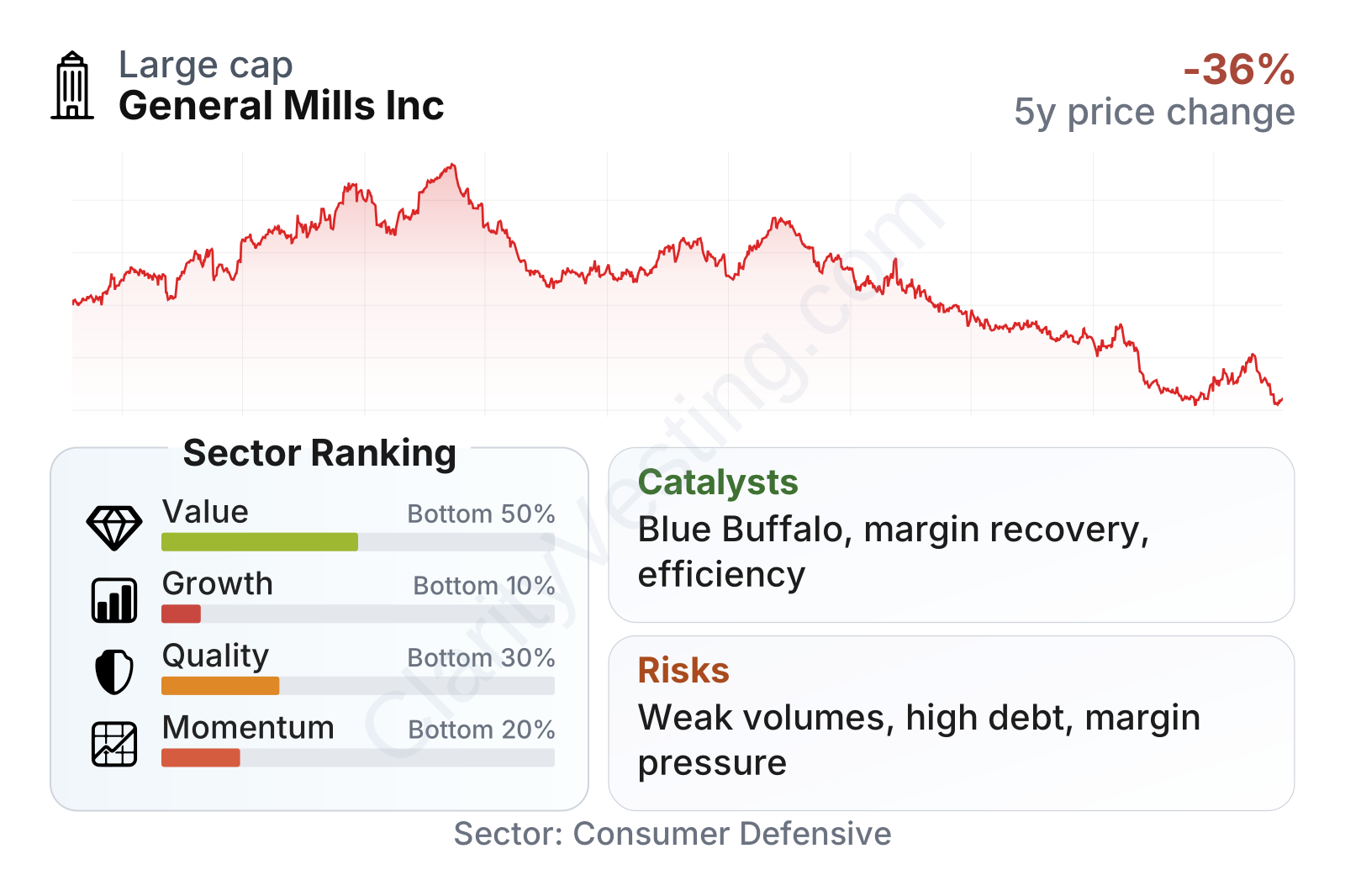
General Mills remains a large consumer staples company, but the current profile is uneven. On one hand, it still generates solid cash flow and offers a dividend yield well above the sector median. On the other hand, its growth and share-price momentum rank weakly against peers, while leverage sits clearly above typical packaged food levels. Quality is not poor overall because the business has historically produced healthy operating returns, but the latest profitability readings were distorted by a recent earnings hit, which makes the headline metrics look weaker than the longer-term record.
The stock’s multi-year price trend has been notably soft after a stronger period in 2022 and early 2023. That decline reflects a combination of slowing sales, pressure on margins, and lower market confidence in near-term growth rather than a collapse of the underlying franchise.
Growth
General Mills operates in a mature sector rather than a high-growth one. Packaged foods usually expand slowly because demand is tied to population growth, household budgets, retailer negotiations, and product innovation more than to rapid structural change. That said, the sector can still support durable long-term businesses when companies own strong brands, manage pricing well, and keep adapting to consumer preferences.
For General Mills, the long-term logic of the strategy is understandable. Management has emphasized three practical growth levers: keeping core brands relevant, pushing innovation into higher-value segments, and expanding in pet food. That approach makes sense because traditional packaged food categories alone are unlikely to deliver strong growth, while premium pet food and convenience-oriented offerings provide better room for volume and pricing gains over time.
The recent revenue trend shows why growth is the key debate around the company. Sales growth was positive in 2022 and much of 2023, but then turned negative in several subsequent periods. That pattern suggests General Mills has been relying more on pricing and mix than on broad-based volume expansion, and that strategy has become harder to sustain as consumers grow more price-sensitive and retailers push back harder.
Cash generation remains one of the more constructive parts of the picture. Free cash flow has come down from earlier highs, but it still stands at a meaningful level for a business of this type. For a mature food company, sustained cash generation matters because it supports dividends, debt servicing, brand investment, and selective acquisitions even when revenue growth is muted.
A credible catalyst is pet food, where Blue Buffalo gives General Mills exposure to a category with better long-term demand than many legacy grocery categories. Another potential driver is margin recovery if input costs, freight, and promotional intensity become more manageable. Product renovation, distribution gains, and international execution can help at the edges, but the clearest future opportunity is likely to come from stabilizing volumes while protecting pricing and cash flow.
Recent company communications have also pointed to portfolio reshaping and efficiency efforts. Those measures do not create fast growth by themselves, but they can improve the quality of growth if they help General Mills focus on stronger brands and more profitable categories.
Risks
This article is for informational purposes only and does not constitute financial advice. Some content is AI-generated. See Disclaimer


