Stock Analysis · Gilead Sciences Inc (GILD)
Overview
Gilead Sciences is a large biopharmaceutical company focused on discovering, developing, and selling medicines for serious diseases. Its business is centered on antiviral treatments, cancer therapies, and liver disease medicines. The company is best known for its long-standing leadership in HIV treatment, where it markets several widely used therapies, and it has also built important positions in oncology and virology.
For long-term analysis, the key point is that Gilead is not a single-product company, but it is still heavily shaped by a few major franchises. HIV remains the economic engine, while oncology and liver disease provide diversification and future expansion potential. Based on the company’s recent annual reporting, revenue is broadly concentrated as follows:
- HIV treatments: about 65% to 70% of total product sales. This includes flagship therapies such as Biktarvy, Descovy, Genvoya, Odefsey, and long-acting HIV prevention and treatment products marketed with partners.
- Oncology: about 10% to 15%. This mainly includes Trodelvy and cell therapies such as Yescarta and Tecartus, which target certain blood cancers and solid tumors.
- Liver disease: about 10% to 12%. This category includes hepatitis B and hepatitis C medicines such as Vemlidy, Epclusa, Harvoni, and Viread.
- Other products, including COVID-19 antiviral and miscellaneous therapies: about 8% to 12%. This group includes Veklury and smaller therapeutic categories.
That mix matters because it shows both strength and dependence. HIV provides durable cash generation, but Gilead’s medium-term outlook depends on whether newer businesses, especially oncology and long-acting medicines, become large enough to offset pricing pressure, patent erosion, and the maturity of older products.
The business model has recently shown a meaningful rebound in profitability after a weak 2024. Revenue has moved higher over the last several years, gross profit remains strong, and research spending stays elevated, which is typical for a company trying to extend its product base. The more notable shift is that earnings recovered sharply in 2025 after a temporary drop tied to much heavier operating expenses in 2024.
Key Figures
| Metric | Value | Sector ⓘ |
|---|---|---|
| Date | Oct 17, 2026 | |
| Context | ||
| Sector | Healthcare | |
| Industry | Drug Manufacturers - General | |
| Market Cap ⓘ | $190.38B | |
| Beta ⓘ | 0.33 | |
Value (Cheapness) | ||
| P/E Ratio ⓘ | N/A | 24.79 |
| P/B Ratio ⓘ | 16.42 | 3.08 |
| FCF Yield ⓘ | 6.93% | 3.15% |
| Dividend Yield ⓘ | 2.18% | 1.94% |
| EBIT / EV ⓘ | -0.45% | 0.57% |
| PEG ⓘ | 2.27 | |
Growth (Business expansion) | ||
| Revenue Growth ⓘ | 10.20% | 7.45% |
| RPS Growth (5Y CAGR) ⓘ | 2.04% | 8.61% |
| EPS Growth (5Y CAGR) ⓘ | N/A | -17.81% |
| BVPS Growth (5Y CAGR) ⓘ | 2.11% | 3.72% |
| Margin Growth (5Y Trend) ⓘ | 2.77% | -0.62% |
| FCF Growth (5Y CAGR) ⓘ | -3.28% | 1.04% |
| DPS Growth (5Y CAGR) ⓘ | 2.80% | 6.77% |
Quality (Business durability) | ||
| ROIC (Latest) ⓘ | 0.27% | 3.24% |
| ROA (Latest) ⓘ | -6.01% | 3.01% |
| ROIC (5Y Median) ⓘ | 14.28% | 4.60% |
| ROA (5Y Median) ⓘ | 9.04% | 1.89% |
| Net Debt / EBIT (Latest) ⓘ | N/A | 1.34 |
| Net Debt / EBIT (5Y Median) ⓘ | 2.49 | 1.84 |
| Net Debt / EBITDA (Latest) ⓘ | 12.79 | 1.00 |
| Net Debt / Assets ⓘ | 46.73% | 5.45% |
| EBITDA / Interest ⓘ | 1.81 | 9.64 |
| Operating Margin (Latest) ⓘ | -3.14% | 9.27% |
| Operating Margin (5Y Median) ⓘ | 28.05% | 7.38% |
| Debt to Equity (Latest) ⓘ | 221.90% | 28.58% |
| Profit Margin (Latest) ⓘ | -10.64% | 3.59% |
| Free Cash Flow (Latest) ⓘ | $13.20B | |
Momentum (Price trend) | ||
| 3Y Return ⓘ | +118.40% | +42.80% |
| 12M Return (excl. last month) ⓘ | +33.21% | +18.50% |
| 6M Return ⓘ | +13.97% | +7.57% |
| Price vs. 200-Day MA ⓘ | +15.30% | +5.12% |
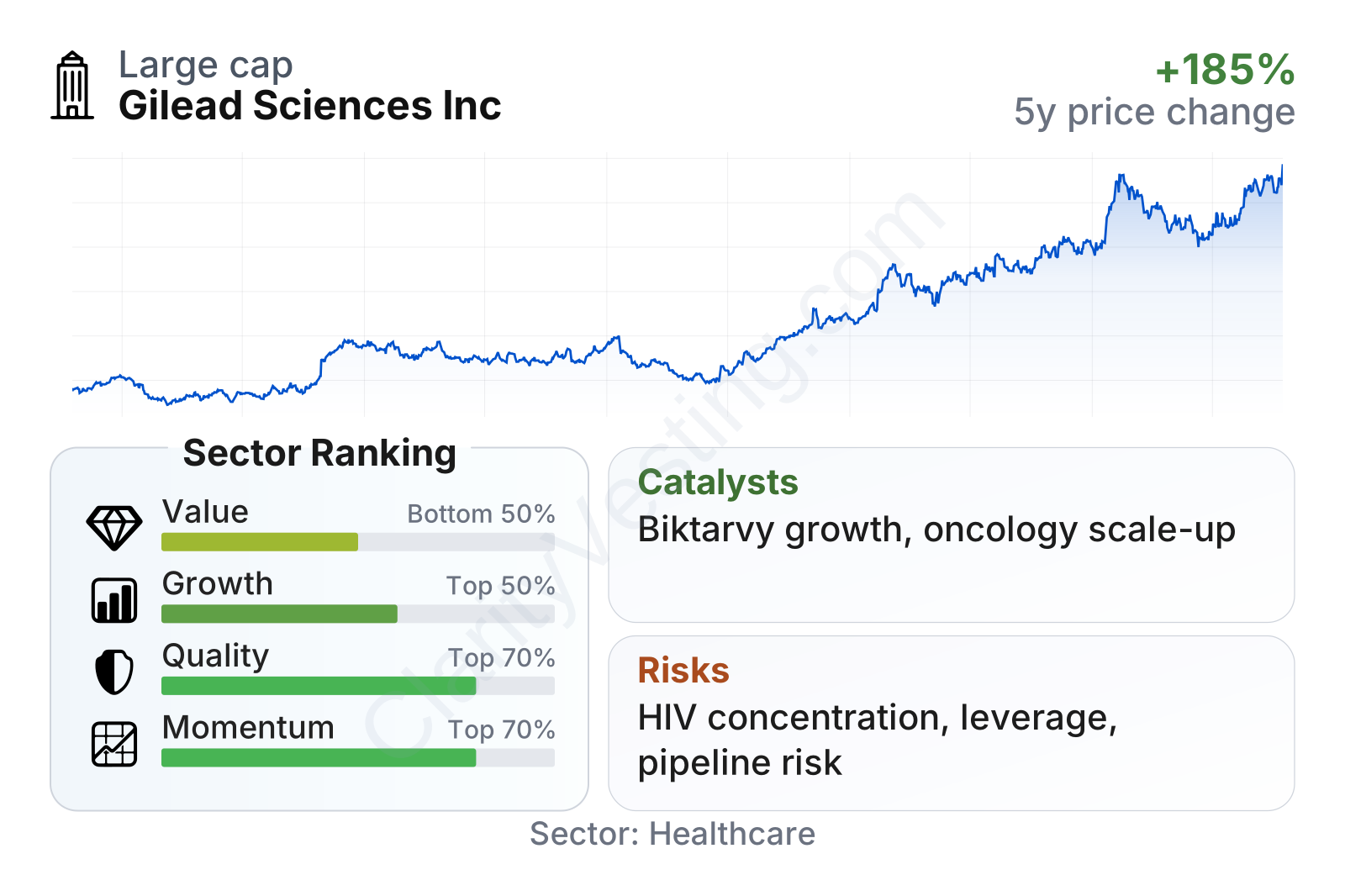
Gilead combines the profile of a defensive large-cap healthcare company with better share-price momentum than many peers. Over three years, the stock has materially outperformed the sector median, while its beta remains low at around 0.35, suggesting lower sensitivity to broad market swings. On valuation and cash generation, the picture is mixed: free cash flow yield stands clearly above the sector median, which is a positive sign, while the price-to-book ratio is much higher than the sector norm. Overall, the company ranks well on business quality, sits around the middle of the pack on growth and value, and remains supported by strong cash production.
Growth
Gilead operates in parts of healthcare that still have long-term growth drivers. HIV remains a large and persistent global treatment market because therapy is chronic and patients stay on treatment for many years. Oncology is also one of the most attractive areas in pharmaceuticals, especially for targeted drugs and cell therapies. These are favorable sectors, but they are also highly competitive and require constant clinical progress.
The company’s strategy for future growth is logical. It is trying to protect its core HIV franchise through product upgrades and long-acting options while using internal research and acquisitions to expand in oncology and inflammation. That matters because mature antiviral products alone would likely not deliver strong long-run expansion. Gilead needs a second growth engine, and oncology is the clearest candidate.
Recent revenue trends suggest the business has regained momentum. Year-over-year growth was uneven for several quarters, but the latest readings show a clear acceleration, with recent growth running above the healthcare sector median. That does not mean a straight line upward, yet it does indicate that the company is no longer in a stagnant phase.
Cash generation remains one of the most important supports for the investment case. Free cash flow has stayed in the multi-billion-dollar range and has improved from the softer levels seen earlier in the period. Even though the five-year free-cash-flow growth rate is not impressive, the absolute level of cash generation is still strong enough to fund research, acquisitions, debt service, and shareholder distributions without relying heavily on external financing.
A major catalyst is the continued expansion of Biktarvy, which remains one of the strongest HIV products in the market. Another important driver is the company’s work in long-acting HIV prevention and treatment, where convenience and adherence could support future demand. In oncology, progress for Trodelvy and the cell therapy portfolio is especially important because these assets represent some of the clearest ways to diversify beyond HIV.
Recent company updates have also highlighted ongoing regulatory and clinical development efforts across HIV, oncology, and liver disease. For a long-term view, these milestones matter because large pharmaceutical stocks often rerate when a pipeline moves from promise to commercial reality. In Gilead’s case, the market is watching whether newer products can become large enough to materially reshape the revenue mix over time.
Risks
This article is for informational purposes only and does not constitute financial advice. Some content is AI-generated. See Disclaimer


