Stock Analysis · GH Research PLC (GHRS)
Overview
GH Research PLC is a clinical-stage biotechnology company focused on developing treatments based on mebufotenin, also known as 5-MeO-DMT, for mental health conditions. Its lead target is treatment-resistant depression, a severe form of depression in which patients do not respond adequately to standard therapies. The company is also studying related delivery approaches and digital support tools intended to help treatment administration in supervised settings.
This is not a commercial-stage business yet. In practical terms, GH Research is still spending money to run clinical trials, build intellectual property, and prepare its drug candidates for possible later-stage development and regulatory review. That means the central question for long-term shareholders is less about current sales and more about whether the pipeline can eventually turn into approved products.
At this stage, revenue is minimal to nonexistent as a recurring business line. Based on recent annual reporting, the economic profile is dominated by operating expenses rather than product sales.
- Product revenue: approximately 0% — GH Research does not yet have an approved product generating meaningful recurring sales.
- Other operating income: negligible — small amounts may appear from incidental items, but not enough to represent a real business segment.
- Cash and financial income: not a revenue engine — interest income can support reported results slightly, but it is not the core activity.
The expense structure is easier to understand than the revenue structure. Research and development is the largest use of cash and has been rising over time, which is typical for a biotech company advancing clinical programs. General and administrative costs have also increased, but research remains the main priority. Over the last several years, operating losses have widened as the company invested more heavily in trials and corporate infrastructure while still producing essentially no product revenue.
The business flow shows a company with almost no top-line contribution and a cost base led by research spending. That is consistent with a biotech still in the development phase: progress depends on clinical milestones rather than on current commercial performance.
Key Figures
| Metric | Value | Sector ⓘ |
|---|---|---|
| Date | Oct 17, 2026 | |
| Context | ||
| Sector | Healthcare | |
| Industry | Biotechnology | |
| Market Cap ⓘ | $1.27B | |
| Beta ⓘ | 1.32 | |
Value (Cheapness) | ||
| P/E Ratio ⓘ | N/A | 24.79 |
| P/B Ratio ⓘ | 3.48 | 3.08 |
| FCF Yield ⓘ | -4.12% | 3.15% |
| Dividend Yield ⓘ | N/A | 1.94% |
| EBIT / EV ⓘ | -4.56% | 0.57% |
| PEG ⓘ | N/A | |
Growth (Business expansion) | ||
| Revenue Growth ⓘ | N/A | 7.45% |
| RPS Growth (5Y CAGR) ⓘ | N/A | 8.61% |
| EPS Growth (5Y CAGR) ⓘ | N/A | -17.81% |
| BVPS Growth (5Y CAGR) ⓘ | -3.70% | 3.72% |
| Margin Growth (5Y Trend) ⓘ | N/A | -0.62% |
| FCF Growth (5Y CAGR) ⓘ | N/A | 1.04% |
| DPS Growth (5Y CAGR) ⓘ | N/A | 6.77% |
Quality (Business durability) | ||
| ROIC (Latest) ⓘ | -16.91% | 3.24% |
| ROA (Latest) ⓘ | -18.47% | 3.01% |
| ROIC (5Y Median) ⓘ | -11.82% | 4.60% |
| ROA (5Y Median) ⓘ | -14.81% | 1.89% |
| Net Debt / EBIT (Latest) ⓘ | N/A | 1.34 |
| Net Debt / EBIT (5Y Median) ⓘ | N/A | 1.84 |
| Net Debt / EBITDA (Latest) ⓘ | N/A | 1.00 |
| Net Debt / Assets ⓘ | -92.57% | 5.45% |
| EBITDA / Interest ⓘ | N/A | 9.64 |
| Operating Margin (Latest) ⓘ | N/A | 9.27% |
| Operating Margin (5Y Median) ⓘ | N/A | 7.38% |
| Debt to Equity (Latest) ⓘ | 0.10% | 28.58% |
| Profit Margin (Latest) ⓘ | N/A | 3.59% |
| Free Cash Flow (Latest) ⓘ | -$52.53M | |
Momentum (Price trend) | ||
| 3Y Return ⓘ | +133.96% | +42.80% |
| 12M Return (excl. last month) ⓘ | +110.14% | +18.50% |
| 6M Return ⓘ | +10.65% | +7.57% |
| Price vs. 200-Day MA ⓘ | -11.71% | +5.12% |
GH Research is a mid-sized biotech by market value, but its fundamentals look like those of an early-stage developer rather than an established healthcare company. Profitability and return metrics sit well below sector medians because there is no meaningful revenue base yet, while free cash flow remains negative. On the other hand, the balance sheet stands out positively: debt is almost nonexistent, net cash is substantial, and recent share price momentum has been much stronger than the typical healthcare stock. That combination usually signals a market that is reacting to pipeline expectations rather than present-day earnings power.
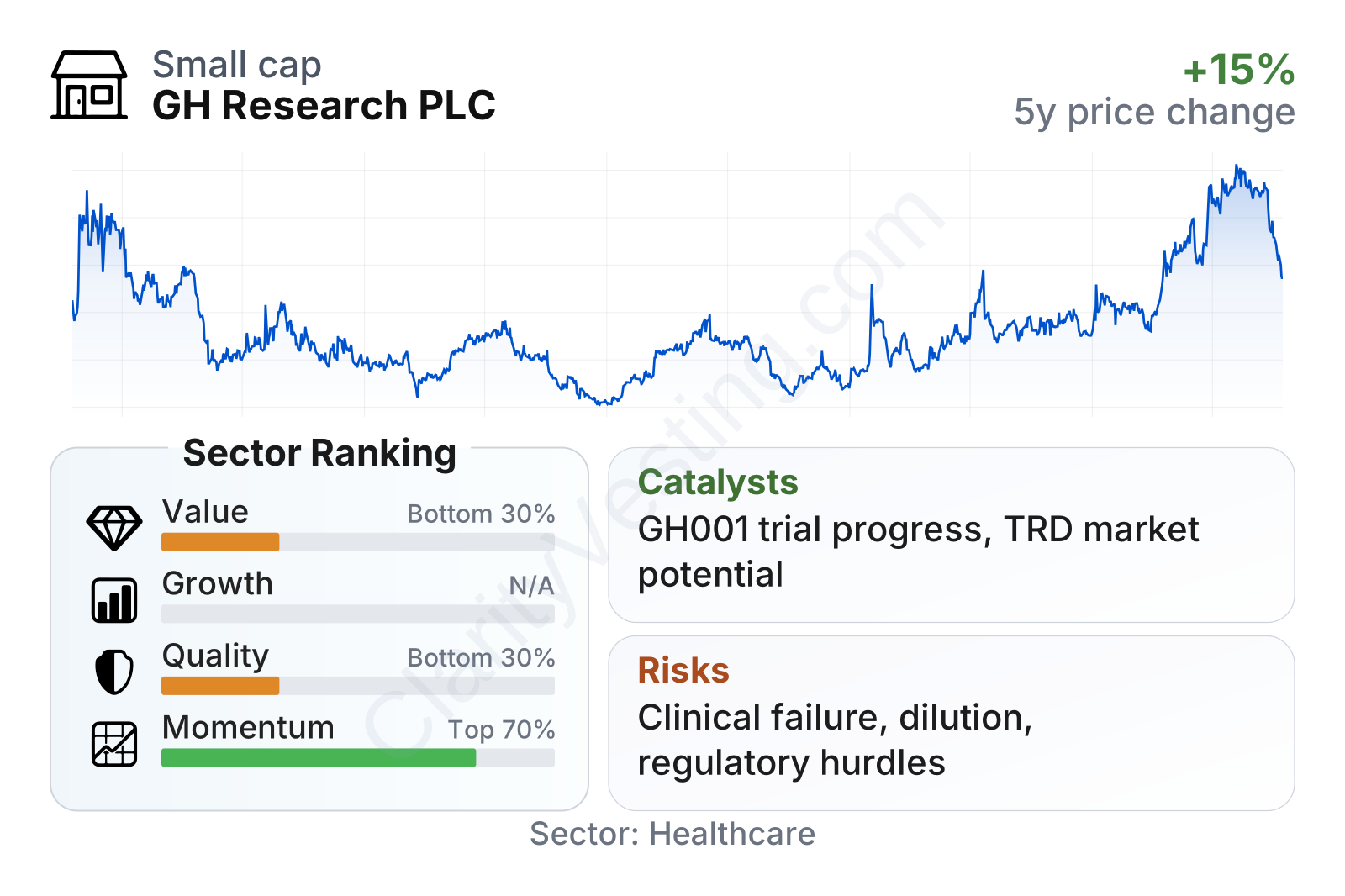
The stock price history also illustrates that point clearly. Shares have been highly volatile since listing, with a deep drawdown followed by a strong rebound into 2026. For a company like this, valuation can move sharply when trial updates change expectations about the future commercial opportunity.
Growth
GH Research operates in a part of healthcare that has attracted intense interest: new treatments for difficult mental health disorders, especially depression that does not respond to standard care. This is a large unmet-need market. Existing antidepressants often take weeks to work and can fail many patients, while newer rapid-acting approaches have shown that regulators and clinicians are open to alternatives when the clinical benefit is strong enough.
The company’s strategy is logically built around that opportunity. Instead of trying to compete in broad primary-care depression immediately, GH Research is focusing first on treatment-resistant depression, where unmet need is high and willingness to adopt innovative therapies can be stronger. Its lead asset, GH001, has been designed around a short-acting 5-MeO-DMT treatment model, which could matter if it produces a rapid antidepressant effect with a treatment session that is shorter and easier to manage than some competing psychedelic-assisted approaches.
Another important part of the strategy is optionality. GH Research has developed more than one delivery format in its pipeline, including inhalation and intranasal approaches, along with a digital support component. That gives it multiple shots on goal around the same core mechanism, although the lead program remains the main value driver.
Recent company updates have kept the focus on advancing clinical development, especially late-stage preparation and ongoing work around GH001 in treatment-resistant depression. For a company without product sales, major catalysts are clinical readouts, trial starts, regulatory interactions, and any evidence that the treatment can be delivered consistently in real-world medical settings. Positive proof on those points could materially expand the perceived commercial potential.
The cash flow trend shows the cost of that growth path. Free cash flow has become more negative over time, reflecting heavier investment in research and development. In a development-stage biotech, that is not automatically a warning sign by itself; it is the normal price of moving programs forward. What matters more is whether the spending is producing credible clinical progress and whether the company has enough liquidity to keep advancing without near-term financial pressure.
Risks
This article is for informational purposes only and does not constitute financial advice. Some content is AI-generated. See Disclaimer


