Stock Analysis · Guild Holdings Co (GHLD)
Overview
Guild Holdings Co is a U.S. mortgage company. Its core business is originating home loans, servicing the loans it keeps or acquires, and providing related products through a distributed retail platform. In simple terms, Guild helps people finance home purchases and refinancings, then earns additional income by collecting monthly payments and managing mortgage servicing rights over time.
The company operates mainly through two economic engines: mortgage originations and servicing. Originations are more sensitive to housing activity and interest-rate cycles, while servicing can become more valuable when higher rates slow refinancing and keep loans outstanding for longer. That mix gives Guild some balance, although the business still remains highly tied to the mortgage market.
Based on recent company filings, the main revenue sources can be summarized as follows:
- Loan origination and sale-related revenue: approximately 60% to 75% of total net revenue in recent periods. This includes gains on loan sales, origination fees, and related production income from purchase and refinance mortgages.
- Loan servicing and servicing-related income: approximately 20% to 35%. This includes servicing fees, changes in the value of mortgage servicing rights, and other income linked to the servicing portfolio.
- Other revenue: generally a small residual share. This can include interest income and smaller ancillary items.
Guild’s geographic reach is national, but its operating model is still centered on local loan officers and branch relationships rather than a purely digital, low-touch approach. That can help in purchase mortgages, where advice and local referral networks matter more than in simple rate-driven refinancings.
The long-term appeal of the business depends largely on whether Guild can keep expanding purchase-focused originations, protect servicing economics, and manage mortgage cycles better than peers.
The business has already shown how cyclical it can be. Revenue fell sharply from the unusually strong mortgage years of 2021 and 2022, turned unprofitable in 2023, then recovered in 2024. The rebound is meaningful, but the path also shows that earnings power can swing widely as industry conditions change.
Key Figures
| Metric | Value | Sector ⓘ |
|---|---|---|
| Date | Oct 17, 2026 | |
| Context | ||
| Sector | Financial Services | |
| Industry | Mortgage Finance | |
| Market Cap ⓘ | $1.25B | |
| Beta ⓘ | 1.08 | |
Value (Cheapness) | ||
| P/E Ratio ⓘ | 9.91 | 12.26 |
| P/B Ratio ⓘ | 3.27 | 1.23 |
| FCF Yield ⓘ | 1.99% | 10.40% |
| Dividend Yield ⓘ | N/A | 3.02% |
| EBIT / EV ⓘ | 3.68% | 8.14% |
| PEG ⓘ | N/A | |
Growth (Business expansion) | ||
| Revenue Growth ⓘ | 74.80% | 9.35% |
| RPS Growth (5Y CAGR) ⓘ | -9.49% | 12.19% |
| EPS Growth (5Y CAGR) ⓘ | -21.11% | -9.53% |
| BVPS Growth (5Y CAGR) ⓘ | 13.26% | 4.99% |
| Margin Growth (5Y Trend) ⓘ | -19.08% | -3.86% |
| FCF Growth (5Y CAGR) ⓘ | N/A | 4.81% |
| DPS Growth (5Y CAGR) ⓘ | -5.48% | 8.79% |
Quality (Business durability) | ||
| ROIC (Latest) ⓘ | 6.17% | 9.49% |
| ROE (Latest) ⓘ | 10.12% | 13.90% |
| ROA (Latest) ⓘ | 2.56% | 1.55% |
| ROIC (5Y Median) ⓘ | 7.86% | 7.86% |
| ROE (5Y Median) ⓘ | 30.30% | 12.17% |
| ROA (5Y Median) ⓘ | 6.17% | 1.30% |
| Net Debt / EBIT (Latest) ⓘ | 19.72 | 0.96 |
| Net Debt / EBIT (5Y Median) ⓘ | 4.71 | 0.73 |
| Net Debt / EBITDA (Latest) ⓘ | 16.18 | 0.92 |
| Operating Margin (Latest) ⓘ | 12.62% | 22.30% |
| Operating Margin (5Y Median) ⓘ | 23.45% | 24.63% |
| Debt to Equity (Latest) ⓘ | 269.53% | 58.56% |
| Profit Margin (Latest) ⓘ | 9.92% | 26.57% |
| Free Cash Flow (Latest) ⓘ | $24.85M | |
Momentum (Price trend) | ||
| 3Y Return ⓘ | N/A | +88.33% |
| 12M Return (excl. last month) ⓘ | +24.67% | +19.38% |
| 6M Return ⓘ | -11.11% | +4.75% |
| Price vs. 200-Day MA ⓘ | -8.33% | +3.50% |
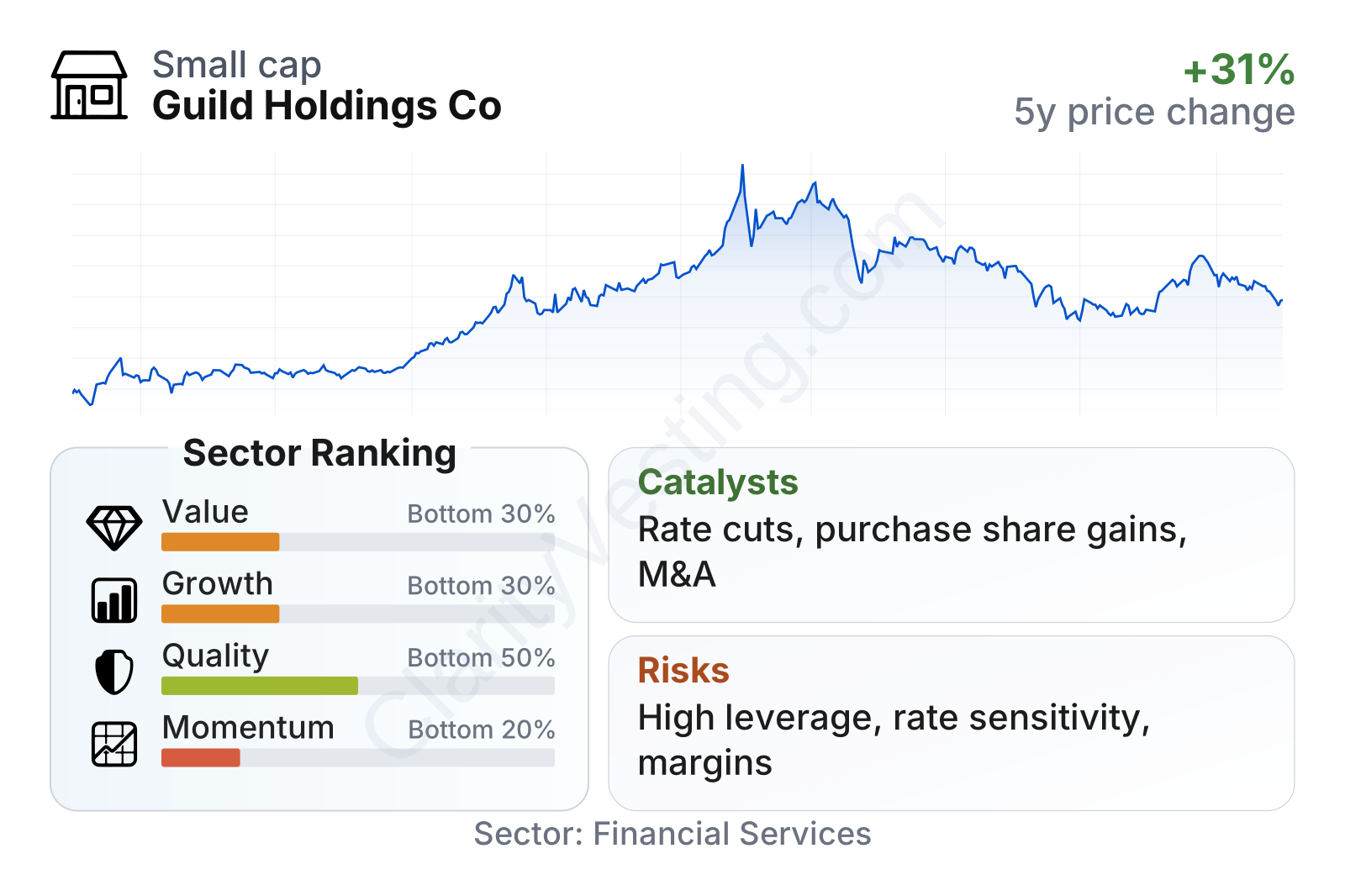
Guild is a mid-sized mortgage finance company with a market value a little above $1 billion and share-price volatility close to the broader market. The overall factor picture is mixed. Revenue growth recently accelerated well above the sector median, but longer-term growth metrics remain weaker because the mortgage cycle hit earnings and per-share revenue hard over the last five years. Profitability is also uneven: current return on equity is below the sector median, while return on assets is better than average. The most important balance-sheet signal is leverage, which stands much higher than typical financial-sector peers on several debt measures. On valuation, the earnings multiple looks modest, but the price-to-book multiple is clearly elevated versus the sector, suggesting the market is assigning a premium to Guild’s franchise despite cyclical results.
Growth
Guild operates in a sector that should remain structurally relevant for decades because housing finance is a permanent need. The more important question is not whether mortgages disappear, but how much volume the industry can generate and which lenders are positioned to gain share. Over time, housing shortages in many U.S. markets, demographic demand from first-time buyers, and eventual refinancing waves can all support industry activity. That said, growth is rarely smooth because mortgage demand is heavily influenced by rates, affordability, and home sales turnover.
Guild’s strategy makes sense within that context. The company has emphasized a purchase-oriented model, recurring servicing income, and branch-based distribution. A purchase-heavy mix matters because purchase lending is usually more durable than refinancing when rates stay high. Servicing matters because it can help offset part of the pressure on originations during weak mortgage markets. Together, those pieces give Guild a model built more for resilience than for pure volume chasing.
Earnings history reflects both the pain of the rate shock and the beginnings of a recovery. Profit per share was much higher during the mortgage boom, then dropped sharply as the industry reset. More recently, earnings have improved again, which suggests Guild has been able to stabilize operations and benefit from better market conditions and internal execution. The challenge is that one recovery year does not remove the sector’s cyclicality.
Book value per share has trended upward over the last several years despite the industry downturn, with some fluctuations. That is an encouraging sign because book value is an important anchor for mortgage lenders and servicers. A business that can rebuild earnings while also growing book value is generally in a stronger position to compound through the cycle.
A meaningful catalyst is any broad improvement in mortgage market activity. Lower long-term interest rates, increased home sales, or a more active refinancing environment could lift origination volumes. Guild could also benefit if independent mortgage banks continue to consolidate and smaller competitors struggle with compliance costs, funding pressure, or weak scale. In that kind of market, companies with established branches, servicing assets, and operating infrastructure can capture share.
Recent company communications have also highlighted acquisitions and branch expansion as part of Guild’s growth approach. In a fragmented mortgage industry, disciplined acquisitions can add loan officers, regional presence, and customer relationships more quickly than organic growth alone. If integration remains controlled, that can create operating leverage when industry volumes recover.
Risks
This article is for informational purposes only and does not constitute financial advice. Some content is AI-generated. See Disclaimer


