Stock Analysis · Graham Holdings Co (GHC)
Overview
Graham Holdings Co is a diversified holding company with operations that span education, television broadcasting, health care, manufacturing, automotive dealerships, restaurants, and a group of smaller investments. The business is the modern successor to the former Washington Post Company, but today it is much less a pure media company and much more a collection of operating businesses under one corporate parent.
That structure matters for long-term analysis because Graham Holdings is not driven by one single market. Instead, results come from several industries with different economic cycles. In stronger periods, that diversification can reduce dependence on any one segment, but it also makes the company harder to analyze than a focused business.
Based on the latest full-year revenue mix available from the company’s recent filings, the main sources of revenue are approximately:
- Education — about 40% to 45%: primarily Kaplan, which provides higher education, professional training, test preparation, language instruction, and corporate training services.
- Health care — about 15% to 20%: mainly hospice, home health, and related care services through CSI Pharmacy and other health-care operations.
- Automotive — about 15% to 20%: new and used vehicle sales, service, parts, and finance-related dealership activities.
- Television broadcasting — about 10% to 15%: local TV stations and related advertising, retransmission fees, and political advertising exposure in election years.
- Manufacturing — about 5% to 10%: industrial products, including educational and other niche manufacturing operations.
- Restaurant and other businesses — less than 10%: restaurant operations and a set of smaller investments and corporate activities.
The broad pattern over the past several years has been steady revenue expansion, with total revenue rising from roughly $3.2 billion in 2021 to just over $4.9 billion in 2025. Operating income and net income, however, have been much more uneven, which shows that the group’s earnings can shift meaningfully depending on segment mix, deal activity, and margin swings.
The financial flow highlights a company that has grown its top line meaningfully since 2021, but profitability has not moved in a straight line. After a very strong 2024, earnings normalized in 2025, which makes it important to separate recurring operating strength from one-off boosts when judging long-term earning power.
Key Figures
| Metric | Value | Sector ⓘ |
|---|---|---|
| Date | Oct 24, 2026 | |
| Context | ||
| Sector | Industrials | |
| Industry | Conglomerates | |
| Market Cap ⓘ | $5.19B | |
| Beta ⓘ | 0.70 | |
Value (Cheapness) | ||
| P/E Ratio ⓘ | 9.91 | 22.29 |
| P/B Ratio ⓘ | 1.12 | 1.98 |
| FCF Yield ⓘ | 4.63% | 6.26% |
| Dividend Yield ⓘ | 0.61% | 1.92% |
| EBIT / EV ⓘ | 15.46% | 4.83% |
| PEG ⓘ | 4.04 | |
Growth (Business expansion) | ||
| Revenue Growth ⓘ | 7.10% | 9.30% |
| RPS Growth (5Y CAGR) ⓘ | 15.02% | 7.76% |
| EPS Growth (5Y CAGR) ⓘ | -12.30% | -13.17% |
| BVPS Growth (5Y CAGR) ⓘ | 5.13% | 6.13% |
| Margin Growth (5Y Trend) ⓘ | -3.60% | 0.74% |
| FCF Growth (5Y CAGR) ⓘ | 60.95% | 10.79% |
| DPS Growth (5Y CAGR) ⓘ | 4.26% | 9.41% |
Quality (Business durability) | ||
| ROIC (Latest) ⓘ | 10.70% | 10.75% |
| ROA (Latest) ⓘ | 6.78% | 5.41% |
| ROIC (5Y Median) ⓘ | 7.18% | 9.37% |
| ROA (5Y Median) ⓘ | 3.64% | 4.95% |
| Net Debt / EBIT (Latest) ⓘ | 1.54 | 2.04 |
| Net Debt / EBIT (5Y Median) ⓘ | 2.58 | 2.27 |
| Net Debt / EBITDA (Latest) ⓘ | 1.27 | 1.39 |
| Net Debt / Assets ⓘ | 14.52% | 19.27% |
| EBITDA / Interest ⓘ | 17.87 | 9.58 |
| Operating Margin (Latest) ⓘ | 15.10% | 10.49% |
| Operating Margin (5Y Median) ⓘ | 11.58% | 10.30% |
| Debt to Equity (Latest) ⓘ | 28.11% | 64.82% |
| Profit Margin (Latest) ⓘ | 10.69% | 6.67% |
| Free Cash Flow (Latest) ⓘ | $240.31M | |
Momentum (Price trend) | ||
| 3Y Return ⓘ | +115.99% | +67.77% |
| 12M Return (excl. last month) ⓘ | +0.30% | +12.05% |
| 6M Return ⓘ | +7.39% | 0.00% |
| Price vs. 200-Day MA ⓘ | +8.17% | +0.67% |
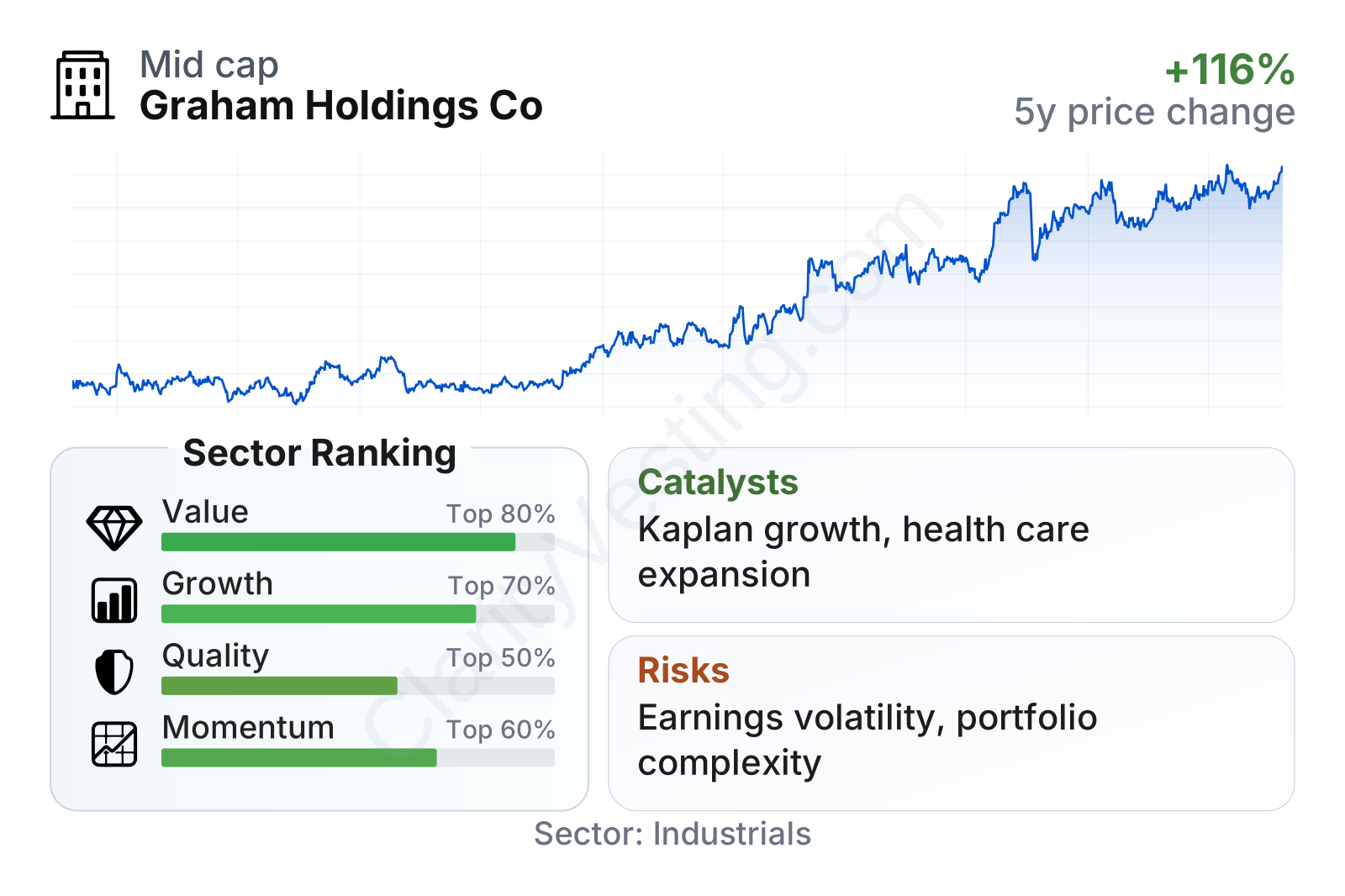
Graham Holdings sits in the mid-cap range and has shown relatively low share-price volatility, with a beta below 1. On valuation, several measures look inexpensive compared with the broader Industrials median, especially earnings and book value multiples. Profitability and balance-sheet quality are also respectable: operating margin and profit margin are above sector medians, while leverage remains notably lower than many peers. Growth is more mixed. Revenue expansion has been solid over five years and free cash flow has improved sharply, but earnings per share and margin trends have been less consistent.
The stock-price record has been strong over the last three years, even though shorter-term momentum has been more moderate. That combination often points to a business that has earned market confidence over time, while still being reassessed as recent profits move around.
Growth
Graham Holdings is exposed to several sectors that have durable demand, especially education and health care. Those two areas are important because they are tied less to short-lived consumer trends and more to ongoing needs: workforce training, credentialing, and medical care delivered outside hospitals. Broadcasting is more cyclical, but it can produce spikes in political advertising and retransmission revenue. Automotive and manufacturing add economic sensitivity, which can lift results in good environments but also slow them when demand weakens.
The company’s strategy appears to favor diversification plus selective acquisitions rather than one large defining theme. That approach can work well when management allocates capital carefully, especially in industries where smaller private businesses can be bought and improved. Graham Holdings has a long history of reshaping its portfolio, and that flexibility is one of the more important parts of the thesis.
Revenue growth has cooled from the very strong post-2021 pace, but it has remained positive. The recent pattern suggests the company is still expanding, though at a more measured rate than during the earlier rebound and acquisition-driven period. That is a healthier signal than a sharp contraction, but it also means future returns will likely depend more on execution and margins than on rapid top-line acceleration alone.
Cash generation has improved substantially over the past few years, even with some pullback from the peak. A business with rising free cash flow has more room to reinvest, repay debt, make acquisitions, or support shareholder returns. For a holding company like Graham Holdings, this matters because internal cash can be redirected toward the subsidiaries with the best opportunities.
Recent company updates have continued to emphasize portfolio development, including activity around health care and other operating businesses. For long-term growth, the clearest catalyst is not one single breakthrough product; it is the company’s ability to keep building larger, steadier segments such as Kaplan and health care while using cash flow to improve the portfolio over time.
Risks
This article is for informational purposes only and does not constitute financial advice. Some content is AI-generated. See Disclaimer


