Stock Analysis · Greggs plc (GGGSY)
Overview
Greggs plc is a U.K.-based food-on-the-go retailer best known for selling sandwiches, savory baked items, pizza, sweet treats, coffee, and other drinks through a large store network. The business started as a bakery, but today it is better understood as a convenience food chain aimed at value-conscious customers who want quick, affordable meals and snacks throughout the day.
The company’s revenue is overwhelmingly generated by company-managed shop sales in the United Kingdom. Greggs also benefits from delivery, evening trading, and newer channels such as travel hubs and retail partnerships, but these are generally embedded within the same core retail operation rather than reported as large standalone segments. Based on company reporting, the business mix can be summarized this way:
- Company-managed shop sales: approximately more than 95% of revenue. This includes in-store purchases of sandwiches, sausage rolls, bakes, pizza, breakfast items, drinks, and sweet products.
- Franchise and partner locations: approximately low single-digit percentage of revenue. These shops are often placed in travel and convenience-focused locations such as service stations and other partner-operated sites.
- Manufacturing and logistics-related internal support activities: these are crucial to operations but are not a separately meaningful external revenue stream in the same way as retail sales.
Greggs does not provide a highly detailed public revenue split by product category in the same way some global restaurant chains do. Still, its sales base is diversified across breakfast, lunch, snacking, hot food, beverages, and increasingly later-day occasions. This matters because it reduces reliance on a single product and supports repeat customer traffic throughout the day.
The operating profile has expanded strongly over the last several years. Revenue moved from about £1.2 billion in 2021 to more than £2.1 billion in 2025, while gross profit also increased materially. The more notable change is that profit conversion weakened in 2025 after several years of improvement, showing that growth is still healthy but margin pressure has become more visible.
The long-term pattern is favorable: sales and gross profit have risen steadily since 2021. However, 2025 also shows that higher revenue did not fully translate into higher earnings, with operating income and net income falling from 2024 levels as costs rose faster than sales.
Key Figures
| Metric | Value | Sector ⓘ |
|---|---|---|
| Date | Oct 31, 2026 | |
| Context | ||
| Sector | Consumer Cyclical | |
| Industry | Restaurants | |
| Market Cap ⓘ | $3.03B | |
| Beta ⓘ | 1.12 | |
Value (Cheapness) | ||
| P/E Ratio ⓘ | 17.09 | 17.02 |
| P/B Ratio ⓘ | 4.81 | 1.61 |
| FCF Yield ⓘ | 5.20% | 8.71% |
| Dividend Yield ⓘ | 3.11% | 2.66% |
| EBIT / EV ⓘ | N/A | 6.51% |
| PEG ⓘ | N/A | |
Growth (Business expansion) | ||
| Revenue Growth ⓘ | 7.20% | 5.50% |
| RPS Growth (5Y CAGR) ⓘ | 15.08% | 9.01% |
| EPS Growth (5Y CAGR) ⓘ | -21.34% | -16.46% |
| BVPS Growth (5Y CAGR) ⓘ | 9.88% | 5.64% |
| Margin Growth (5Y Trend) ⓘ | -3.86% | -0.17% |
| FCF Growth (5Y CAGR) ⓘ | -25.28% | 5.33% |
| DPS Growth (5Y CAGR) ⓘ | 45.69% | 10.21% |
Quality (Business durability) | ||
| ROIC (Latest) ⓘ | N/A | 12.02% |
| ROA (Latest) ⓘ | 19.71% | 5.51% |
| ROIC (5Y Median) ⓘ | 29.75% | 10.72% |
| ROA (5Y Median) ⓘ | 12.92% | 5.44% |
| Net Debt / EBIT (Latest) ⓘ | 1.07 | 2.17 |
| Net Debt / EBIT (5Y Median) ⓘ | 0.70 | 2.30 |
| Net Debt / EBITDA (Latest) ⓘ | 0.60 | 1.49 |
| Net Debt / Assets ⓘ | 29.56% | 21.53% |
| EBITDA / Interest ⓘ | N/A | 9.26 |
| Operating Margin (Latest) ⓘ | 9.57% | 9.01% |
| Operating Margin (5Y Median) ⓘ | 10.81% | 9.56% |
| Debt to Equity (Latest) ⓘ | 74.16% | 75.88% |
| Profit Margin (Latest) ⓘ | 5.93% | 5.30% |
| Free Cash Flow (Latest) ⓘ | $157.51M | |
Momentum (Price trend) | ||
| 3Y Return ⓘ | +18.54% | +22.25% |
| 12M Return (excl. last month) ⓘ | +17.99% | -4.14% |
| 6M Return ⓘ | +37.39% | -0.38% |
| Price vs. 200-Day MA ⓘ | +32.32% | -1.19% |
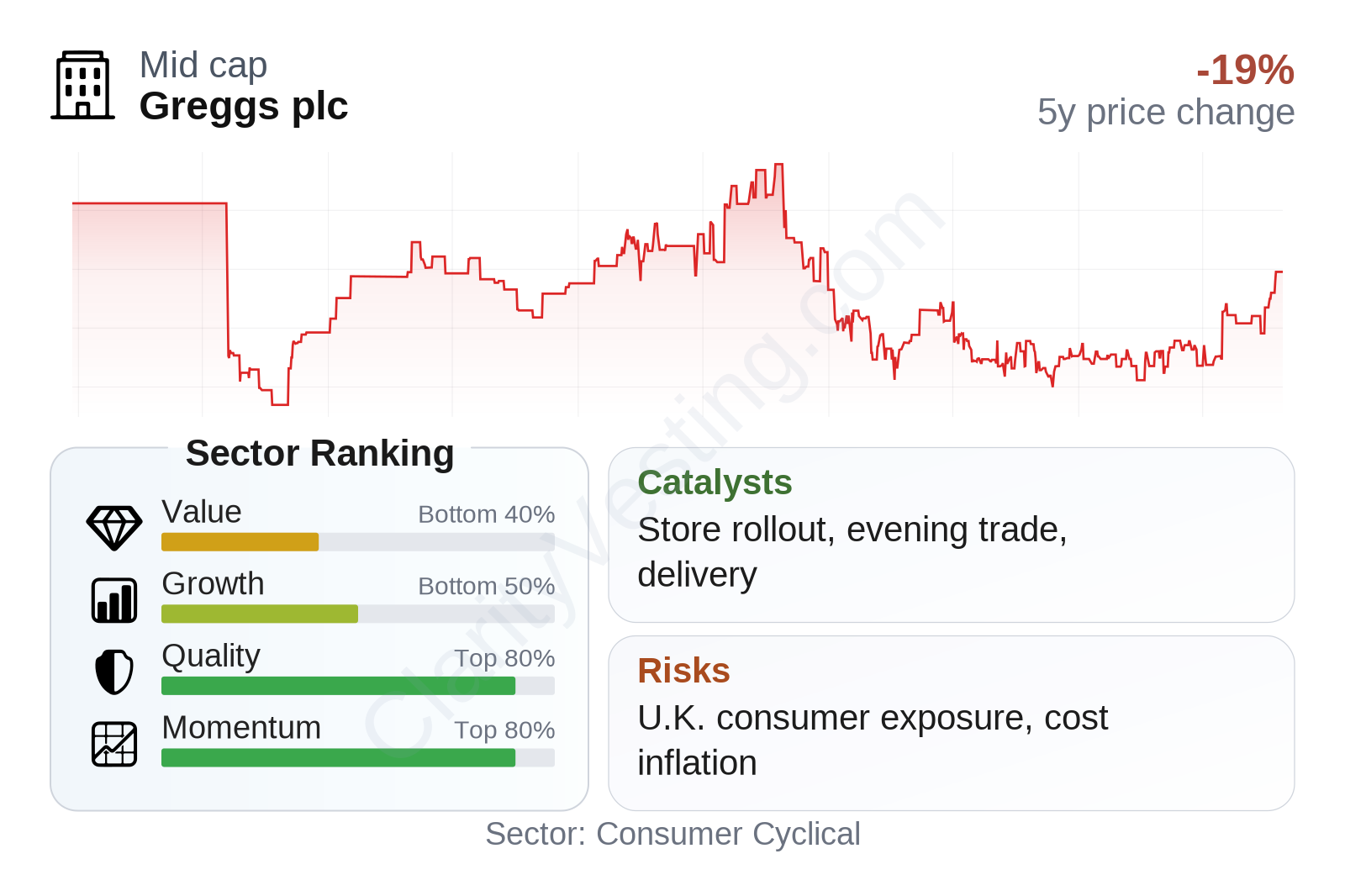
Greggs sits in the mid-sized range for listed restaurant and consumer names, with share-price volatility close to the broader market. The table points to a mixed profile. Profitability and balance-sheet quality look strong relative to the sector, helped by high returns on assets, solid operating margins, and modest net debt compared with earnings. Growth is less convincing than the headline sales trend might suggest, because earnings, margins, and free cash flow have been more uneven over a five-year view. On valuation, the earnings multiple is near the sector median, but the price-to-book ratio is much higher, suggesting the market still assigns a premium to the strength of the brand and store economics.
The share-price history shows a sharp reset from 2021 highs, followed by rebounds and renewed volatility. More recently, momentum has turned positive, with the stock outperforming the sector over six and twelve months even though the longer three-year return remains less impressive.
Growth
Greggs operates in a part of the food service market that still has room to expand: affordable, convenient food and drink bought for immediate consumption. This segment tends to benefit from busy lifestyles, commuter traffic, and consumers looking for lower-priced alternatives to full-service restaurants. In weaker economic periods, value positioning can also help traffic because customers trade down from more expensive meal options.
The company’s strategy is straightforward and commercially sensible. Greggs has been opening more shops, broadening dayparts beyond breakfast and lunch, increasing evening trade with pizza and hot food, and pushing into locations with structural demand such as transport hubs, roadside sites, hospitals, and retail parks. Delivery has also widened its reach without changing the core proposition. This is not a speculative growth plan; it is an extension of a model that is already proven at scale.
A key catalyst is continued store expansion. Greggs has repeatedly highlighted a significantly larger long-term U.K. estate opportunity than its current footprint, which means growth does not depend only on price increases or same-store sales. Another support is menu extension: hot food, chicken, and beverages can raise average ticket and improve use of the store base later in the day. Digital ordering and loyalty tools are also useful because they can increase frequency and improve customer data over time.
Recent company updates have also emphasized resilience in customer demand despite a tougher consumer backdrop. That matters because it suggests the brand still holds pricing power at the value end of the market, even while household budgets remain under pressure. If cost inflation moderates while sales keep rising, margin recovery becomes a realistic medium-term opportunity.
Risks
This article is for informational purposes only and does not constitute financial advice. Some content is AI-generated. See Disclaimer