Stock Analysis · Greggs plc (GGGSF)
Overview
Greggs plc is a U.K.-based food-on-the-go retailer best known for bakery items, sandwiches, hot drinks, pizza, and savory snacks sold through a large company-managed store network. Over time, the business has moved beyond its traditional bakery identity and now positions itself as a convenient, everyday food and beverage chain serving breakfast, lunch, snacks, and evening occasions. Its offer is built around value pricing, high store traffic, and a simple menu that can be produced at scale.
The main source of revenue is retail sales from Greggs shops, including company-operated locations on high streets, in transport hubs, at retail parks, roadside sites, and increasingly through digital channels and delivery partnerships. Public reporting does not provide a detailed product-by-product revenue split every year, but the structure of the business is clear.
- Company-managed shop sales: approximately more than 95% of group revenue. This includes food and drink sold directly in stores, such as sandwiches, breakfast items, hot drinks, pizza, bakes, sweet treats, and cold beverages.
- Franchise and wholesale-related income: approximately less than 5% of group revenue. This includes franchise activities and selected channels outside the core owned-store estate.
Within shop sales, Greggs has highlighted faster-growing categories in recent years such as hot food, chicken, pizza, iced drinks, and delivery. The business is also supported by its own manufacturing and distribution system, which helps control quality, availability, and costs across the estate.
From 2021 to 2025, revenue increased from roughly £1.2 billion to about £2.15 billion, while operating profit and net income also expanded overall, even though 2025 showed some margin pressure versus 2024. That pattern suggests a business still growing its sales base, but with profitability exposed to labor, energy, and food cost movements.
The financial flow shows a business that has scaled meaningfully over the last several years. Sales and gross profit both rose strongly through 2025, but operating profit did not keep pace in the most recent year, indicating that expansion and inflation-related costs absorbed a larger share of revenue.
Key Figures
| Metric | Value | Sector ⓘ |
|---|---|---|
| Date | Oct 03, 2026 | |
| Context | ||
| Sector | Consumer Cyclical | |
| Industry | Restaurants | |
| Market Cap ⓘ | $2.46B | |
| Beta ⓘ | 1.16 | |
Value (Cheapness) | ||
| P/E Ratio ⓘ | 14.18 | 17.04 |
| P/B Ratio ⓘ | 3.93 | 1.61 |
| FCF Yield ⓘ | 6.88% | 9.02% |
| Dividend Yield ⓘ | 2.86% | 2.75% |
| EBIT / EV ⓘ | N/A | 6.69% |
| PEG ⓘ | N/A | |
Growth (Business expansion) | ||
| Revenue Growth ⓘ | 7.20% | 5.60% |
| RPS Growth (5Y CAGR) ⓘ | 15.08% | 9.04% |
| EPS Growth (5Y CAGR) ⓘ | -21.34% | -17.44% |
| BVPS Growth (5Y CAGR) ⓘ | 9.93% | 5.73% |
| Margin Growth (5Y Trend) ⓘ | -3.63% | -0.26% |
| FCF Growth (5Y CAGR) ⓘ | -24.86% | 4.91% |
| DPS Growth (5Y CAGR) ⓘ | 46.50% | 10.48% |
Quality (Business durability) | ||
| ROIC (Latest) ⓘ | N/A | 12.38% |
| ROA (Latest) ⓘ | 19.79% | 5.54% |
| ROIC (5Y Median) ⓘ | 29.71% | 10.63% |
| ROA (5Y Median) ⓘ | 12.92% | 5.44% |
| Net Debt / EBIT (Latest) ⓘ | 1.08 | 2.16 |
| Net Debt / EBIT (5Y Median) ⓘ | 0.70 | 2.31 |
| Net Debt / EBITDA (Latest) ⓘ | 0.67 | 1.52 |
| Net Debt / Assets ⓘ | 29.56% | 21.74% |
| EBITDA / Interest ⓘ | 16.37 | 9.06 |
| Operating Margin (Latest) ⓘ | 9.38% | 9.12% |
| Operating Margin (5Y Median) ⓘ | 10.80% | 9.56% |
| Debt to Equity (Latest) ⓘ | 74.16% | 76.18% |
| Profit Margin (Latest) ⓘ | 5.93% | 5.30% |
| Free Cash Flow (Latest) ⓘ | $169.25M | |
Momentum (Price trend) | ||
| 3Y Return ⓘ | -12.85% | +11.77% |
| 12M Return (excl. last month) ⓘ | +17.03% | +0.61% |
| 6M Return ⓘ | +24.65% | +1.32% |
| Price vs. 200-Day MA ⓘ | +10.24% | -3.47% |
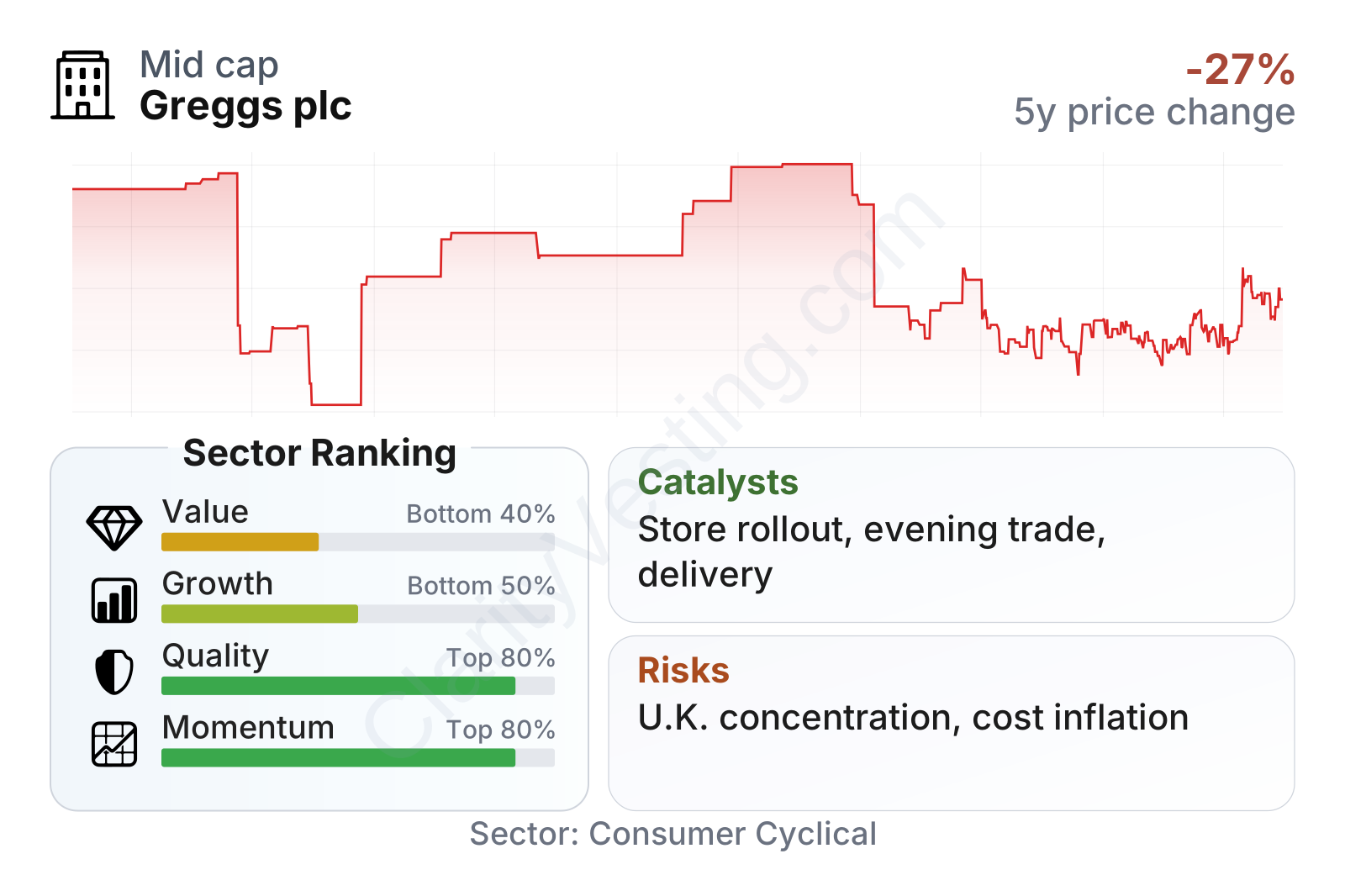
Greggs stands out more for business quality than for classic deep-value characteristics. Profitability metrics are strong relative to much of the restaurant sector, with returns on assets and longer-term returns on invested capital well above typical peers. Balance sheet leverage also looks controlled, with net debt low relative to earnings and interest coverage comfortably strong.
Growth is more mixed. Revenue has expanded at a healthy pace both recently and over five years, but earnings and free cash flow trends have been less smooth, reflecting margin pressure and investment needs. Market performance has improved over the last 6 to 12 months after a weak multi-year share-price stretch, suggesting sentiment has stabilized but not fully returned to earlier highs.
Growth
Greggs operates in a large and resilient part of the market: convenient, affordable prepared food. That segment tends to benefit from repeat purchases, broad customer reach, and demand across multiple dayparts. Even when consumer spending becomes strained, lower-ticket food options can remain relatively durable compared with more expensive dining formats. This does not make the sector immune to downturns, but it does give Greggs exposure to a category with steady everyday relevance.
The company’s strategy appears coherent for long-term expansion. A key pillar is new store growth, with Greggs continuing to add locations across the U.K. and targeting a larger national footprint over time. The mix of openings has shifted toward travel, retail park, suburban, and roadside locations, which broadens the customer base beyond traditional town-center foot traffic. Longer trading hours and a wider food range also help the chain capture breakfast, lunch, snacking, and evening demand.
Another growth driver is menu diversification. Greggs has spent several years building categories beyond classic bakery products, including pizza, chicken, hot food, and cold drinks. This matters because it can lift average transaction values and spread demand more evenly through the day. Delivery, click-and-collect, and loyalty-linked digital ordering add another layer by making the brand more accessible without relying only on walk-in traffic.
The operational model is another important support for growth. Greggs has invested in manufacturing capacity and distribution infrastructure, which is valuable for a chain with thousands of daily stock movements and a menu requiring fresh replenishment. For a value-led retailer, supply chain control can become a meaningful advantage if it supports speed, consistency, and cost management while the estate grows.
Recent developments also suggest a real opportunity if execution improves. The share-price reset since its earlier peak has already reflected weaker sentiment around consumer demand and costs, while the underlying business still shows positive sales growth and continued store expansion. If newer formats, evening trade, and digital channels mature as planned, Greggs could become less dependent on its legacy lunchtime bakery identity and more like an all-day convenience food chain.
Risks
This article is for informational purposes only and does not constitute financial advice. Some content is AI-generated. See Disclaimer