Stock Analysis · Graco Inc (GGG)
Overview
Graco Inc is an industrial equipment company that designs and manufactures systems used to move, measure, control, dispense, and spray fluids and coatings. In simple terms, it sells the machines and components that help manufacturers, contractors, and service providers apply paint, sealants, lubricants, chemicals, and other materials with precision. Its products are used in factories, vehicle service centers, construction sites, and many other industrial settings.
The business is organized into three main segments. Based on the latest annual mix, revenue is roughly distributed as follows:
- Contractor segment: about 41% — equipment for paint spraying, texture application, line striping, and related tools used mainly in professional construction and maintenance markets.
- Industrial segment: about 38% — systems for applying coatings, sealants, adhesives, and foam in manufacturing environments, including powder finishing and process applications.
- Process segment: about 21% — pumps, valves, meters, and accessories used to transfer and handle chemicals, water, petroleum, lubricants, and sanitary fluids in industrial processes.
Geographically, Graco is a global company with meaningful exposure outside the United States, which helps diversify demand across end markets and regions. The business model also benefits from a mix of equipment sales and recurring demand for parts, accessories, and system upgrades, which can support resilience over time.
Over the last five years, the company has kept a strong gross profit structure while operating income and net income remained robust even through demand fluctuations. That points to a business with good pricing discipline and efficient cost control rather than one relying heavily on debt or one-off gains.
Key Figures
| Metric | Value | Sector ⓘ |
|---|---|---|
| Date | Oct 24, 2026 | |
| Context | ||
| Sector | Industrials | |
| Industry | Specialty Industrial Machinery | |
| Market Cap ⓘ | $13.13B | |
| Beta ⓘ | 0.88 | |
Value (Cheapness) | ||
| P/E Ratio ⓘ | 25.50 | 22.29 |
| P/B Ratio ⓘ | 5.36 | 1.98 |
| FCF Yield ⓘ | 4.57% | 6.26% |
| Dividend Yield ⓘ | 1.44% | 1.92% |
| EBIT / EV ⓘ | 5.36% | 4.83% |
| PEG ⓘ | 2.32 | |
Growth (Business expansion) | ||
| Revenue Growth ⓘ | 3.30% | 9.30% |
| RPS Growth (5Y CAGR) ⓘ | 3.79% | 7.76% |
| EPS Growth (5Y CAGR) ⓘ | -12.95% | -13.17% |
| BVPS Growth (5Y CAGR) ⓘ | 12.49% | 6.13% |
| Margin Growth (5Y Trend) ⓘ | 2.70% | 0.74% |
| FCF Growth (5Y CAGR) ⓘ | 18.52% | 10.79% |
| DPS Growth (5Y CAGR) ⓘ | 10.44% | 9.41% |
Quality (Business durability) | ||
| ROIC (Latest) ⓘ | 19.93% | 10.75% |
| ROA (Latest) ⓘ | 15.83% | 5.41% |
| ROIC (5Y Median) ⓘ | 24.29% | 9.37% |
| ROA (5Y Median) ⓘ | 18.87% | 4.95% |
| Net Debt / EBIT (Latest) ⓘ | -0.71 | 2.04 |
| Net Debt / EBIT (5Y Median) ⓘ | -0.77 | 2.27 |
| Net Debt / EBITDA (Latest) ⓘ | 0.02 | 1.39 |
| Net Debt / Assets ⓘ | 0.48% | 19.27% |
| EBITDA / Interest ⓘ | 217.00 | 9.58 |
| Operating Margin (Latest) ⓘ | 28.63% | 10.49% |
| Operating Margin (5Y Median) ⓘ | 28.02% | 10.30% |
| Debt to Equity (Latest) ⓘ | 6.30% | 64.82% |
| Profit Margin (Latest) ⓘ | 23.53% | 6.67% |
| Free Cash Flow (Latest) ⓘ | $600.10M | |
Momentum (Price trend) | ||
| 3Y Return ⓘ | +21.35% | +67.77% |
| 12M Return (excl. last month) ⓘ | -8.23% | +12.05% |
| 6M Return ⓘ | -5.56% | 0.00% |
| Price vs. 200-Day MA ⓘ | +0.99% | +0.67% |
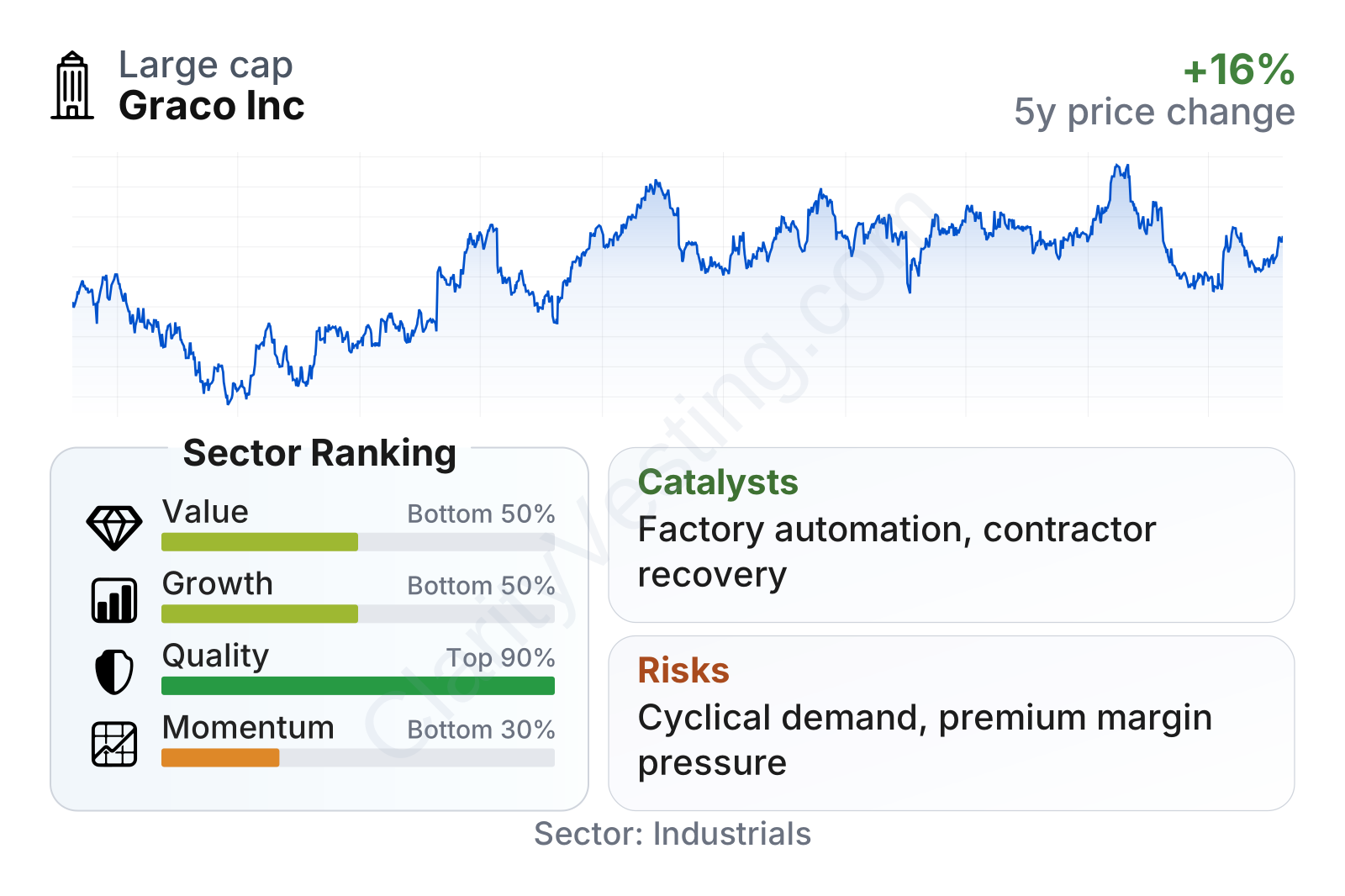
Graco stands out more on business quality than on classic value metrics. Profitability is well above much of the industrial machinery sector, with operating margin close to 29% and profit margin around 24%, far stronger than typical peers. Returns on capital and assets are also unusually high, while leverage is exceptionally low. On the other hand, the stock does not screen as cheap on earnings, book value, or cash flow yield, and recent share-price momentum has lagged the broader sector.
The company is also relatively large for a niche industrial manufacturer, with a market value in the large-cap range and a beta below 1, suggesting somewhat lower share-price volatility than the overall market. The dividend yield is modest, so the equity case rests more on business quality, cash generation, and long-term compounding than on current income.
Growth
Graco operates in a sector with durable long-term demand drivers rather than a fast-changing trend market. Demand is tied to construction activity, factory automation, vehicle maintenance, infrastructure work, and the need for precise fluid handling in manufacturing. These are not temporary themes. They are ongoing industrial needs, and they tend to reward suppliers with strong distribution, reliability, and specialized know-how.
The company’s strategy is coherent for future growth. It focuses on niche applications where performance matters, expands through product development, and adds capabilities through selective acquisitions. This approach makes sense because customers often care more about uptime, accuracy, and total operating cost than about the initial price of the equipment alone. That creates room for Graco to defend margins while broadening its installed base.
Recent growth has been uneven. After strong post-pandemic gains, revenue went through a softer patch in 2024 before returning to low-single-digit year-over-year growth in 2025 and the first half of 2026. That pattern suggests Graco is still exposed to industrial cycles, but it also shows the business has resumed expansion rather than entering a prolonged decline.
One of the most encouraging elements is cash generation. Free cash flow has risen sharply over the last several years and now sits at a high level for a company of this size. That gives Graco flexibility to fund product development, acquisitions, dividends, and share repurchases without depending on heavy borrowing. In practical terms, the company appears to be turning accounting profits into real cash at an attractive rate.
A meaningful catalyst is continued investment in automation and precision dispensing across manufacturing. As factories try to reduce waste, improve consistency, and automate repetitive processes, Graco’s equipment can become more valuable. Another catalyst is infrastructure and maintenance-related activity that supports contractor demand for spraying and marking systems. The company has also continued to launch products and integrate acquisitions, which can widen its addressable market over time.
Risks
This article is for informational purposes only and does not constitute financial advice. Some content is AI-generated. See Disclaimer


