Stock Analysis · Gold Fields Limited (GFIOF)
Overview
Gold Fields Limited is a global gold mining company. It explores for gold, develops mines, operates producing assets, and sells refined gold into international markets. The group also has some exposure to copper through projects and by-products, but gold is the core of the business by a very wide margin. Its mines and projects are spread across several regions, which helps reduce dependence on any single country, although mining remains a location-sensitive business.
For long-term readers, the easiest way to think about Gold Fields is as a producer of ounces from a portfolio of large mining assets. Revenue mainly depends on three things: the gold price, how many ounces the company produces, and the cost of extracting those ounces. When gold prices rise and operations run smoothly, earnings and cash flow can move up quickly.
The company’s revenue sources are primarily operational rather than diversified across many business lines. Based on recent annual reporting, the mix is approximately as follows:
- Gold sales: about 95% to 99% — revenue from mined and sold gold across the company’s producing operations.
- Copper and other by-products: about 1% to 5% — mainly by-product metals and other minor sales linked to mining operations.
- By geography, revenue is indirectly supported by operations in Australia, South Africa, Ghana, Peru, and the Americas development pipeline — the exact yearly contribution shifts depending on production, grades, and metal prices.
Recent financial flow trends point to a business that has expanded strongly. Revenue and operating income moved up meaningfully from 2021 through 2025, while interest expense stayed comparatively low. That combination suggests that higher metal prices and stronger operating performance have translated into much stronger profitability rather than being absorbed by financing costs.
Key Figures
| Metric | Value | Sector ⓘ |
|---|---|---|
| Date | Oct 04, 2026 | |
| Context | ||
| Sector | Basic Materials | |
| Industry | Gold | |
| Market Cap ⓘ | $37.65B | |
| Beta ⓘ | 0.65 | |
Value (Cheapness) | ||
| P/E Ratio ⓘ | 8.61 | 17.61 |
| P/B Ratio ⓘ | 4.37 | 1.78 |
| FCF Yield ⓘ | 16.49% | 5.86% |
| Dividend Yield ⓘ | 5.06% | 2.07% |
| EBIT / EV ⓘ | 27.16% | 6.43% |
| PEG ⓘ | 11.59 | |
Growth (Business expansion) | ||
| Revenue Growth ⓘ | 78.90% | 11.30% |
| RPS Growth (5Y CAGR) ⓘ | 22.17% | 4.46% |
| EPS Growth (5Y CAGR) ⓘ | N/A | -13.11% |
| BVPS Growth (5Y CAGR) ⓘ | 18.37% | 5.51% |
| Margin Growth (5Y Trend) ⓘ | 15.40% | -1.57% |
| FCF Growth (5Y CAGR) ⓘ | 63.78% | 0.55% |
| DPS Growth (5Y CAGR) ⓘ | 23.75% | 6.02% |
Quality (Business durability) | ||
| ROIC (Latest) ⓘ | 70.60% | 9.31% |
| ROA (Latest) ⓘ | 49.76% | 4.94% |
| ROIC (5Y Median) ⓘ | 29.95% | 7.91% |
| ROA (5Y Median) ⓘ | 10.65% | 3.93% |
| Net Debt / EBIT (Latest) ⓘ | 0.04 | 1.40 |
| Net Debt / EBIT (5Y Median) ⓘ | 0.70 | 1.70 |
| Net Debt / EBITDA (Latest) ⓘ | 0.04 | 0.91 |
| Net Debt / Assets ⓘ | 2.80% | 13.69% |
| EBITDA / Interest ⓘ | 61.28 | 11.93 |
| Operating Margin (Latest) ⓘ | 56.62% | 13.07% |
| Operating Margin (5Y Median) ⓘ | 33.01% | 11.86% |
| Debt to Equity (Latest) ⓘ | 29.35% | 40.43% |
| Profit Margin (Latest) ⓘ | 38.65% | 6.57% |
| Free Cash Flow (Latest) ⓘ | $6.21B | |
Momentum (Price trend) | ||
| 3Y Return ⓘ | +297.91% | +65.06% |
| 12M Return (excl. last month) ⓘ | +41.18% | +35.57% |
| 6M Return ⓘ | -8.91% | +1.69% |
| Price vs. 200-Day MA ⓘ | -0.65% | +0.95% |
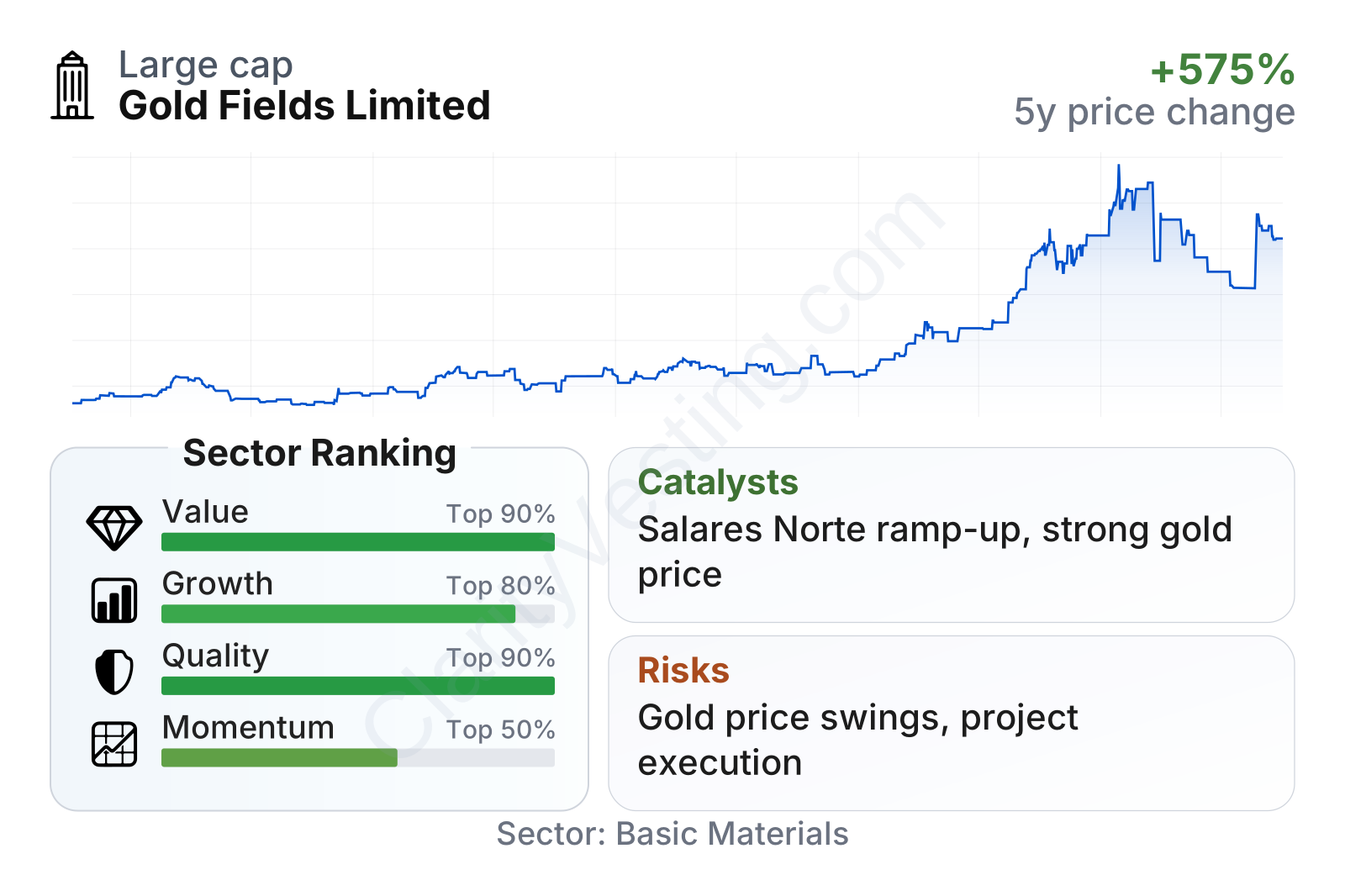
Gold Fields stands out as a large company in the gold mining space with a relatively low share-price volatility profile for the sector. On the factor breakdown, it ranks strongly on value, growth, and quality, while momentum is positive but not as exceptional as the other categories. The most notable points are the low earnings multiple versus the sector median, a free cash flow yield that is well above peers, and very strong returns on capital and assets. The main counterweight is that the price-to-book ratio is richer than the sector median, which usually reflects the market assigning a premium to asset quality, profitability, or both.
Growth
Gold mining is not a classic high-volume growth industry, but it is a sector with durable long-term relevance. Gold remains important for jewelry, central bank reserves, investment demand, and as a perceived store of value during periods of inflation, geopolitical tension, or financial uncertainty. That does not guarantee steady growth every year, but it does support long-duration demand.
Gold Fields’ strategy broadly makes sense for long-term expansion because it combines current production with future project development. A mining company cannot grow simply by selling more of the same asset forever; it needs reserve replacement, mine-life extensions, and new projects. That is why execution on development assets matters so much. The company has been working to strengthen its production base through both organic projects and portfolio shaping, aiming to maintain output while improving quality and asset life.
Operationally, the recent numbers show a sharp acceleration. Revenue growth has been far above the sector median, and the five-year trend in revenue per share, book value per share, free cash flow, and dividend per share all look materially stronger than the industry midpoint. This matters because it suggests growth has not come only from accounting gains; it has also shown up in cash generation and capital base expansion.
Cash flow is especially important in mining because new projects require heavy spending before they produce returns. Here, Gold Fields looks unusually strong. Trailing free cash flow is in the multibillion-dollar range, and the longer-term trend has improved substantially. Strong free cash flow gives the company more flexibility to fund development, absorb commodity cycles, and continue shareholder distributions without leaning heavily on debt.
A major catalyst is the company’s project pipeline, particularly large-scale assets that could support production growth or extend mine life over many years. Another catalyst is the gold price itself: because operating margins are already strong, additional increases in realized gold prices can have an outsized effect on profit and cash flow. Recent company communications have also emphasized portfolio quality and disciplined capital allocation, which are important for turning favorable gold markets into lasting financial gains rather than temporary spikes.
Risks
This article is for informational purposes only and does not constitute financial advice. Some content is AI-generated. See Disclaimer


