Stock Analysis · Geo Group Inc (GEO)
Overview
GEO Group is a private-sector operator of correctional, detention, and community reentry facilities. It works mainly for government agencies in the United States and also provides transportation, electronic monitoring, and other supervision services tied to the criminal justice and immigration systems. In simple terms, the company earns money by housing and supervising people under contracts with federal, state, and local authorities.
The business is organized around a few main revenue streams. Based on the company’s recent filings, the largest contributor is secure services in owned, leased, or managed facilities, followed by community-based services and then monitoring and transportation-related activities. A practical way to think about the mix is:
- Secure Services: approximately 70% to 75% of revenue. This includes correctional and detention facilities operated for agencies such as the U.S. federal government, states, and local jurisdictions.
- Community Services: approximately 15% to 20% of revenue. This covers residential reentry centers, day reporting, treatment, and other post-release or alternative-to-incarceration programs.
- Electronic Monitoring and Supervision, Transportation, and Other Services: approximately 10% to 15% of revenue. This includes ankle-monitoring technology, case management, transportation, and related support services.
A key feature of GEO’s model is that most revenue comes from multi-year government contracts, which can make demand relatively steady once capacity is filled. At the same time, this also means the company is highly exposed to public policy decisions, budget priorities, and contract renewals.
The broad financial flow shows a business with revenue that has been fairly stable to growing over the last several years, but with earnings that can move around more sharply because interest costs, occupancy changes, and one-time items matter a lot.
Over the past few years, revenue has gradually improved, operating income has been volatile, and interest expense has remained a meaningful drag on profits. The biggest improvement has come from better operating performance and debt reduction, which helped net income recover after a weak 2024.
Key Figures
| Metric | Value | Sector ⓘ |
|---|---|---|
| Date | Oct 24, 2026 | |
| Context | ||
| Sector | Industrials | |
| Industry | Security & Protection Services | |
| Market Cap ⓘ | $3.64B | |
| Beta ⓘ | 0.77 | |
Value (Cheapness) | ||
| P/E Ratio ⓘ | 13.16 | 22.29 |
| P/B Ratio ⓘ | 2.40 | 1.98 |
| FCF Yield ⓘ | 4.43% | 6.26% |
| Dividend Yield ⓘ | N/A | 1.92% |
| EBIT / EV ⓘ | 9.19% | 4.83% |
| PEG ⓘ | 1.35 | |
Growth (Business expansion) | ||
| Revenue Growth ⓘ | 15.10% | 9.30% |
| RPS Growth (5Y CAGR) ⓘ | 0.19% | 7.76% |
| EPS Growth (5Y CAGR) ⓘ | -17.22% | -13.17% |
| BVPS Growth (5Y CAGR) ⓘ | 7.44% | 6.13% |
| Margin Growth (5Y Trend) ⓘ | 4.74% | 0.74% |
| FCF Growth (5Y CAGR) ⓘ | N/A | 10.79% |
| DPS Growth (5Y CAGR) ⓘ | -61.91% | 9.41% |
Quality (Business durability) | ||
| ROIC (Latest) ⓘ | 12.01% | 10.75% |
| ROA (Latest) ⓘ | 7.72% | 5.41% |
| ROIC (5Y Median) ⓘ | 10.61% | 9.37% |
| ROA (5Y Median) ⓘ | 2.88% | 4.95% |
| Net Debt / EBIT (Latest) ⓘ | 3.02 | 2.04 |
| Net Debt / EBIT (5Y Median) ⓘ | 5.03 | 2.27 |
| Net Debt / EBITDA (Latest) ⓘ | 2.39 | 1.39 |
| Net Debt / Assets ⓘ | 41.42% | 19.27% |
| EBITDA / Interest ⓘ | 4.23 | 9.58 |
| Operating Margin (Latest) ⓘ | 18.14% | 10.49% |
| Operating Margin (5Y Median) ⓘ | 14.77% | 10.30% |
| Debt to Equity (Latest) ⓘ | 105.98% | 64.82% |
| Profit Margin (Latest) ⓘ | 10.31% | 6.67% |
| Free Cash Flow (Latest) ⓘ | $161.19M | |
Momentum (Price trend) | ||
| 3Y Return ⓘ | +225.94% | +67.77% |
| 12M Return (excl. last month) ⓘ | +38.70% | +12.05% |
| 6M Return ⓘ | +45.24% | 0.00% |
| Price vs. 200-Day MA ⓘ | +15.75% | +0.67% |
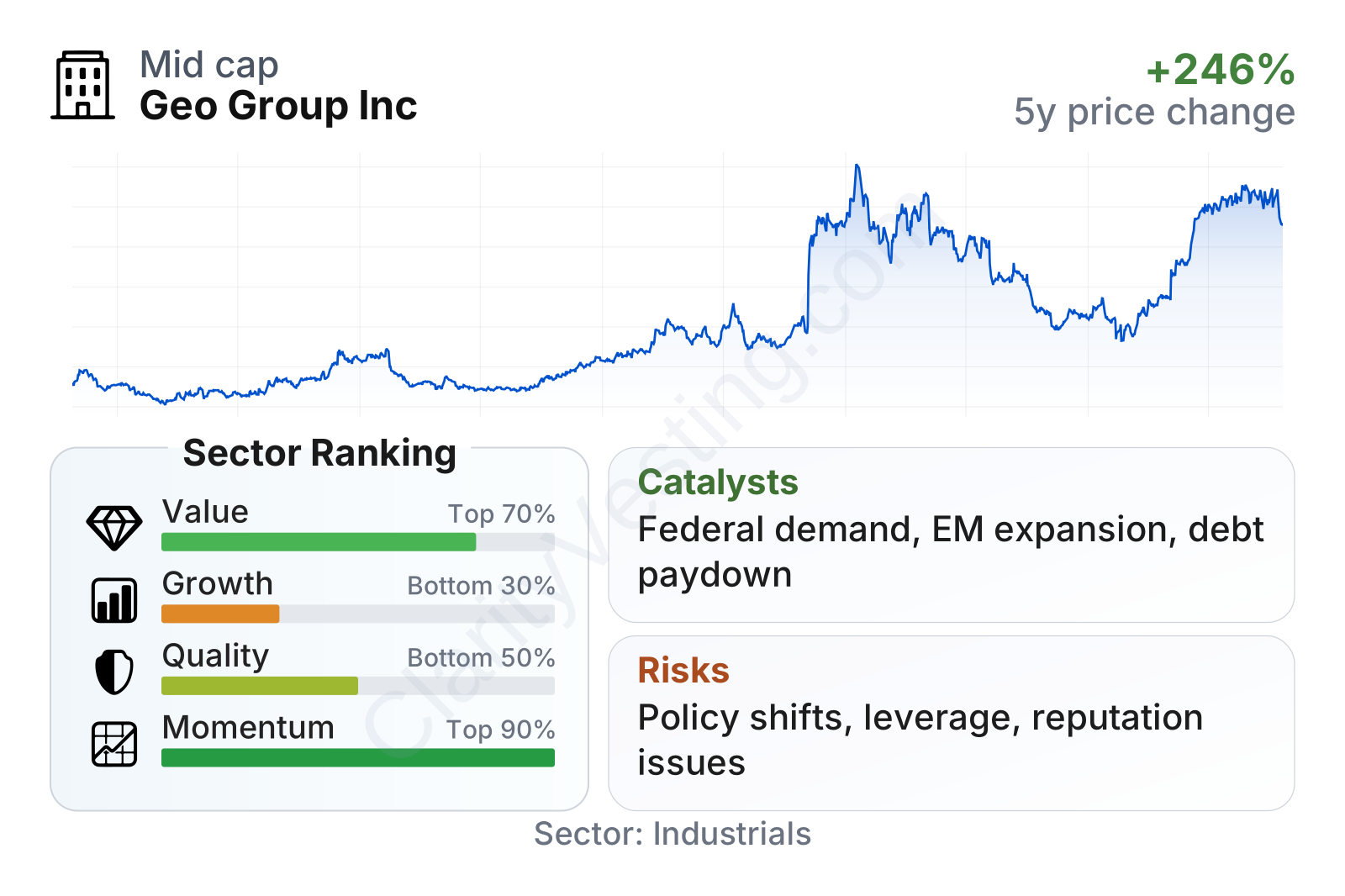
GEO is a mid-sized company with a market value around the low single-digit billions of dollars. The table suggests a mixed profile: valuation is not stretched versus the sector on earnings, profitability is stronger than many peers on operating margin and return measures, but balance-sheet leverage remains heavier than average. Growth looks uneven over longer periods even though recent revenue growth has accelerated, and share-price momentum has been exceptionally strong.
Growth
GEO operates in a sector where demand is driven less by consumer cycles and more by public policy, detention volumes, prison overcrowding, immigration enforcement, and the need for alternatives to incarceration. That makes this a specialized market rather than a classic high-growth industry. Still, some parts of the business, especially electronic monitoring and community supervision, fit with long-term government interest in lower-cost alternatives to traditional incarceration.
The company’s strategy has recently centered on three things: renewing and expanding contracts in secure services, growing monitoring and supervision offerings, and using cash flow to reduce debt. That approach is logical for this kind of business because lower leverage can directly improve earnings by reducing interest expense, while technology-enabled supervision can broaden GEO’s role beyond physical facilities.
Recent revenue growth has clearly improved. The latest year-over-year trend is running in the mid-teens, ahead of the broader sector median. That matters because GEO’s longer-term growth record has been modest, so a sustained pickup would mark a meaningful change rather than just a routine quarter-to-quarter fluctuation.
Cash generation has been less smooth. GEO has produced meaningful free cash flow in several periods, which is important because debt repayment has been a major corporate priority. However, the latest trailing figure turned negative, showing that the path is not linear. For a company with significant leverage, consistency in cash flow is one of the most important items to watch.
One of the clearest catalysts is the possibility of higher utilization in detention and correctional facilities, particularly if federal demand remains elevated. Another is continued growth in electronic monitoring and community-based services, which can be more scalable and politically easier to expand than building new secure facilities. Recent company communications have also emphasized contract activity and stronger operating trends, which support the view that GEO is in a more favorable phase than it was a few years ago.
Risks
This article is for informational purposes only and does not constitute financial advice. Some content is AI-generated. See Disclaimer


