Stock Analysis · Genus plc (GENSF)
Overview
Genus plc is an animal genetics company focused on improving how farm animals are bred. Its products and services are used mainly in pigs and cattle. The business helps farmers produce animals with better health, fertility, feed efficiency, and meat or milk performance. In simple terms, Genus sells breeding genetics rather than food itself. That places it upstream in the agricultural supply chain.
The company operates through two main brands: PIC in porcine genetics and ABS in bovine genetics. PIC supplies elite pig breeding animals, genetic lines, and technical support to pork producers. ABS provides cattle semen, reproductive services, and genetics tools for dairy and beef herds. Genus also invests in advanced breeding technologies, including gene-editing work designed to make pigs resistant to PRRS, a major viral disease in swine production.
Based on recent annual reporting, revenue is mainly split between porcine and bovine genetics, with porcine representing the larger business.
- PIC porcine genetics: approximately 55% to 60% of revenue. This includes pig breeding stock, royalties, and technical support tied to commercial pork production.
- ABS bovine genetics: approximately 40% to 45% of revenue. This includes dairy and beef semen sales, reproductive products, and breeding-related services.
- Other and central activities: a very small share of revenue, mainly support and non-core items.
That mix matters because pig genetics has historically offered stronger margins and a larger long-term opportunity if Genus can expand in major pork markets such as North America, Latin America, and Asia. Cattle genetics adds diversification and recurring demand from dairy and beef producers.
The broad financial picture shows a business with annual revenue in the mid-hundreds of millions of dollars, moderate operating margins, and meaningful spending on innovation and commercial infrastructure. Over the last few years, revenue has moved within a fairly narrow band, while profitability has been more volatile than sales. The latest period also shows an unusually strong net profit outcome compared with operating profit, suggesting that below-the-line items played an important role and should be interpreted carefully.
Over time, sales have been relatively steady, but margins have not moved in a straight line. The business has absorbed periods of higher costs, while still maintaining a meaningful level of operating profit and continued investment in research, especially around animal health-related genetics.
Key Figures
| Metric | Value | Sector ⓘ |
|---|---|---|
| Date | Oct 03, 2026 | |
| Context | ||
| Sector | Healthcare | |
| Industry | Biotechnology | |
| Market Cap ⓘ | $1.92B | |
| Beta ⓘ | 0.90 | |
Value (Cheapness) | ||
| P/E Ratio ⓘ | 5.14 | 24.06 |
| P/B Ratio ⓘ | 2.55 | 3.08 |
| FCF Yield ⓘ | 6.62% | 3.07% |
| Dividend Yield ⓘ | 1.22% | 2.05% |
| EBIT / EV ⓘ | 6.92% | 0.63% |
| PEG ⓘ | N/A | |
Growth (Business expansion) | ||
| Revenue Growth ⓘ | -4.10% | 7.50% |
| RPS Growth (5Y CAGR) ⓘ | 1.67% | 8.70% |
| EPS Growth (5Y CAGR) ⓘ | -4.97% | -18.20% |
| BVPS Growth (5Y CAGR) ⓘ | 6.51% | 3.95% |
| Margin Growth (5Y Trend) ⓘ | 6.41% | -0.58% |
| FCF Growth (5Y CAGR) ⓘ | N/A | 0.88% |
| DPS Growth (5Y CAGR) ⓘ | 0.01% | 6.80% |
Quality (Business durability) | ||
| ROIC (Latest) ⓘ | N/A | 3.29% |
| ROA (Latest) ⓘ | 30.05% | 3.02% |
| ROIC (5Y Median) ⓘ | 4.09% | 4.75% |
| ROA (5Y Median) ⓘ | 3.29% | 1.93% |
| Net Debt / EBIT (Latest) ⓘ | 0.47 | 1.33 |
| Net Debt / EBIT (5Y Median) ⓘ | 4.46 | 1.83 |
| Net Debt / EBITDA (Latest) ⓘ | 0.29 | 0.99 |
| Net Debt / Assets ⓘ | 6.27% | 5.33% |
| EBITDA / Interest ⓘ | 5.97 | 9.63 |
| Operating Margin (Latest) ⓘ | 10.22% | 9.25% |
| Operating Margin (5Y Median) ⓘ | 6.86% | 7.80% |
| Debt to Equity (Latest) ⓘ | 14.02% | 28.99% |
| Profit Margin (Latest) ⓘ | 43.35% | 3.60% |
| Free Cash Flow (Latest) ⓘ | $126.92M | |
Momentum (Price trend) | ||
| 3Y Return ⓘ | -13.10% | +37.48% |
| 12M Return (excl. last month) ⓘ | -10.52% | +20.85% |
| 6M Return ⓘ | -19.52% | +9.73% |
| Price vs. 200-Day MA ⓘ | -12.53% | +4.69% |
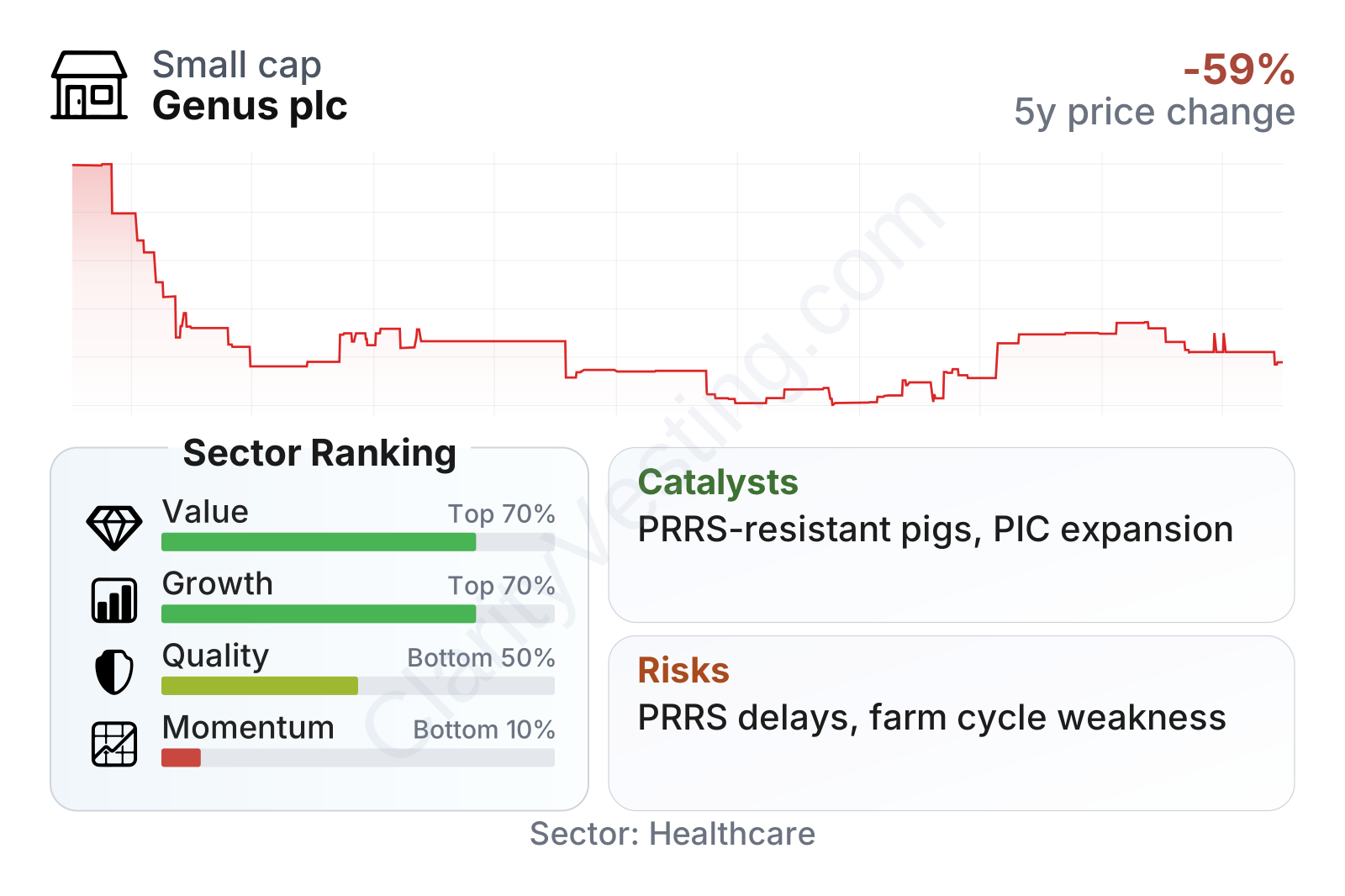
Genus looks stronger on quality and cash generation than on recent growth or market momentum. Profitability and balance-sheet leverage appear better than many peers in the sector, and free cash flow generation is solid relative to its market value. On the other hand, recent revenue growth has been negative, long-term sales growth has been modest, and the stock has underperformed the broader healthcare peer group over multiple time frames. This creates a mixed picture: the business fundamentals look sturdier than recent share-price performance suggests, but the market is still waiting for clearer evidence of a stronger growth phase.
The stock history reflects that tension. Shares fell sharply from 2021 into 2024, recovered during 2025, and then weakened again in 2026. That pattern often points to changing expectations around earnings quality, industry conditions, and the timing of major business catalysts rather than a simple one-way deterioration in the underlying company.
Growth
Genus operates in a part of agriculture that benefits from long-term structural demand. Global protein consumption tends to rise with population growth, urbanization, and improving incomes, especially in emerging markets. Farmers also face pressure to produce more meat and milk with fewer resources, lower disease losses, and tighter environmental constraints. That is exactly where animal genetics can matter: better breeding can improve output per animal and reduce inefficiency across the production cycle.
The company’s strategy is logical for that backdrop. Instead of competing as a commodity producer, Genus focuses on intellectual property, breeding lines, reproductive technologies, and long-term customer relationships. In theory, that can create a more durable business than one based only on fluctuating farm prices. PIC is particularly important because leading pig genetics can compound over time as commercial herds adopt higher-performing lines and remain within an established breeding system.
The clearest growth catalyst is the PRRS-resistant pig program. PRRS is one of the most economically damaging diseases in global pork production. If regulators continue to clear commercialization and customers adopt the trait at scale, Genus could unlock a new layer of value that goes beyond traditional breeding improvement. This would not just be a better version of an existing product; it could address a major industry pain point with potentially global relevance.
Another growth support is geographic expansion. Genus has highlighted opportunities in large pork-producing and dairy-producing markets where genetics penetration can still increase. New product introductions in sexed semen, reproductive services, and data-driven breeding tools may also help ABS improve its position, although that segment operates in a more competitive environment than PIC.
Recent company updates have also pointed to continued progress around the PRRS-resistant pig pathway and commercial preparation. For long-term analysis, that matters more than short-term quarterly fluctuations because a successful launch could influence future margins, market share, and the company’s strategic importance in animal health and farm productivity.
Risks
This article is for informational purposes only and does not constitute financial advice. Some content is AI-generated. See Disclaimer