Stock Analysis · GE HealthCare Technologies Inc (GEHC)
Overview
GE HealthCare Technologies Inc. is a large medical technology company focused on imaging systems, ultrasound, patient monitoring, diagnostic pharmaceuticals, and healthcare software. Hospitals, imaging centers, clinics, and life sciences customers use its products to detect disease, guide treatment, monitor patients, and improve workflow. The company was separated from General Electric and now operates as a standalone healthcare business, with a global footprint and a broad installed base of equipment that also supports recurring service revenue.
Its revenue comes from four main operating segments. Based on the latest annual mix, the business is relatively diversified rather than dependent on one single product line.
- Imaging: about 41% of revenue. This includes MRI, CT, X-ray, molecular imaging, and related services.
- Ultrasound: about 18% of revenue. This covers general imaging, women’s health, cardiovascular, and point-of-care ultrasound systems.
- Patient Care Solutions: about 17% of revenue. This segment includes patient monitoring, anesthesia delivery, maternal-infant care, and consumables and services tied to those systems.
- Pharmaceutical Diagnostics: about 14% of revenue. This business sells contrast media and radiopharmaceutical products used to enhance medical imaging exams.
- Other activities, including advanced visualization and digital solutions: the remaining share, roughly 10%, depending on reporting classifications and intersegment items.
What stands out in this mix is that GE HealthCare is not just an equipment manufacturer. A meaningful part of its business comes from services, software, consumables, and diagnostic agents, which can make revenue more resilient than a one-time machine sale model alone. Over the last several years, revenue has trended upward overall, while operating income has improved faster than sales, pointing to better operating discipline even if net income has moved around more because of taxes, interest, and accounting items.
The business flow shows a company with solid gross profit generation and improving operating income over time. Research and development spending has remained substantial, which is important in an industry where product upgrades, imaging quality, AI tools, and clinical workflow improvements can influence long-term competitiveness.
Key Figures
| Metric | Value | Sector ⓘ |
|---|---|---|
| Date | Oct 03, 2026 | |
| Context | ||
| Sector | Healthcare | |
| Industry | Medical Devices | |
| Market Cap ⓘ | $29.53B | |
| Beta ⓘ | 0.82 | |
Value (Cheapness) | ||
| P/E Ratio ⓘ | 15.06 | 24.06 |
| P/B Ratio ⓘ | 2.71 | 3.08 |
| FCF Yield ⓘ | 3.03% | 3.07% |
| Dividend Yield ⓘ | 0.21% | 2.05% |
| EBIT / EV ⓘ | 6.44% | 0.63% |
| PEG ⓘ | 1.65 | |
Growth (Business expansion) | ||
| Revenue Growth ⓘ | 5.80% | 7.50% |
| RPS Growth (5Y CAGR) ⓘ | 3.75% | 8.70% |
| EPS Growth (5Y CAGR) ⓘ | -16.78% | -18.20% |
| BVPS Growth (5Y CAGR) ⓘ | -11.89% | 3.95% |
| Margin Growth (5Y Trend) ⓘ | -1.03% | -0.58% |
| FCF Growth (5Y CAGR) ⓘ | 2.60% | 0.88% |
| DPS Growth (5Y CAGR) ⓘ | N/A | 6.80% |
Quality (Business durability) | ||
| ROIC (Latest) ⓘ | 9.32% | 3.29% |
| ROA (Latest) ⓘ | 4.34% | 3.02% |
| ROIC (5Y Median) ⓘ | 13.82% | 4.75% |
| ROA (5Y Median) ⓘ | 7.12% | 1.93% |
| Net Debt / EBIT (Latest) ⓘ | 3.24 | 1.33 |
| Net Debt / EBIT (5Y Median) ⓘ | 2.10 | 1.83 |
| Net Debt / EBITDA (Latest) ⓘ | 2.30 | 0.99 |
| Net Debt / Assets ⓘ | 21.45% | 5.33% |
| EBITDA / Interest ⓘ | 7.97 | 9.63 |
| Operating Margin (Latest) ⓘ | 12.18% | 9.25% |
| Operating Margin (5Y Median) ⓘ | 15.55% | 7.80% |
| Debt to Equity (Latest) ⓘ | 91.96% | 28.99% |
| Profit Margin (Latest) ⓘ | 9.33% | 3.60% |
| Free Cash Flow (Latest) ⓘ | $895.00M | |
Momentum (Price trend) | ||
| 3Y Return ⓘ | -5.20% | +37.48% |
| 12M Return (excl. last month) ⓘ | -4.31% | +20.85% |
| 6M Return ⓘ | -11.02% | +9.73% |
| Price vs. 200-Day MA ⓘ | -10.30% | +4.69% |
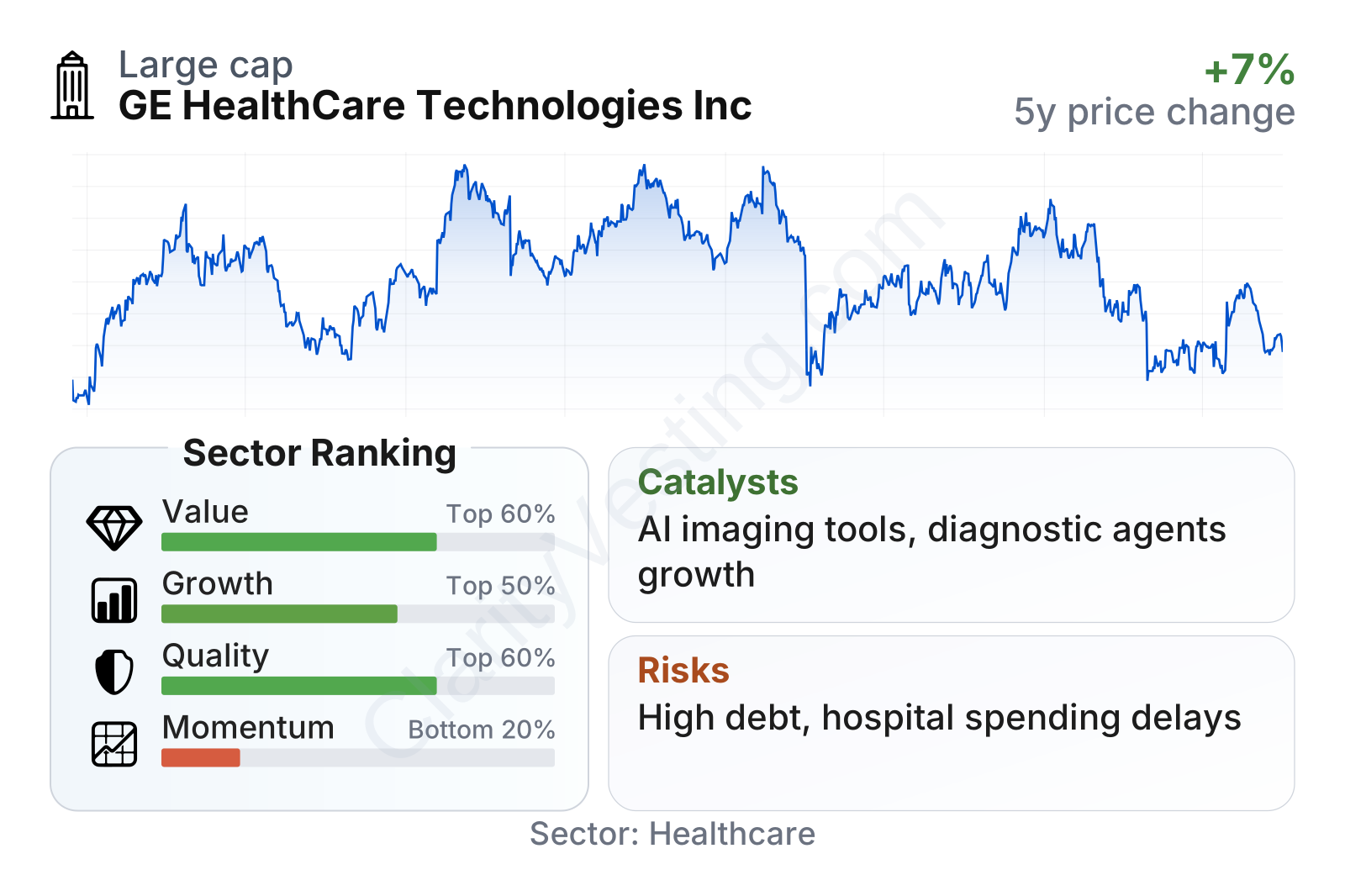
GE HealthCare is a large-cap healthcare equipment company with lower share-price volatility than the broader market, as reflected by a beta below 1. On valuation, it sits below the sector median on earnings and slightly below on book value, while its cash flow yield is close to the sector norm. Quality metrics are stronger than many peers, especially returns on capital and profitability, but the balance sheet remains more leveraged than the typical healthcare company. Growth is mixed: recent revenue growth is positive, free cash flow has held up reasonably well, yet longer-term per-share growth has been less impressive than the sector median. Momentum is currently weak, with the stock trailing much of the healthcare sector over recent periods.
Growth
GE HealthCare operates in a part of healthcare that benefits from durable long-term demand. Aging populations, higher rates of chronic disease, growing use of imaging in diagnosis, and the push to improve hospital productivity all support continued need for imaging systems, monitoring equipment, and related software. That does not mean growth is always fast, but it does mean the sector has structural support.
The company’s strategy is broadly aligned with those trends. It is investing in advanced imaging, AI-enabled workflow tools, cloud and digital platforms, and precision care applications. That matters because hospitals are not only looking for better machines; they also want faster throughput, lower downtime, more automation, and tools that help staff handle rising workloads. GE HealthCare’s large installed base gives it an advantage here, since software upgrades, service contracts, and connected solutions can be sold into existing customer relationships.
Revenue growth has not been perfectly smooth, but the more recent pattern points to renewed expansion after a softer period. Mid-single-digit year-over-year growth is not exceptional for healthcare technology, yet it is healthy enough to support margin improvement if execution stays disciplined.
Cash generation remains an important part of the growth case. Free cash flow has come down from earlier levels but remains solid in absolute terms, which gives the company room to fund research, bolt-on acquisitions, debt reduction, and shareholder returns without relying heavily on external financing.
One of the clearest growth catalysts is the combination of imaging hardware and AI software. GE HealthCare has been building partnerships and product capabilities around image analysis, workflow automation, and clinician productivity. Another catalyst is pharmaceutical diagnostics, where imaging agents can benefit from procedure growth and from rising use of more advanced scans in oncology, cardiology, and neurology. In addition, hospitals continue to refresh aging equipment fleets over time, and that replacement cycle can support demand even in slower economic environments.
Recent company updates have also emphasized innovation launches, care pathway software, and selective acquisitions to strengthen imaging and diagnostic capabilities. None of these alone transforms the business overnight, but together they support a practical, believable path to steady expansion rather than a speculative one.
Risks
This article is for informational purposes only and does not constitute financial advice. Some content is AI-generated. See Disclaimer


