Stock Analysis · Gecina SA (GECFF)
Overview
Gecina SA is a French real estate company focused mainly on owning, managing, and improving high-quality properties in and around Paris. It is widely known for office buildings in central business districts, but it also has a meaningful residential portfolio and a smaller exposure to student housing and services. Its business model is relatively simple: acquire or develop properties in attractive urban locations, lease them to tenants, collect rent, and enhance value through redevelopment, refurbishment, and active asset management.
The company’s revenue is primarily rental income, with additional contributions from service income and occasional property-related activities. Based on the company’s recent portfolio mix and reporting structure, the revenue base can be approximated as follows:
- Office properties: about 75% to 80% of gross rental income. This includes Paris central business district offices and other well-located commercial assets.
- Residential properties: about 15% to 20%. This mainly covers traditional housing in dense urban areas, largely in Paris.
- Student residences and other activities: about 3% to 7%. This includes student housing and certain service-related or ancillary real estate income.
Geographically, the business is highly concentrated in the Paris region, which is both a strength and a constraint. It gives Gecina exposure to one of Europe’s deepest office and housing markets, but also ties performance closely to local economic, political, and regulatory conditions.
Over the past several years, revenue has been fairly resilient and has gradually increased, even though reported earnings have been much more volatile because property companies are strongly affected by changes in asset valuations. In practical terms, rent collection and operating profitability have remained more stable than net income might suggest.
The business also stands out for its strong operating margin profile. Property ownership, once a portfolio is stabilized, can produce high recurring margins, and Gecina’s recent operating structure reflects that. That said, financing costs remain important because real estate companies rely heavily on debt.
The broad trend is that rental revenue has edged higher from 2021 to 2025, while operating profitability recovered after the large 2023 valuation-driven downturn. Interest expense has stayed meaningful but relatively contained, which is important in a higher-rate environment for property owners.
Key Figures
| Metric | Value | Sector ⓘ |
|---|---|---|
| Date | Oct 17, 2026 | |
| Context | ||
| Sector | Real Estate | |
| Industry | REIT - Office | |
| Market Cap ⓘ | $5.10B | |
| Beta ⓘ | 1.05 | |
Value (Cheapness) | ||
| P/E Ratio ⓘ | 28.63 | 17.38 |
| P/B Ratio ⓘ | 0.50 | 0.85 |
| FCF Yield ⓘ | N/A | 7.38% |
| Dividend Yield ⓘ | 7.55% | 4.85% |
| EBIT / EV ⓘ | 3.86% | 3.78% |
| PEG ⓘ | N/A | |
Growth (Business expansion) | ||
| Revenue Growth ⓘ | 4.10% | 5.30% |
| RPS Growth (5Y CAGR) ⓘ | 3.13% | 6.02% |
| EPS Growth (5Y CAGR) ⓘ | -48.15% | -11.37% |
| BVPS Growth (5Y CAGR) ⓘ | -5.14% | 0.45% |
| Margin Growth (5Y Trend) ⓘ | 1.17% | -0.22% |
| FCF Growth (5Y CAGR) ⓘ | N/A | 5.40% |
| DPS Growth (5Y CAGR) ⓘ | 0.70% | 5.02% |
Quality (Business durability) | ||
| ROIC (Latest) ⓘ | N/A | 5.69% |
| ROE (Latest) ⓘ | N/A | 7.56% |
| ROA (Latest) ⓘ | N/A | 2.85% |
| ROIC (5Y Median) ⓘ | 1.84% | 4.22% |
| ROE (5Y Median) ⓘ | 2.94% | 6.03% |
| ROA (5Y Median) ⓘ | 1.74% | 2.44% |
| Net Debt / EBIT (Latest) ⓘ | N/A | 7.59 |
| Net Debt / EBIT (5Y Median) ⓘ | N/A | 8.40 |
| Net Debt / EBITDA (Latest) ⓘ | N/A | 5.27 |
| Net Debt / Assets ⓘ | 37.17% | 37.76% |
| EBITDA / Interest ⓘ | N/A | 4.10 |
| Operating Margin (Latest) ⓘ | N/A | 35.29% |
| Operating Margin (5Y Median) ⓘ | 62.25% | 37.31% |
| Debt to Equity (Latest) ⓘ | N/A | 88.87% |
| Profit Margin (Latest) ⓘ | 18.36% | 19.61% |
| Free Cash Flow (Latest) ⓘ | N/A | |
Momentum (Price trend) | ||
| 3Y Return ⓘ | -17.79% | +30.75% |
| 12M Return (excl. last month) ⓘ | -17.68% | +4.36% |
| 6M Return ⓘ | -8.96% | -2.52% |
| Price vs. 200-Day MA ⓘ | -17.67% | -2.34% |
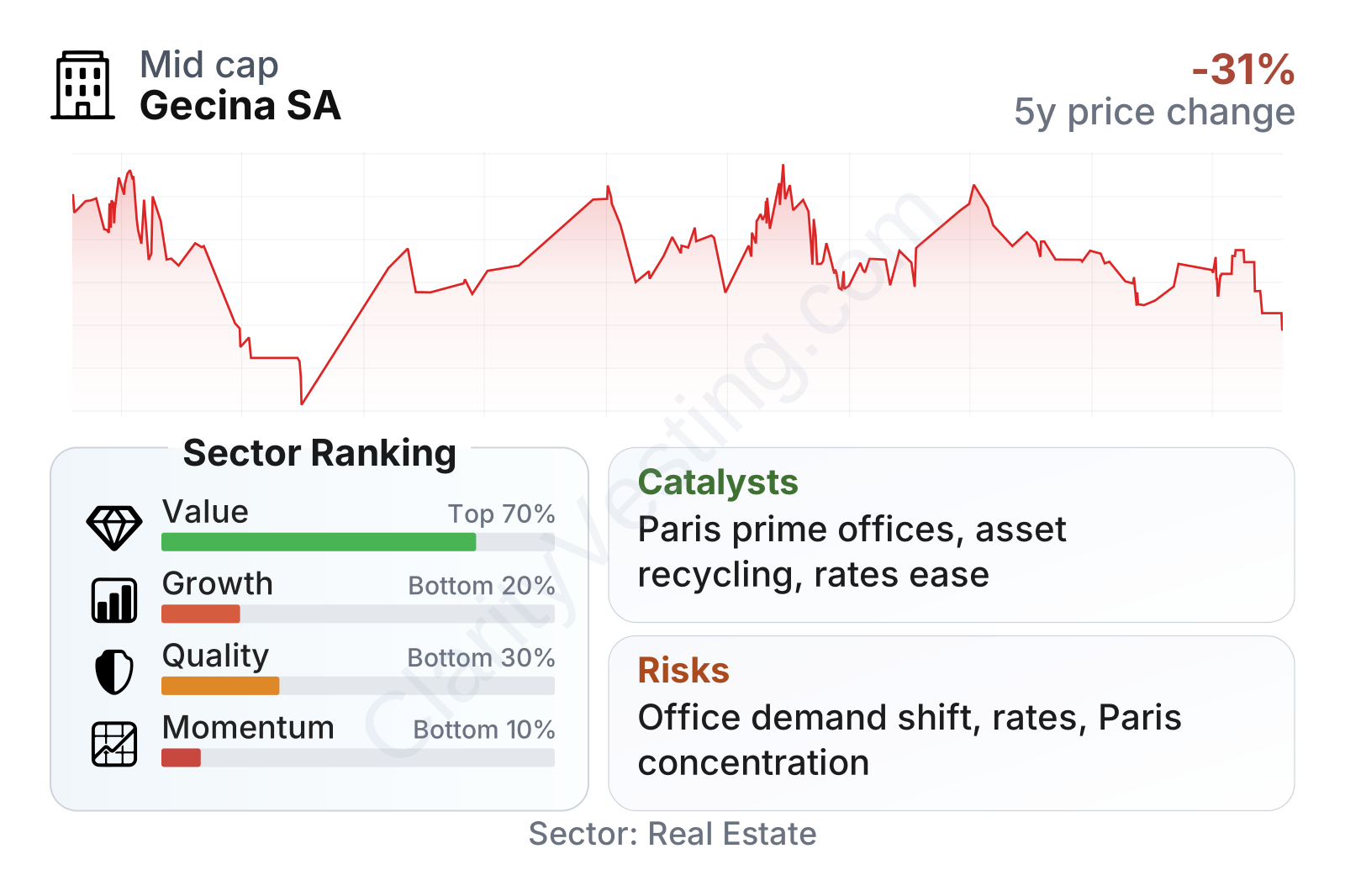
Gecina is a large listed real estate company, but the market has remained cautious. The share price trend over the last few years has been weak versus the broader real estate sector, even with some recovery from the lows. The metrics table points to a mixed profile: valuation looks inexpensive on book value and attractive on dividend yield, but growth, quality, and market momentum rank below much of the sector. In other words, the market appears to be recognizing the value of the underlying assets while still questioning the pace of growth and the near-term outlook for office real estate.
Growth
Gecina operates in sectors with very different growth profiles. Paris residential real estate tends to be defensive, supported by limited supply and long-term urban demand. The office segment is more complex. Prime offices in central locations can remain attractive because companies still want well-connected, energy-efficient space that helps with employee retention and brand image. At the same time, older or less competitive office stock faces pressure from hybrid work, stricter environmental standards, and tenant selectivity.
That context makes Gecina’s strategy logical. The company has focused on central, high-quality assets and on upgrading buildings to match tenant expectations on location, flexibility, and sustainability. In office real estate, the quality gap is becoming more important: the best buildings often lease better and retain value more effectively than average stock. A landlord positioned in prime Paris assets has a clearer path to defend occupancy and rent levels than owners of more secondary properties.
Revenue per share has shown a modest but consistent upward trend over the last five years. That does not point to rapid expansion, but it does suggest that the core portfolio has remained productive despite a difficult environment for European office property.
Another support for the long-term case is the company’s redevelopment and asset rotation model. Real estate owners can create value not only through rising rents, but also by selling mature or lower-priority assets and reinvesting in properties with better long-term potential. For Gecina, this is especially relevant as environmental regulation tightens and occupiers increasingly prefer high-performance buildings.
A further catalyst is the gradual normalization of property markets after the shock from higher interest rates. If financing conditions stabilize and investment transaction volumes recover, pressure on asset valuations could ease. For a company trading well below book value, even a more stable appraisal environment can materially change market perception.
Dividend per share has been notably steady, with a slight increase in the most recent period. That stability is consistent with the company’s recurring rental base. It does not by itself indicate strong growth, but it does highlight the cash-generating nature of the underlying portfolio.
Recent company communications have also emphasized leasing activity, asset recycling, and disciplined balance sheet management. Those are not dramatic short-term events, but for a property company they are meaningful indicators of execution quality. In this industry, steady portfolio optimization can matter more than headline expansion.
Risks
This article is for informational purposes only and does not constitute financial advice. Some content is AI-generated. See Disclaimer


