Stock Analysis · Great Eagle Holdings Limited (GEAHF)
Overview
Great Eagle Holdings Limited is a Hong Kong-based property group with a mix of recurring real estate income and hotel-related operations. The company owns and develops residential, office, retail, and mixed-use properties, and it also has a meaningful presence in hospitality through hotel ownership and asset management. Its best-known international brand is Langham Hospitality Group, which manages luxury hotels under names such as Langham, Cordis, Eaton, and Ying’nFlo. In addition, the group has exposure to U.S. commercial real estate through its office holdings and operates other property-related businesses such as building management, maintenance, and trading of construction materials.
This combination makes Great Eagle different from a pure landlord or a pure hotel operator. The business is tied to property values, rental demand, hotel occupancy, room rates, and financing costs, so results can move meaningfully from year to year.
Based on the company’s recent annual reporting structure, revenue mainly comes from the following areas:
- Hotel operations and related services: the largest contributor in recent years, roughly 45% to 60% of group revenue depending on travel conditions and hotel performance. This includes room revenue, food and beverage, hotel management, and related hospitality income.
- Property sales and development: often the second-largest source but more volatile, roughly 15% to 35%. This includes sales of completed residential or other development projects and can swing sharply depending on launch timing.
- Rental income from investment properties: typically around 10% to 20%. This comes from office, retail, and other leased properties, including major assets in Hong Kong and overseas.
- Other operations: generally a smaller share, roughly 5% to 10%. This includes property management, maintenance agency services, building materials trading, and miscellaneous business lines.
For long-term analysis, the most important point is that Great Eagle’s revenue mix is diversified, but not simple. Hotels add recovery potential when travel is strong, rental assets add recurring cash flow, and development sales can boost results in good property markets but also create volatility.
Over the last several years, revenue expanded overall, but profitability has been much less steady. Interest expense rose materially, and more recent results show that higher financing costs and weaker operating performance can sharply reduce earnings even when top-line revenue remains sizable.
Key Figures
| Metric | Value | Sector ⓘ |
|---|---|---|
| Date | Oct 17, 2026 | |
| Context | ||
| Sector | Real Estate | |
| Industry | Real Estate - Diversified | |
| Market Cap ⓘ | $1.66B | |
| Beta ⓘ | 0.54 | |
Value (Cheapness) | ||
| P/E Ratio ⓘ | N/A | 17.38 |
| P/B Ratio ⓘ | 0.00 | 0.85 |
| FCF Yield ⓘ | 706.58% | 7.38% |
| Dividend Yield ⓘ | 48.42% | 4.85% |
| EBIT / EV ⓘ | N/A | 3.78% |
| PEG ⓘ | N/A | |
Growth (Business expansion) | ||
| Revenue Growth ⓘ | -7.50% | 5.30% |
| RPS Growth (5Y CAGR) ⓘ | 108.70% | 6.02% |
| EPS Growth (5Y CAGR) ⓘ | N/A | -11.37% |
| BVPS Growth (5Y CAGR) ⓘ | 50.21% | 0.45% |
| Margin Growth (5Y Trend) ⓘ | -29.82% | -0.22% |
| FCF Growth (5Y CAGR) ⓘ | 52.80% | 5.40% |
| DPS Growth (5Y CAGR) ⓘ | 65.97% | 5.02% |
Quality (Business durability) | ||
| ROIC (Latest) ⓘ | N/A | 5.69% |
| ROE (Latest) ⓘ | -3.92% | 7.56% |
| ROA (Latest) ⓘ | -1.97% | 2.85% |
| ROIC (5Y Median) ⓘ | -0.69% | 4.22% |
| ROE (5Y Median) ⓘ | -0.83% | 6.03% |
| ROA (5Y Median) ⓘ | -0.43% | 2.44% |
| Net Debt / EBIT (Latest) ⓘ | 128.85 | 7.59 |
| Net Debt / EBIT (5Y Median) ⓘ | N/A | 8.40 |
| Net Debt / EBITDA (Latest) ⓘ | 12.27 | 5.27 |
| Net Debt / Assets ⓘ | 24.07% | 37.76% |
| EBITDA / Interest ⓘ | 0.64 | 4.10 |
| Operating Margin (Latest) ⓘ | 0.63% | 35.29% |
| Operating Margin (5Y Median) ⓘ | 23.97% | 37.31% |
| Debt to Equity (Latest) ⓘ | 62.42% | 88.87% |
| Profit Margin (Latest) ⓘ | -1.41% | 19.61% |
| Free Cash Flow (Latest) ⓘ | $11.71B | |
Momentum (Price trend) | ||
| 3Y Return ⓘ | +65.07% | +30.75% |
| 12M Return (excl. last month) ⓘ | +20.91% | +4.36% |
| 6M Return ⓘ | +14.69% | -2.52% |
| Price vs. 200-Day MA ⓘ | +22.86% | -2.34% |
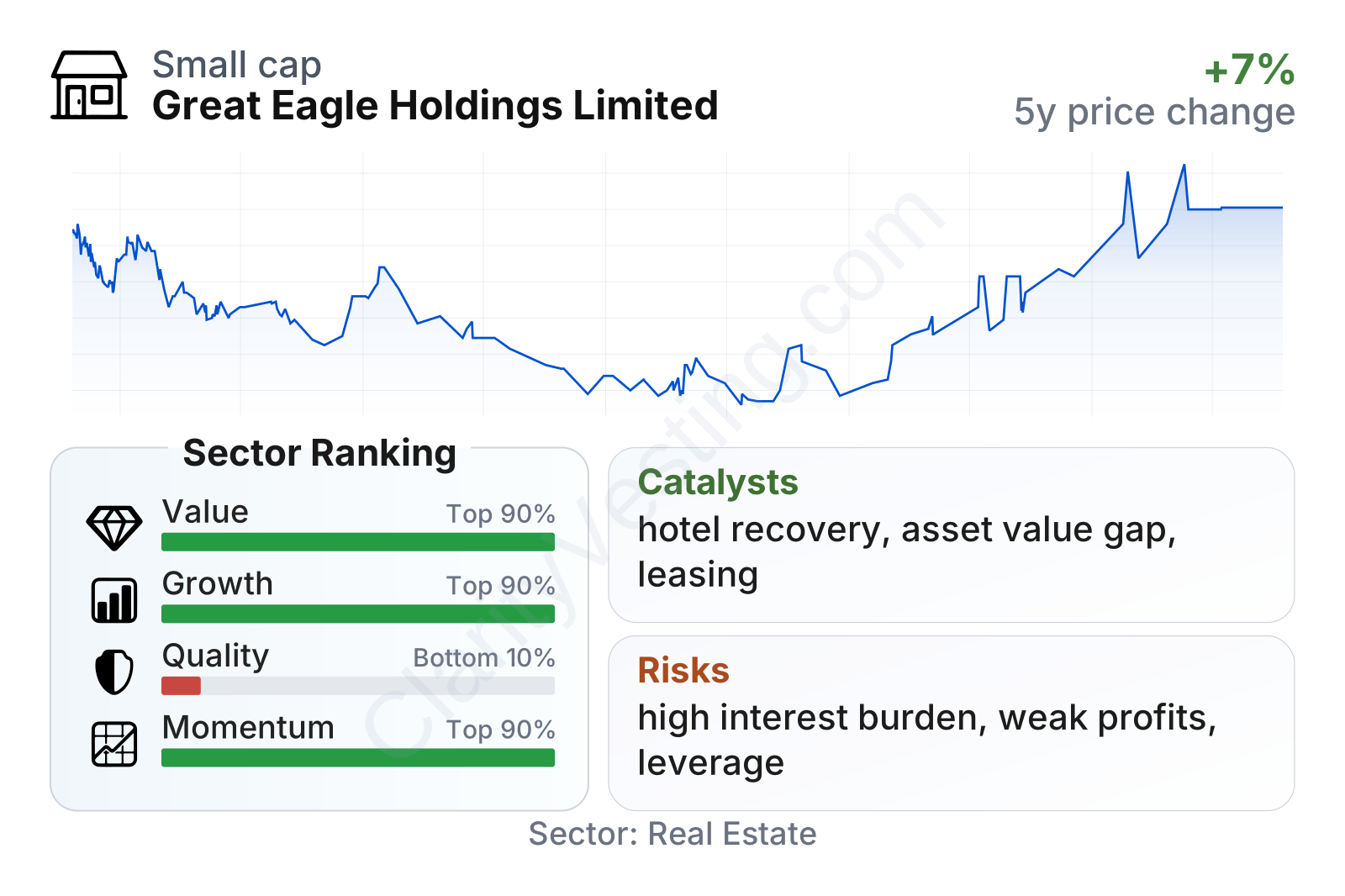
Great Eagle is a mid-sized real estate company by market value, and its shares have shown relatively low price volatility, with a beta well below 1. In the factor breakdown, the most striking contrast is very strong value metrics against weak quality metrics. The stock screens as unusually cheap on book value and cash flow measures, and its dividend yield is far above the sector median. At the same time, returns on equity and assets are negative, operating profitability is thin, and debt servicing looks stretched compared with peers.
Momentum has been better than much of the sector, with the share price recovering strongly from 2024 levels and outperforming the real estate median over multiple periods. That suggests the market has started to recognize some underlying asset value, even though recent operating results remain uneven.
Growth
Great Eagle operates in sectors that should still matter over the long run, but growth is likely to remain cyclical rather than smooth. Hospitality can benefit from continued normalization in international travel, premium tourism, and business travel recovery. Prime real estate in Hong Kong and selected overseas gateway cities can also retain strategic value over time, especially when replacement costs and land scarcity remain high.
The company’s strategy is coherent in one important sense: it owns hard assets, runs branded hotels, and keeps exposure to several property-related profit pools rather than relying on only one. That can help when one segment is weak. Its luxury and upscale hotel brands also give it an identity beyond being only a local landlord. If hotel performance improves further and financing pressure eases, earnings can recover faster than revenue because hospitality and property groups often have significant operating leverage.
Revenue per share has risen strongly over the last five years, although the latest jump looks too extreme to treat as a normal run rate and likely reflects one-off accounting or transaction effects rather than purely organic expansion. The broader direction still suggests that the business has been able to grow its top line across cycles.
The dividend record also points to a business that has historically returned cash to shareholders, but the recent spike should be treated carefully because it may not represent a sustainable annual pattern. For a real estate group, the more important long-term question is whether recurring rental and hotel cash flow can comfortably support distributions after interest and capital needs.
A meaningful catalyst is the potential realization of value from the company’s asset base. Great Eagle has often traded at a very large discount to book value, which can attract attention when property markets stabilize, hotel earnings improve, or management takes steps to unlock capital through disposals, redevelopment, or balance-sheet actions. Another support comes from its hotel platform: a stronger luxury travel market can improve both owned-hotel results and management-related income.
Recent company updates have continued to highlight asset management activity, hotel positioning, and leasing efforts across key properties. The broad opportunity is straightforward: if travel demand holds up and prime property values become more stable, the gap between reported asset value and market valuation could narrow.
Risks
This article is for informational purposes only and does not constitute financial advice. Some content is AI-generated. See Disclaimer


