Stock Analysis · Grid Dynamics Holdings Inc (GDYN)
Overview
Grid Dynamics Holdings Inc is a technology services company that helps large enterprises build and modernize digital products, data platforms, cloud systems, and artificial intelligence applications. In simple terms, it is a consulting and engineering partner for businesses that want better websites, apps, analytics, and software infrastructure. The company focuses heavily on complex enterprise projects rather than mass-market software products sold directly to consumers.
Its revenue mainly comes from professional services and engineering work delivered to corporate clients, often through multi-quarter programs. Based on recent annual reporting, the business is still largely service-led, with activity spread across several industry verticals rather than separate product lines.
- Technology, media, and telecom: approximately 34% of revenue in 2025. This includes digital platforms, software engineering, cloud work, and AI-related projects for technology-oriented clients.
- Retail, consumer packaged goods, and manufacturing: approximately 27%. This work often covers e-commerce platforms, supply chain tools, pricing, personalization, and customer experience systems.
- Finance: approximately 18%. This includes modernization, payments, analytics, and digital customer interfaces for financial institutions.
- Other industries: approximately 21% combined, including sectors such as healthcare, pharma, and other enterprise clients.
Geographically, the company earns the majority of its revenue in North America, especially the United States, while delivery talent is spread internationally. That model is common in IT services: client demand is concentrated in large developed markets, while engineering capacity is built globally.
Over the last several years, revenue expanded strongly from about $211 million in 2021 to about $412 million in 2025. At the same time, the company moved from losses toward modest profitability, although margins remain thin for the sector. The broad financial picture is one of a growing mid-sized digital engineering firm that has improved scale faster than it has improved earnings quality.
The business has clearly become larger, with revenue and gross profit both rising materially since 2021. However, selling, general, and administrative costs and ongoing investment in development have also stayed high, which helps explain why the path to durable profitability has been uneven.
Key Figures
| Metric | Value | Sector ⓘ |
|---|---|---|
| Date | Nov 04, 2026 | |
| Context | ||
| Sector | Technology | |
| Industry | Information Technology Services | |
| Market Cap ⓘ | $1.07B | |
| Beta ⓘ | 0.94 | |
Value (Cheapness) | ||
| P/E Ratio ⓘ | 148.56 | 27.60 |
| FCF Yield ⓘ | 2.45% | 4.23% |
| Dividend Yield ⓘ | N/A | 1.40% |
| EBIT / EV ⓘ | 1.17% | 3.00% |
| PEG ⓘ | N/A | |
Growth (Business expansion) | ||
| Revenue Growth ⓘ | 9.70% | 16.50% |
| RPS Growth (5Y CAGR) ⓘ | 7.10% | 8.55% |
| EPS Growth (5Y CAGR) ⓘ | -14.78% | -8.74% |
| Margin Growth (5Y Trend) ⓘ | N/A | 0.52% |
| FCF Growth (5Y CAGR) ⓘ | 17.50% | 9.82% |
| DPS Growth (5Y CAGR) ⓘ | 20.58% | 7.74% |
Quality (Business durability) | ||
| ROIC (Latest) ⓘ | 0.77% | 9.60% |
| ROIC (5Y Median) ⓘ | -0.47% | 8.32% |
| Net Debt / EBIT (Latest) ⓘ | -30.32 | 0.52 |
| Net Debt / EBIT (5Y Median) ⓘ | N/A | 0.46 |
| Net Debt / EBITDA (Latest) ⓘ | -11.62 | 0.28 |
| Net Debt / Assets ⓘ | -47.93% | 2.95% |
| EBITDA / Interest ⓘ | N/A | 13.46 |
| Operating Margin (Latest) ⓘ | 2.20% | 10.22% |
| Operating Margin (5Y Median) ⓘ | -0.39% | 8.51% |
| Debt to Equity (Latest) ⓘ | 2.97% | 32.45% |
| Profit Margin (Latest) ⓘ | 1.81% | 7.26% |
| Free Cash Flow (Latest) ⓘ | $26.31M | |
Momentum (Price trend) | ||
| 3Y Return ⓘ | +12.26% | +52.02% |
| 12M Return (excl. last month) ⓘ | -4.98% | +13.33% |
| 6M Return ⓘ | +128.94% | +5.13% |
| Price vs. 200-Day MA ⓘ | +90.93% | +2.72% |
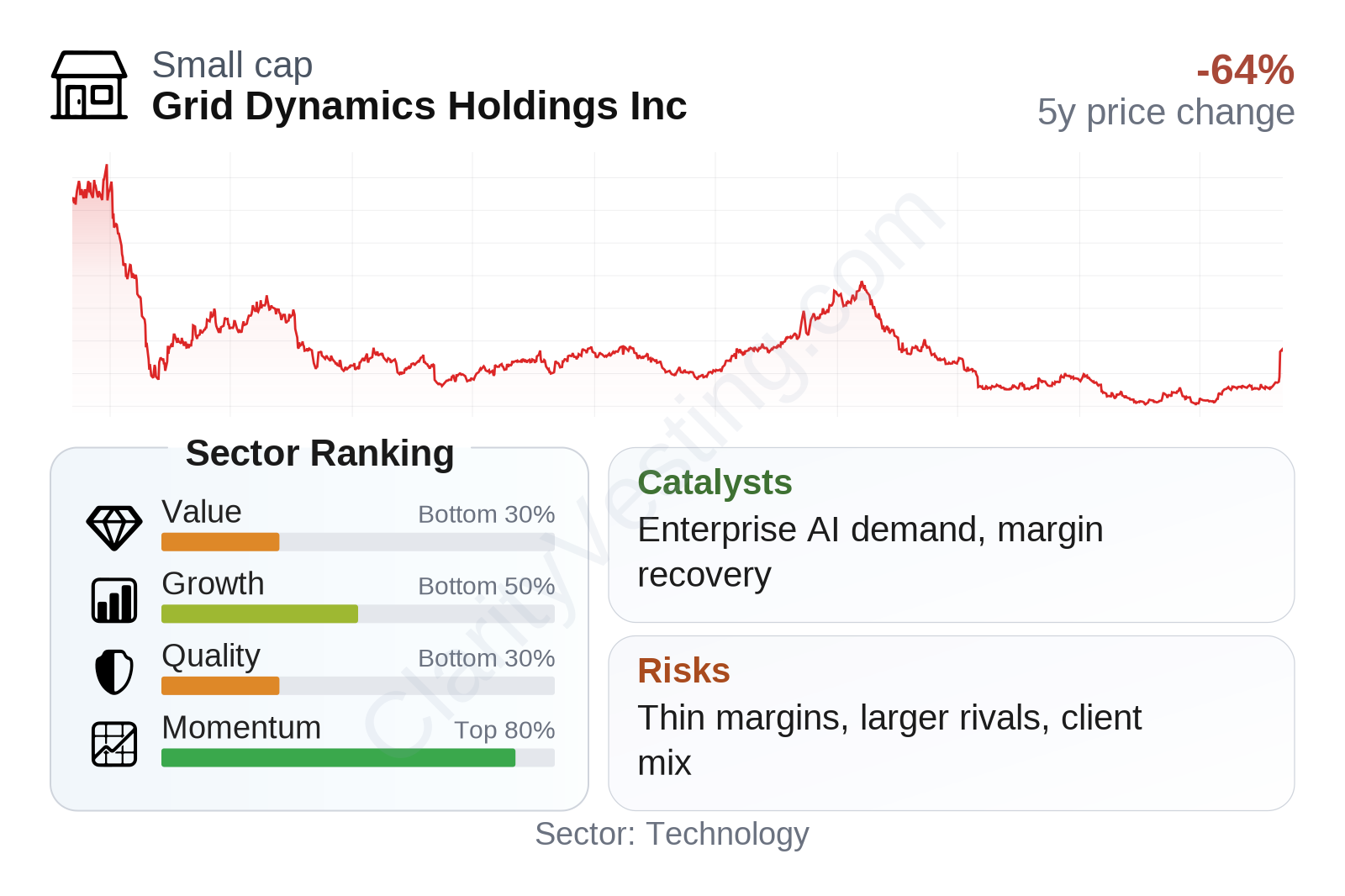
Grid Dynamics is a relatively small public company in a very large technology sector. The balance sheet stands out positively, with very low debt and net cash, which gives the company financial flexibility. On the other hand, profitability and returns on capital remain well below typical sector levels, while valuation metrics look demanding because earnings are still modest. Recent share-price momentum has improved sharply, but long-term stock performance has been much more volatile.
The stock history reflects that volatility well: after trading above $35 in late 2021, the shares fell into the single digits by 2026 before showing some recovery. That pattern usually signals a business that the market sees as promising but still not fully proven in terms of earnings consistency.
Growth
Grid Dynamics operates in a part of the technology market that still has long-term tailwinds. Enterprises continue to spend on cloud migration, application modernization, data engineering, cybersecurity-related architecture changes, and increasingly on generative AI. These are not short-lived themes. Large companies often need outside specialists because internal teams cannot handle every transformation program alone, especially when projects require both strategy and deep engineering execution.
The company’s strategy broadly fits that demand. It positions itself as a high-end engineering partner for large enterprises, with particular emphasis on cloud, data, and AI. It has also expanded through acquisitions in recent years, adding delivery capacity, customers, and domain expertise. That can make strategic sense in IT services if integration is disciplined and if the acquired teams strengthen access to bigger contracts.
The growth pattern has not been smooth. After a very strong expansion phase, revenue growth slowed sharply in 2023, then recovered through 2024 and 2025, with 2026 showing positive but more moderate year-over-year gains around the high-single-digit range. That suggests demand is still present, but not at the explosive pace seen earlier. Compared with the broader sector, recent revenue growth looks respectable rather than exceptional.
Cash generation is an encouraging point. Free cash flow has stayed positive and fairly stable in recent years, even while accounting profitability remained light. For a services business, that matters because it shows the company is converting a meaningful share of its work into actual cash rather than relying on aggressive accounting or balance-sheet expansion.
A notable catalyst is the market’s growing appetite for enterprise AI implementation. Many companies are moving beyond experimentation and starting to fund practical use cases such as automation, customer support, software development assistance, and internal knowledge systems. Grid Dynamics has been emphasizing AI engineering and industry-specific solutions, which gives it a chance to win follow-on work from existing clients. Another potential opportunity comes from large enterprises consolidating vendors and preferring partners that can combine consulting, engineering, and offshore delivery at scale.
Recent company updates have also highlighted new client wins, expanded AI-related offerings, and partnerships with major cloud and technology platforms. None of these guarantee acceleration, but they are consistent with a business trying to move toward higher-value work rather than basic outsourced development.
Risks
This article is for informational purposes only and does not constitute financial advice. Some content is AI-generated. See Disclaimer