Stock Analysis · General Dynamics Corporation (GD)
Overview
General Dynamics is a large American aerospace and defense company. It operates in four main businesses: business jets, military vehicles, weapons and munitions, naval shipbuilding, and technology services for government customers. The company’s customers are mainly the U.S. government, allied governments, and corporate or wealthy private buyers in business aviation. That mix gives General Dynamics exposure to both defense budgets and private-sector aircraft demand.
Its revenue base is relatively diversified across four reporting segments. Based on the latest full-year company reporting, the largest sources of revenue are approximately:
- Aerospace: about 22% of revenue. This is mainly Gulfstream business jets and related services.
- Marine Systems: about 22% of revenue. This includes nuclear-powered submarines, destroyers, and other naval construction and support work.
- Combat Systems: about 21% of revenue. This includes armored vehicles such as Abrams tanks and Stryker vehicles, along with weapons and munitions.
- Technologies: about 35% of revenue. This business provides IT services, mission systems, cloud, intelligence, and communication solutions, largely for U.S. government agencies.
That structure matters because it reduces dependence on a single program. It also means General Dynamics is not just a pure weapons producer or just a jet maker; it is a broad defense contractor with an important business-aviation franchise.
Over the last several years, revenue and profit have generally moved higher, while interest expense has trended lower and net income has improved. The biggest disruption in the period came in 2023, when profitability was pressured, but the following years show a recovery in both sales and earnings power.
Key Figures
| Metric | Value | Sector ⓘ |
|---|---|---|
| Date | Oct 24, 2026 | |
| Context | ||
| Sector | Industrials | |
| Industry | Aerospace & Defense | |
| Market Cap ⓘ | $93.19B | |
| Beta ⓘ | 0.33 | |
Value (Cheapness) | ||
| P/E Ratio ⓘ | 21.02 | 22.29 |
| P/B Ratio ⓘ | 3.52 | 1.98 |
| FCF Yield ⓘ | 6.92% | 6.26% |
| Dividend Yield ⓘ | 1.81% | 1.92% |
| EBIT / EV ⓘ | 5.87% | 4.83% |
| PEG ⓘ | 2.12 | |
Growth (Business expansion) | ||
| Revenue Growth ⓘ | 8.10% | 9.30% |
| RPS Growth (5Y CAGR) ⓘ | 8.90% | 7.76% |
| EPS Growth (5Y CAGR) ⓘ | -9.65% | -13.17% |
| BVPS Growth (5Y CAGR) ⓘ | 10.58% | 6.13% |
| Margin Growth (5Y Trend) ⓘ | -0.88% | 0.74% |
| FCF Growth (5Y CAGR) ⓘ | 4.00% | 10.79% |
| DPS Growth (5Y CAGR) ⓘ | 5.68% | 9.41% |
Quality (Business durability) | ||
| ROIC (Latest) ⓘ | 14.09% | 10.75% |
| ROA (Latest) ⓘ | 7.62% | 5.41% |
| ROIC (5Y Median) ⓘ | 13.39% | 9.37% |
| ROA (5Y Median) ⓘ | 6.67% | 4.95% |
| Net Debt / EBIT (Latest) ⓘ | 0.89 | 2.04 |
| Net Debt / EBIT (5Y Median) ⓘ | 2.16 | 2.27 |
| Net Debt / EBITDA (Latest) ⓘ | 0.77 | 1.39 |
| Net Debt / Assets ⓘ | 8.55% | 19.27% |
| EBITDA / Interest ⓘ | 26.25 | 9.58 |
| Operating Margin (Latest) ⓘ | 10.49% | 10.49% |
| Operating Margin (5Y Median) ⓘ | 10.34% | 10.30% |
| Debt to Equity (Latest) ⓘ | 35.34% | 64.82% |
| Profit Margin (Latest) ⓘ | 8.18% | 6.67% |
| Free Cash Flow (Latest) ⓘ | $6.45B | |
Momentum (Price trend) | ||
| 3Y Return ⓘ | +55.53% | +67.77% |
| 12M Return (excl. last month) ⓘ | +11.13% | +12.05% |
| 6M Return ⓘ | +6.88% | 0.00% |
| Price vs. 200-Day MA ⓘ | -1.98% | +0.67% |
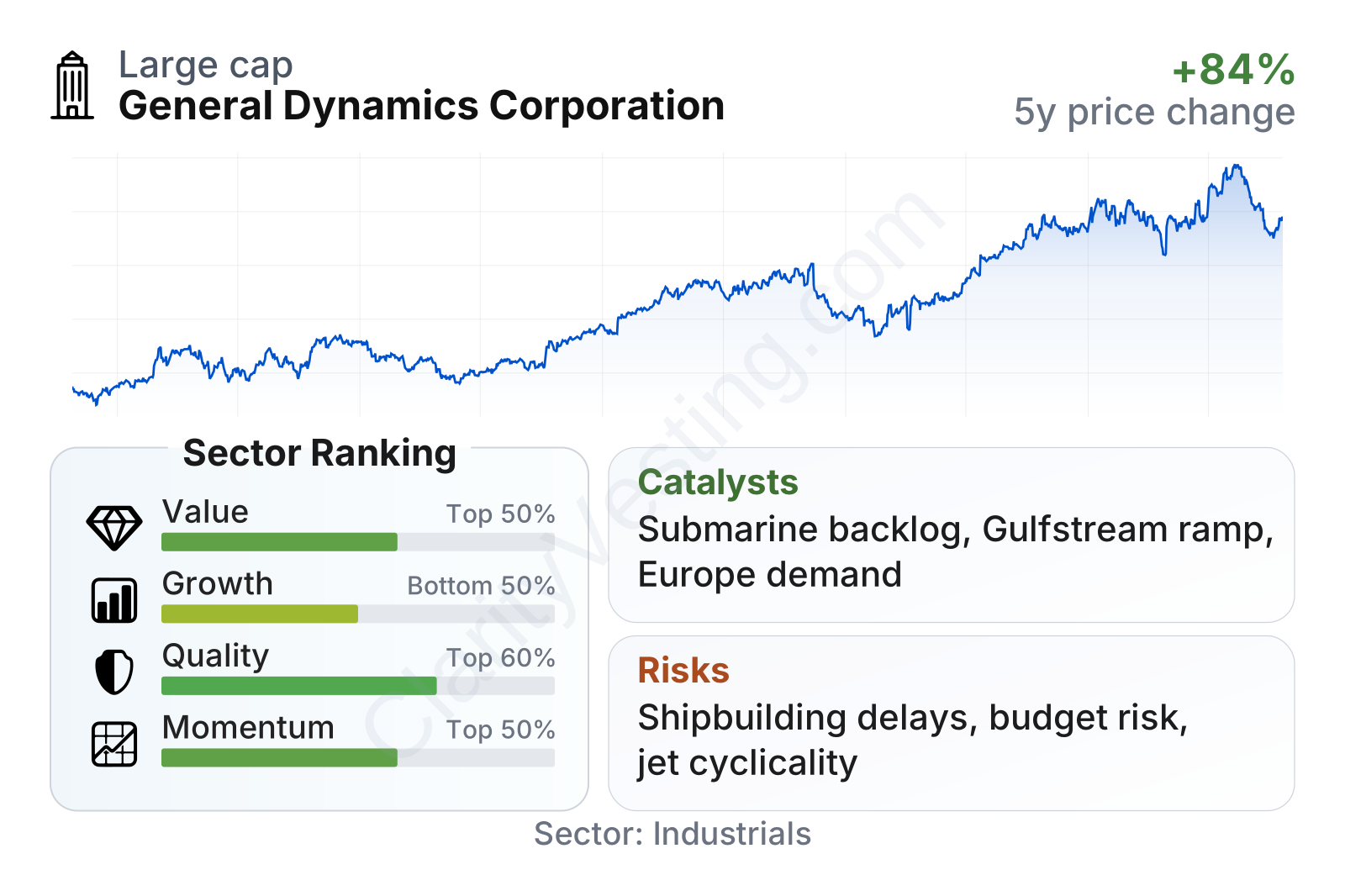
General Dynamics is a very large company with a market value in the tens of billions of dollars, and its stock has shown relatively low volatility, with a beta well below 1. On valuation, the shares trade at an earnings multiple slightly below the sector median, while free cash flow yield and EBIT relative to enterprise value look somewhat better than the sector midpoint. Quality metrics are solid: returns on capital and assets are above sector medians, leverage is moderate, and interest coverage is strong. The weaker area is growth, where recent revenue expansion is respectable but not exceptional for the sector, and margin progression over five years has been less favorable than many peers.
Growth
General Dynamics operates in sectors that still have clear long-term demand drivers. Defense spending remains supported by geopolitical tension, replenishment of munitions, modernization of armored vehicles, naval fleet investment, and demand for secure communications and mission systems. On the civilian side, business aviation continues to benefit from demand for premium long-range aircraft, where Gulfstream is one of the strongest brands in the market.
The company’s strategy is coherent because it focuses on areas with high barriers to entry. In submarines and major warships, the number of capable suppliers is very limited. In armored combat vehicles, incumbent positions matter because governments tend to stay with trusted platforms and upgrade them over time. In business jets, product reputation, certification, global service, and installed base create durable advantages.
Revenue growth has accelerated from the softer period seen earlier in the decade. More recently, year-over-year growth has mostly been in the high-single-digit to low-double-digit range, with some quarters moving above that level. This points to a business that is expanding at a healthy pace, even if it is not among the fastest growers in the industrial universe.
Cash generation is also an important part of the picture. Free cash flow was weaker around 2023 and 2024, then rebounded strongly, reaching above $6 billion on a trailing basis. That recovery suggests better operating execution and working-capital performance, and it supports balance-sheet flexibility, dividends, and capital returns.
One of the most important catalysts is continued demand in Marine Systems, especially the U.S. Navy’s submarine programs, where General Dynamics Electric Boat plays a central role. Another is Gulfstream’s newer aircraft lineup, including large-cabin jets that can lift both deliveries and margins as production matures. In combat systems, European rearmament and U.S. vehicle modernization can support multi-year orders. The technologies business can also benefit from secure IT, defense electronics, and intelligence-related spending, although that segment tends to be more competitive and lower margin than shipbuilding or aerospace.
Recent company updates in 2026 have continued to show backlog support and solid demand in core programs, which is important for long-duration defense businesses because it provides visibility that many industrial companies do not have.
Risks
This article is for informational purposes only and does not constitute financial advice. Some content is AI-generated. See Disclaimer