Stock Analysis · Grupo Cementos de Chihuahua S.A.B. de C.V (GCWOF)
Overview
Grupo Cementos de Chihuahua, usually called GCC, is a cement and construction materials producer with operations centered in the United States and Mexico. The company makes and sells cement, ready-mix concrete, aggregates, and related construction solutions used in highways, industrial projects, residential building, commercial construction, and public infrastructure. In simple terms, it supplies core materials that go into roads, bridges, warehouses, factories, homes, and large civil works.
Its business is tied to construction activity, especially in regions where population growth, industrial development, and public works support demand for heavy building materials. Cement is the key product because it feeds the rest of the chain: it is sold directly to customers and also used internally to make concrete products.
Based on recent annual reporting, revenue is mainly generated from the following activities:
- Cement: approximately 70% to 75% of revenue. This is the company’s main product and includes bulk and bagged cement sold to distributors, contractors, and industrial users.
- Concrete: approximately 15% to 20% of revenue. This includes ready-mix concrete delivered to construction sites for buildings and infrastructure work.
- Aggregates and other products: approximately 10% to 15% of revenue. This includes crushed stone, sand, and other complementary construction materials and services.
Geographically, GCC has meaningful exposure to the United States, which has become increasingly important, while Mexico remains a major market. That mix matters because U.S. infrastructure and industrial construction can provide support even when one local market slows.
The company’s income profile has improved notably over the last few years. Revenue climbed from a little above $1.0 billion in 2021 to roughly $1.4 billion in 2025, while operating income and net income expanded faster than sales. That suggests GCC has not only grown, but also converted more of each sales dollar into profit.
The long-term pattern shows a business that has widened gross profit and operating profit since 2021, while interest expense has trended down. That combination points to stronger pricing, better operating efficiency, and a lighter financing burden than a few years ago.
Key Figures
| Metric | Value | Sector ⓘ |
|---|---|---|
| Date | Oct 23, 2026 | |
| Context | ||
| Sector | Basic Materials | |
| Industry | Building Materials | |
| Market Cap ⓘ | $3.11B | |
| Beta ⓘ | 0.47 | |
Value (Cheapness) | ||
| P/E Ratio ⓘ | 10.15 | 16.92 |
| P/B Ratio ⓘ | 1.32 | 1.66 |
| FCF Yield ⓘ | 6.20% | 5.83% |
| Dividend Yield ⓘ | 1.17% | 2.07% |
| EBIT / EV ⓘ | 12.81% | 6.38% |
| PEG ⓘ | N/A | |
Growth (Business expansion) | ||
| Revenue Growth ⓘ | 15.00% | 11.25% |
| RPS Growth (5Y CAGR) ⓘ | 8.21% | 4.49% |
| EPS Growth (5Y CAGR) ⓘ | -10.13% | -15.24% |
| BVPS Growth (5Y CAGR) ⓘ | 15.16% | 5.49% |
| Margin Growth (5Y Trend) ⓘ | 5.78% | -1.54% |
| FCF Growth (5Y CAGR) ⓘ | -34.09% | 0.37% |
| DPS Growth (5Y CAGR) ⓘ | 6.97% | 5.91% |
Quality (Business durability) | ||
| ROIC (Latest) ⓘ | N/A | 9.59% |
| ROA (Latest) ⓘ | 8.75% | 4.92% |
| ROIC (5Y Median) ⓘ | 11.09% | 7.91% |
| ROA (5Y Median) ⓘ | 9.75% | 3.92% |
| Net Debt / EBIT (Latest) ⓘ | -0.37 | 1.36 |
| Net Debt / EBIT (5Y Median) ⓘ | -0.78 | 1.69 |
| Net Debt / EBITDA (Latest) ⓘ | -0.29 | 0.93 |
| Net Debt / Assets ⓘ | -4.20% | 13.69% |
| EBITDA / Interest ⓘ | 30.85 | 12.38 |
| Operating Margin (Latest) ⓘ | 27.37% | 13.24% |
| Operating Margin (5Y Median) ⓘ | 28.58% | 11.82% |
| Debt to Equity (Latest) ⓘ | 27.84% | 40.30% |
| Profit Margin (Latest) ⓘ | 20.31% | 6.38% |
| Free Cash Flow (Latest) ⓘ | $193.03M | |
Momentum (Price trend) | ||
| 3Y Return ⓘ | +21.14% | +73.47% |
| 12M Return (excl. last month) ⓘ | +12.35% | +27.59% |
| 6M Return ⓘ | -21.10% | -4.02% |
| Price vs. 200-Day MA ⓘ | +11.42% | -0.65% |
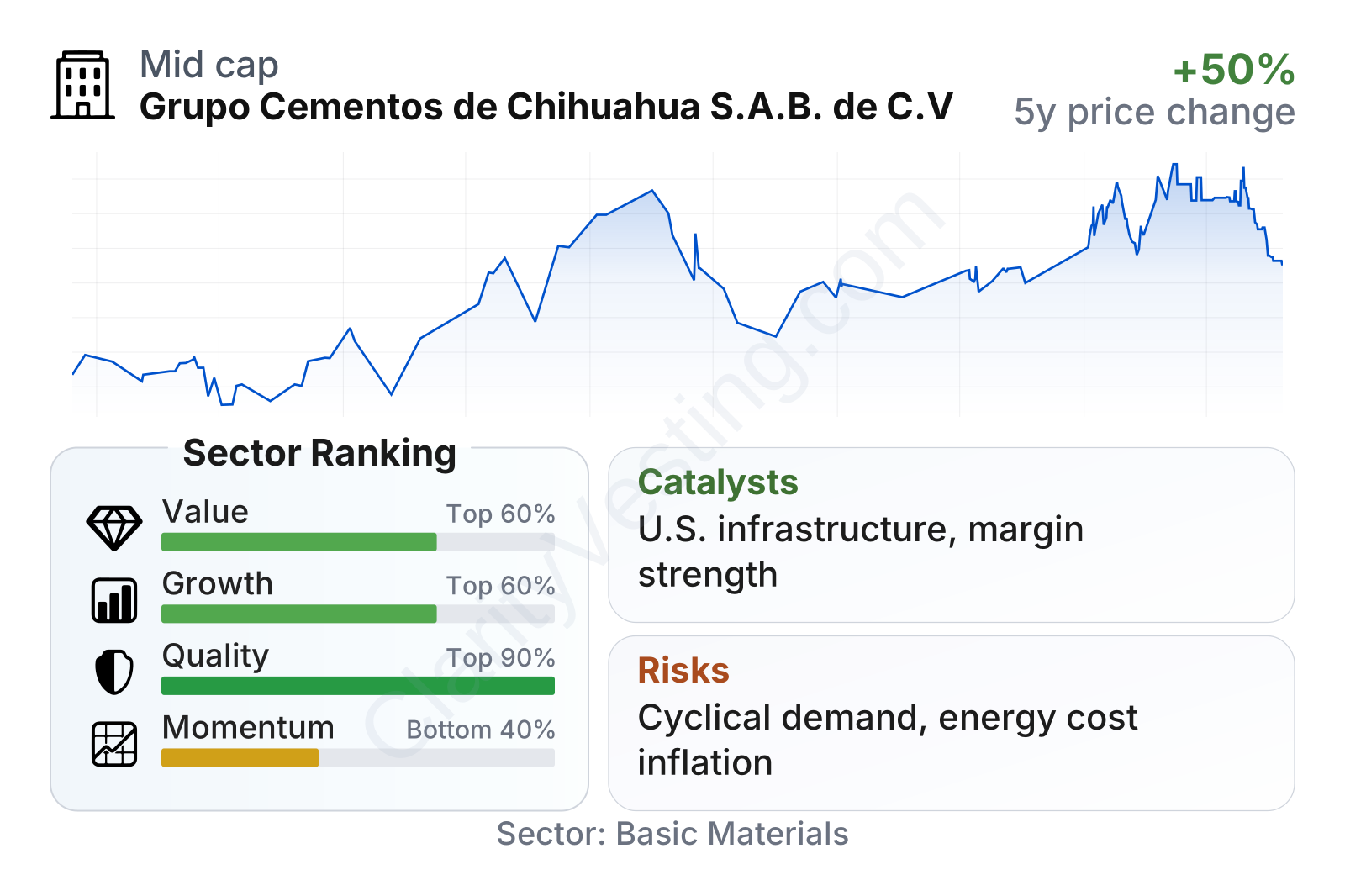
GCC stands out more for quality and profitability than for recent share-price momentum. Profitability metrics are clearly ahead of the sector median, with operating margin around 27% and profit margin around 20%, both unusually strong for building materials. The balance sheet also looks conservative: debt-to-equity is below the sector median, and net debt metrics indicate the company currently holds more cash than debt on a net basis. On valuation, the stock trades at lower P/E and P/B multiples than the sector median, while its EBIT-to-enterprise-value ratio remains comfortably above the sector norm. The weaker area is momentum, as the stock has lagged many peers over the last several months despite still trading above its 200-day average.
Growth
GCC operates in a sector with steady long-term relevance rather than rapid disruption. Cement and aggregates are basic inputs for modern economies, and demand usually follows population growth, housing formation, industrial investment, logistics expansion, and public infrastructure spending. In North America, these drivers remain important because roads, bridges, water systems, manufacturing facilities, and distribution centers all require large volumes of cement-based materials.
The company’s strategy appears coherent for this environment. GCC focuses on regions where it already has industrial assets, logistics capabilities, and customer relationships. That local density matters in cement because transportation costs are high and plants close to demand centers often enjoy a structural advantage. GCC has also emphasized operational discipline, modernization, and selective expansion rather than highly aggressive dealmaking.
Recent revenue growth has not been perfectly smooth, which is normal in this industry, but the latest trend shows renewed acceleration. The most recent year-over-year growth rate is around 15%, ahead of the sector median. Over a five-year period, revenue per share growth has also outpaced many peers, which suggests the business has been expanding in a way that has not relied heavily on dilution.
Cash generation has been more volatile than accounting profit. Free cash flow dropped sharply at one point and even turned negative briefly, likely reflecting working capital swings or capital spending, before recovering again. That does not automatically indicate weakness, but it does mean growth should be assessed not only through earnings, but also through the company’s ability to consistently convert profit into cash after investment needs.
One of the clearest catalysts is continued infrastructure and industrial construction demand in the United States. GCC’s U.S. footprint gives it exposure to projects linked to manufacturing reshoring, data centers, transportation, and public works. Another positive element is the company’s strong internal economics: high margins, low leverage, and high interest coverage give it room to invest in capacity, logistics, and efficiency projects without obvious balance-sheet strain.
Recent company updates have also pointed to capital allocation aimed at expanding production and improving operating efficiency. For a cement producer, incremental capacity and plant optimization can be meaningful because they allow more volume to move through a largely fixed-cost asset base, which can support margins if demand stays healthy.
Risks
This article is for informational purposes only and does not constitute financial advice. Some content is AI-generated. See Disclaimer


