Stock Analysis · Greenbrier Companies Inc (GBX)
Overview
Greenbrier Companies is a rail equipment manufacturer and services company focused mainly on freight railcars. In simple terms, it builds railcars, helps customers keep them in service, and also provides leasing and fleet management support. Its customers include railroads, shippers, leasing companies, and industrial businesses that need to move goods such as agricultural products, energy materials, construction inputs, and consumer freight.
The business is centered on North America, with additional operations in Europe and Brazil. Greenbrier is best known for designing and manufacturing new freight railcars, but the company also earns recurring revenue from maintenance, parts, wheels, and railcar management services. That mix matters because manufacturing can be cyclical, while aftermarket and leasing-related activities can help smooth results.
Based on recent company reporting, revenue is primarily generated from two operating segments:
- Manufacturing: approximately 80% to 90% of revenue in recent periods. This includes the design and production of new freight railcars and marine barges, as well as railcar conversions.
- Maintenance Services: approximately 10% to 20% of revenue. This includes railcar repair, refurbishment, parts, wheel services, inspections, and other support work that keeps fleets operating.
Greenbrier also has a leasing and fleet management platform, but this has generally been a much smaller contributor to total revenue than manufacturing. It is still strategically important because it supports customer relationships, can generate fee income, and may help place railcars into the market.
Over the last few years, the company has improved profitability even while revenue has moved around. Revenue rose sharply through 2023, then moderated in 2024 and 2025, but operating income and net income continued to improve. That suggests a better sales mix, stronger execution, or firmer pricing, although the business remains tied to order cycles in rail equipment.
The overall picture is of a mid-sized industrial company with a specialized role in freight transportation infrastructure: not a broad transportation giant, but an important supplier to the rail system.
Key Figures
| Metric | Value | Sector ⓘ |
|---|---|---|
| Date | Oct 17, 2026 | |
| Context | ||
| Sector | Industrials | |
| Industry | Railroads | |
| Market Cap ⓘ | $1.22B | |
| Beta ⓘ | 1.44 | |
Value (Cheapness) | ||
| P/E Ratio ⓘ | 11.63 | 22.10 |
| P/B Ratio ⓘ | 0.88 | 1.97 |
| FCF Yield ⓘ | -9.75% | 6.38% |
| Dividend Yield ⓘ | 3.32% | 1.94% |
| EBIT / EV ⓘ | 6.74% | 4.79% |
| PEG ⓘ | 0.58 | |
Growth (Business expansion) | ||
| Revenue Growth ⓘ | -31.60% | 9.30% |
| RPS Growth (5Y CAGR) ⓘ | 17.97% | 7.81% |
| EPS Growth (5Y CAGR) ⓘ | 12.29% | -13.06% |
| BVPS Growth (5Y CAGR) ⓘ | 1.62% | 6.14% |
| Margin Growth (5Y Trend) ⓘ | 10.50% | 0.88% |
| FCF Growth (5Y CAGR) ⓘ | -46.51% | 11.01% |
| DPS Growth (5Y CAGR) ⓘ | -9.18% | 9.48% |
Quality (Business durability) | ||
| ROIC (Latest) ⓘ | 4.72% | 10.84% |
| ROA (Latest) ⓘ | 2.34% | 5.41% |
| ROIC (5Y Median) ⓘ | 5.44% | 9.38% |
| ROA (5Y Median) ⓘ | 1.60% | 4.95% |
| Net Debt / EBIT (Latest) ⓘ | 7.73 | 2.08 |
| Net Debt / EBIT (5Y Median) ⓘ | 6.70 | 2.27 |
| Net Debt / EBITDA (Latest) ⓘ | 4.69 | 1.39 |
| Net Debt / Assets ⓘ | 35.23% | 19.28% |
| EBITDA / Interest ⓘ | 4.00 | 9.58 |
| Operating Margin (Latest) ⓘ | 7.54% | 10.50% |
| Operating Margin (5Y Median) ⓘ | 5.22% | 10.29% |
| Debt to Equity (Latest) ⓘ | 114.77% | 65.48% |
| Profit Margin (Latest) ⓘ | 4.07% | 6.67% |
| Free Cash Flow (Latest) ⓘ | -$118.60M | |
Momentum (Price trend) | ||
| 3Y Return ⓘ | +5.04% | +61.68% |
| 12M Return (excl. last month) ⓘ | -4.02% | +12.58% |
| 6M Return ⓘ | -24.40% | 0.00% |
| Price vs. 200-Day MA ⓘ | -18.85% | +0.02% |
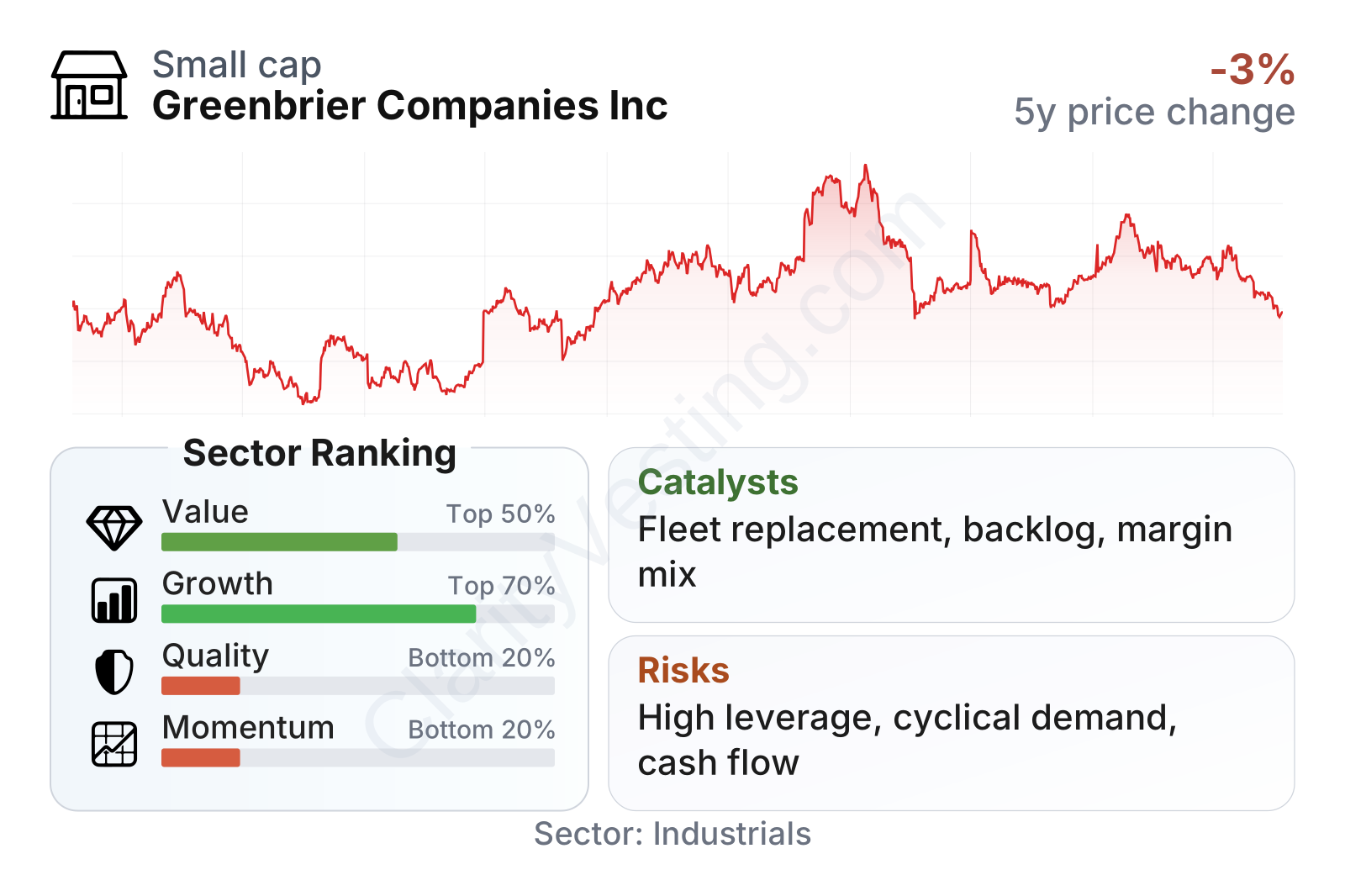
Greenbrier sits in the small-cap range, with a stock that has been noticeably volatile over the last several years. The share price has experienced wide swings rather than a steady climb, which fits the cyclical nature of rail equipment demand. In the latest factor snapshot, valuation looks cheaper than much of the sector on earnings and book value, growth measures are mixed but not weak over a multi-year period, and quality measures remain the biggest soft spot because returns on capital are modest and leverage is elevated.
The table also points to an important contrast: Greenbrier looks inexpensive on traditional valuation ratios, but that lower multiple comes with weaker balance-sheet and cash-flow characteristics than the median industrial company. This is a stock where the headline valuation cannot be viewed separately from the business cycle and financing profile.
Growth
Greenbrier operates in a sector that has long-term relevance. Freight rail remains one of the most efficient ways to move heavy goods over land, which supports ongoing demand for railcar replacement, modernization, and maintenance. That does not make the industry a fast-growth market every year, but it does give it durable industrial importance. Demand tends to come in waves, driven by rail traffic, commodity markets, customer confidence, fleet age, and replacement needs.
The company’s strategy is logical for that environment. Greenbrier is not relying only on selling new railcars; it is also trying to expand higher-value activities such as repair, parts, fleet services, and leasing-related support. That approach can help reduce dependence on pure manufacturing cycles and improve margins when production volumes fluctuate.
Recent revenue growth has clearly turned weaker after a period of strong expansion. Year-over-year growth moved from very strong positive levels in 2022 and early 2023 to negative readings more recently, including declines above 20% and around 30% in the latest periods. That signals a softer part of the cycle rather than a straight-line growth phase. Even so, the longer view is better: five-year revenue per share growth and earnings per share growth remain ahead of the sector median, showing that Greenbrier has built scale and earnings power over time despite short-term swings.
Cash generation has also improved materially from very negative levels a few years ago to positive territory more recently, although the latest trailing figure in the factor table is still negative. That inconsistency shows how working capital and order timing can heavily affect cash flow in this business. For long-term analysis, the key takeaway is that Greenbrier has shown it can recover cash flow, but not yet with the steadiness seen in stronger industrial franchises.
A meaningful catalyst is the need to replace aging freight railcar fleets in North America. Railcars do not last forever, and regulatory, efficiency, and maintenance considerations can support replacement demand over time. Another catalyst is the company’s backlog and its ability to shift production toward better-margin car types and service work. If rail traffic, industrial activity, and customer fleet investment improve together, Greenbrier is positioned to benefit because it already has manufacturing capacity, customer relationships, and a service footprint in place.
Recent company updates have also highlighted ongoing railcar orders, deliveries, and service activity, which matter more than broad market narratives for a company like this. In Greenbrier’s case, order flow and backlog quality are especially important because they provide visibility into future production and pricing.
Risks
This article is for informational purposes only and does not constitute financial advice. Some content is AI-generated. See Disclaimer


