Stock Analysis · Golub Capital BDC Inc (GBDC)
Overview
Golub Capital BDC Inc. is a business development company, or BDC. In simple terms, it provides financing to privately owned U.S. middle-market companies, mainly through loans. These are businesses that are usually too large for small-bank lending but not large enough to issue public bonds easily. As a BDC, GBDC is designed to pass most of its income through to shareholders, which helps explain its high dividend yield.
The company is externally managed by Golub Capital, a well-known private credit manager. Its strategy centers on lending to companies backed by private equity sponsors, with a strong emphasis on senior secured debt. That matters because senior secured loans are higher in the repayment order if a borrower runs into trouble, and they are often backed by collateral.
GBDC’s revenue mainly comes from investment income generated by its portfolio. Based on recent annual filings, the mix is dominated by interest-bearing debt investments, while equity-related gains and fee income play a smaller role.
- Interest income from debt investments: approximately 85% to 95% of total investment income. This mostly includes first lien and other senior secured loans made to middle-market companies.
- Payment-in-kind income and fee income: approximately 2% to 8%. This can include structuring fees, prepayment-related income, and non-cash interest that is added to loan balances instead of paid immediately.
- Dividend income and gains from equity or fund positions: generally 0% to 10%, depending on the year. These sources are more variable and depend on exits, market conditions, and portfolio company performance.
The broad financial flow shows a business that has expanded meaningfully over the last few years: total revenue increased strongly from 2022 through 2025, and net income also moved higher, although rising interest expense absorbed a growing share of that revenue. That pattern is typical for a lender using debt to fund a larger investment portfolio.
Key Figures
| Metric | Value | Sector ⓘ |
|---|---|---|
| Date | Oct 03, 2026 | |
| Context | ||
| Sector | Financial Services | |
| Industry | Asset Management | |
| Market Cap ⓘ | $3.28B | |
| Beta ⓘ | 0.42 | |
Value (Cheapness) | ||
| P/E Ratio ⓘ | 19.14 | 12.60 |
| P/B Ratio ⓘ | 0.89 | 1.23 |
| FCF Yield ⓘ | 21.54% | 10.16% |
| Dividend Yield ⓘ | 11.38% | 2.96% |
| EBIT / EV ⓘ | N/A | 7.77% |
| PEG ⓘ | 1.40 | |
Growth (Business expansion) | ||
| Revenue Growth ⓘ | -14.00% | 9.50% |
| RPS Growth (5Y CAGR) ⓘ | 12.00% | 12.10% |
| EPS Growth (5Y CAGR) ⓘ | -2.69% | -9.45% |
| BVPS Growth (5Y CAGR) ⓘ | -0.66% | 5.01% |
| Margin Growth (5Y Trend) ⓘ | -97.53% | -4.07% |
| FCF Growth (5Y CAGR) ⓘ | -21.95% | 4.96% |
| DPS Growth (5Y CAGR) ⓘ | 13.70% | 8.79% |
Quality (Business durability) | ||
| ROIC (Latest) ⓘ | N/A | 9.60% |
| ROE (Latest) ⓘ | 3.82% | 13.84% |
| ROA (Latest) ⓘ | 1.69% | 1.53% |
| ROIC (5Y Median) ⓘ | 4.74% | 7.86% |
| ROE (5Y Median) ⓘ | 9.41% | 12.20% |
| ROA (5Y Median) ⓘ | 4.25% | 1.29% |
| Net Debt / EBIT (Latest) ⓘ | N/A | 0.91 |
| Net Debt / EBIT (5Y Median) ⓘ | 10.41 | 0.74 |
| Net Debt / EBITDA (Latest) ⓘ | 11.49 | 0.97 |
| Operating Margin (Latest) ⓘ | N/A | 22.12% |
| Operating Margin (5Y Median) ⓘ | 100.23% | 24.39% |
| Debt to Equity (Latest) ⓘ | 122.48% | 60.37% |
| Profit Margin (Latest) ⓘ | 21.45% | 26.62% |
| Free Cash Flow (Latest) ⓘ | $706.51M | |
Momentum (Price trend) | ||
| 3Y Return ⓘ | +23.35% | +89.23% |
| 12M Return (excl. last month) ⓘ | -3.82% | +17.35% |
| 6M Return ⓘ | +6.53% | +10.00% |
| Price vs. 200-Day MA ⓘ | +2.46% | +3.73% |
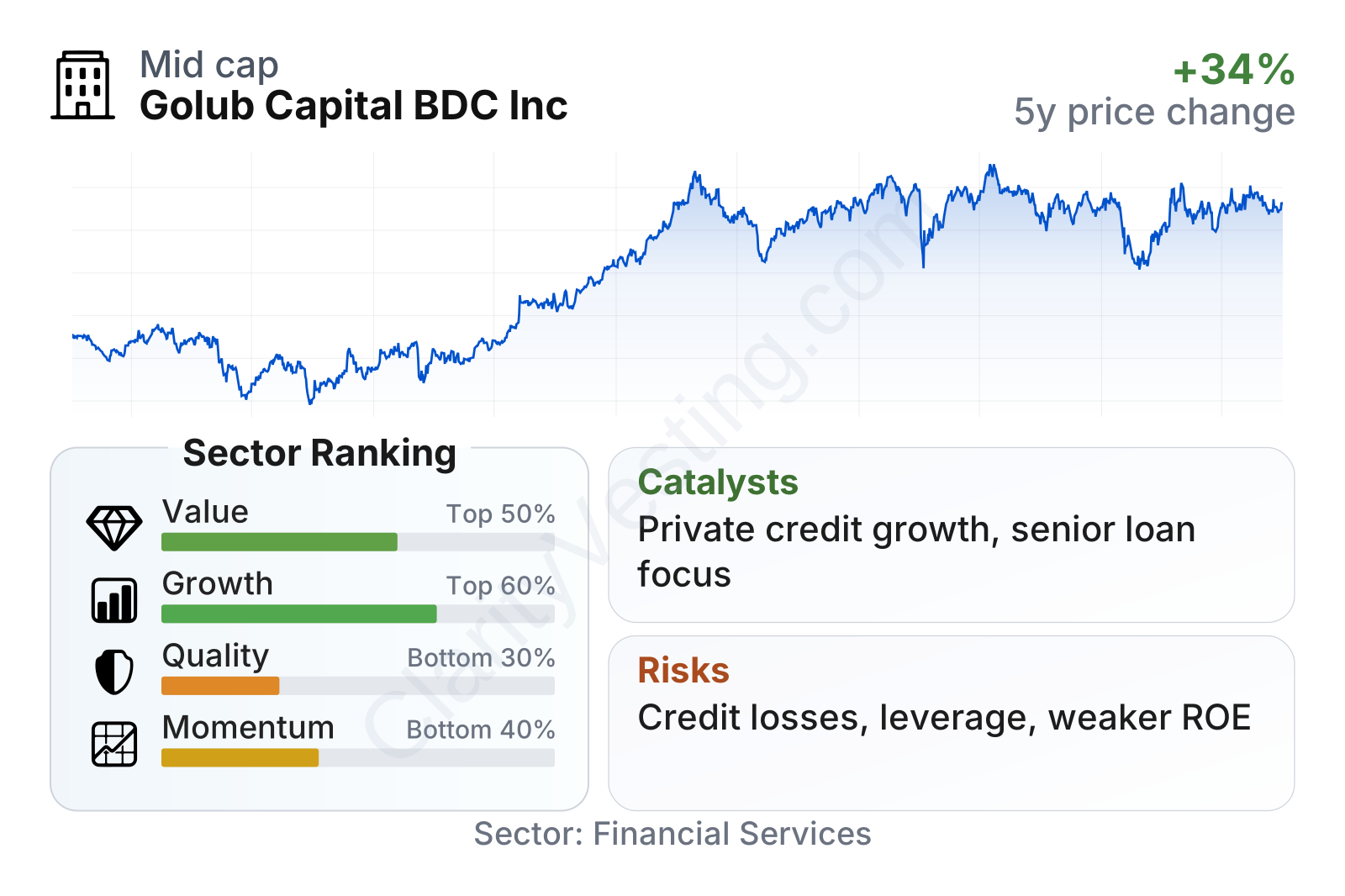
GBDC is a mid-sized public BDC with a low beta of about 0.42, which suggests the stock has historically moved less than the broader market. The value profile is mixed: the shares trade at a price-to-earnings ratio above the sector median, but at a price-to-book ratio below the sector median. The income profile stands out more clearly, with a trailing dividend yield around 11.5%, far above the sector median near 2.9%.
Growth and quality metrics are less straightforward. Five-year revenue per share growth has been solid at roughly 12% annually, close to the sector median, and dividend per share growth has been stronger than the typical peer. However, recent year-over-year revenue declined, return on equity is well below the sector median, and leverage is high even by financial-sector standards. Price performance has been positive over several years, but weaker than the broader sector.
Growth
GBDC operates in private credit, a part of the financial industry that has grown steadily as banks have pulled back from some forms of corporate lending. That has created more room for specialized lenders to finance middle-market companies. This is an important long-term tailwind: demand for flexible, non-bank lending remains healthy, especially for sponsor-backed borrowers looking for acquisition financing, refinancings, and recapitalizations.
The company’s strategy is sensible for this environment. It focuses on directly originated loans, especially first lien senior secured debt, and it benefits from the broader Golub Capital platform, which provides deal sourcing, underwriting experience, and borrower relationships. In private credit, scale and reputation matter because they can improve access to transactions and allow a lender to be selective instead of stretching for yield.
Earnings have been uneven rather than consistently rising. Per-share earnings improved from 2022 into 2024, then moved lower in 2025 and remained softer into 2026. That suggests GBDC has benefited from higher loan yields in the past few years, but also faces pressure from funding costs, credit marks, portfolio changes, or lower fee-related contributions.
Book value per share also tells an important part of the growth picture for a BDC. GBDC showed a sharp increase through 2024, followed by a drop back closer to earlier levels in 2025. For long-term analysis, that matters because book value often reflects whether a BDC is creating value through underwriting discipline and stable portfolio marks, not just paying out attractive dividends.
A recent and relevant opportunity for GBDC is the continued institutional shift toward private credit as an alternative to traditional bank lending. If capital markets remain selective and merger, acquisition, and refinancing activity stays active, that can support deal flow. GBDC’s sponsor-focused lending model is built for that environment. The main catalyst is not one dramatic event, but the continued expansion of private credit and the company’s ability to deploy capital into senior secured loans while maintaining credit quality.
Risks
This article is for informational purposes only and does not constitute financial advice. Some content is AI-generated. See Disclaimer