Stock Analysis · Glacier Bancorp Inc (GBCI)
Overview
Glacier Bancorp is a regional bank holding company focused on community banking across the Western United States. It operates through locally branded bank divisions in markets such as Montana, Idaho, Wyoming, Colorado, Utah, Washington, Arizona, Nevada, California, and Oregon. In simple terms, the company takes deposits from customers, makes loans, earns interest on those loans and investments, and also collects fees from everyday banking services.
Its business model is relatively straightforward for a bank: gather low-cost deposits, lend prudently to businesses and households, and keep strong local relationships in smaller and mid-sized markets. Glacier has historically expanded both organically and through acquisitions of community banks, which has helped it build a broad footprint without becoming a national megabank.
The company’s revenue mix is mainly driven by interest income, which is typical for regional banks. Based on recent annual results and the structure described in company filings, the main sources of revenue are approximately:
- Net interest income: about 75% to 85% of total revenue. This is the spread between what Glacier earns on loans and securities and what it pays on deposits and other funding.
- Fee-based and other non-interest income: about 15% to 25%. This includes service charges on deposit accounts, loan-related fees, wealth management and trust revenue, debit and card-related fees, and gains tied to loan sales or other banking activities.
Within lending, Glacier is primarily exposed to commercial real estate, commercial and industrial lending, residential real estate, and consumer lending. On the funding side, deposits are the core engine of the franchise, which matters because stable local deposits are usually cheaper and more durable than wholesale funding.
Over the last several years, total revenue has trended upward, but profitability was squeezed when funding costs rose sharply. More recently, earnings have shown signs of stabilization and partial recovery rather than a full return to prior peak profitability.
The long-term pattern is clear: revenue has grown meaningfully since 2021, but higher interest expense and rising operating costs absorbed a large part of that growth. Net income remains below the level reached before the banking pressure cycle intensified.
Key Figures
| Metric | Value | Sector ⓘ |
|---|---|---|
| Date | Oct 03, 2026 | |
| Context | ||
| Sector | Financial Services | |
| Industry | Banks - Regional | |
| Market Cap ⓘ | $5.63B | |
| Beta ⓘ | 0.72 | |
Value (Cheapness) | ||
| P/E Ratio ⓘ | 17.93 | 12.60 |
| P/B Ratio ⓘ | 1.31 | 1.23 |
| FCF Yield ⓘ | 7.05% | 10.16% |
| Dividend Yield ⓘ | 3.02% | 2.96% |
| EBIT / EV ⓘ | 6.17% | 7.77% |
| PEG ⓘ | 1.75 | |
Growth (Business expansion) | ||
| Revenue Growth ⓘ | 41.50% | 9.50% |
| RPS Growth (5Y CAGR) ⓘ | 7.58% | 12.10% |
| EPS Growth (5Y CAGR) ⓘ | -15.95% | -9.45% |
| BVPS Growth (5Y CAGR) ⓘ | 0.32% | 5.01% |
| Margin Growth (5Y Trend) ⓘ | -20.13% | -4.07% |
| FCF Growth (5Y CAGR) ⓘ | -11.35% | 4.96% |
| DPS Growth (5Y CAGR) ⓘ | -3.87% | 8.79% |
Quality (Business durability) | ||
| ROIC (Latest) ⓘ | 7.32% | 9.60% |
| ROE (Latest) ⓘ | 7.87% | 13.84% |
| ROA (Latest) ⓘ | 1.03% | 1.53% |
| ROIC (5Y Median) ⓘ | 5.30% | 7.86% |
| ROE (5Y Median) ⓘ | 7.60% | 12.20% |
| ROA (5Y Median) ⓘ | 0.82% | 1.29% |
| Net Debt / EBIT (Latest) ⓘ | 4.36 | 0.91 |
| Net Debt / EBIT (5Y Median) ⓘ | 7.90 | 0.74 |
| Net Debt / EBITDA (Latest) ⓘ | 4.02 | 0.97 |
| Operating Margin (Latest) ⓘ | 27.41% | 22.12% |
| Operating Margin (5Y Median) ⓘ | 23.99% | 24.39% |
| Debt to Equity (Latest) ⓘ | 50.87% | 60.37% |
| Profit Margin (Latest) ⓘ | 27.60% | 26.62% |
| Free Cash Flow (Latest) ⓘ | $396.45M | |
Momentum (Price trend) | ||
| 3Y Return ⓘ | +66.01% | +89.23% |
| 12M Return (excl. last month) ⓘ | -5.13% | +17.35% |
| 6M Return ⓘ | -2.34% | +10.00% |
| Price vs. 200-Day MA ⓘ | -8.50% | +3.73% |
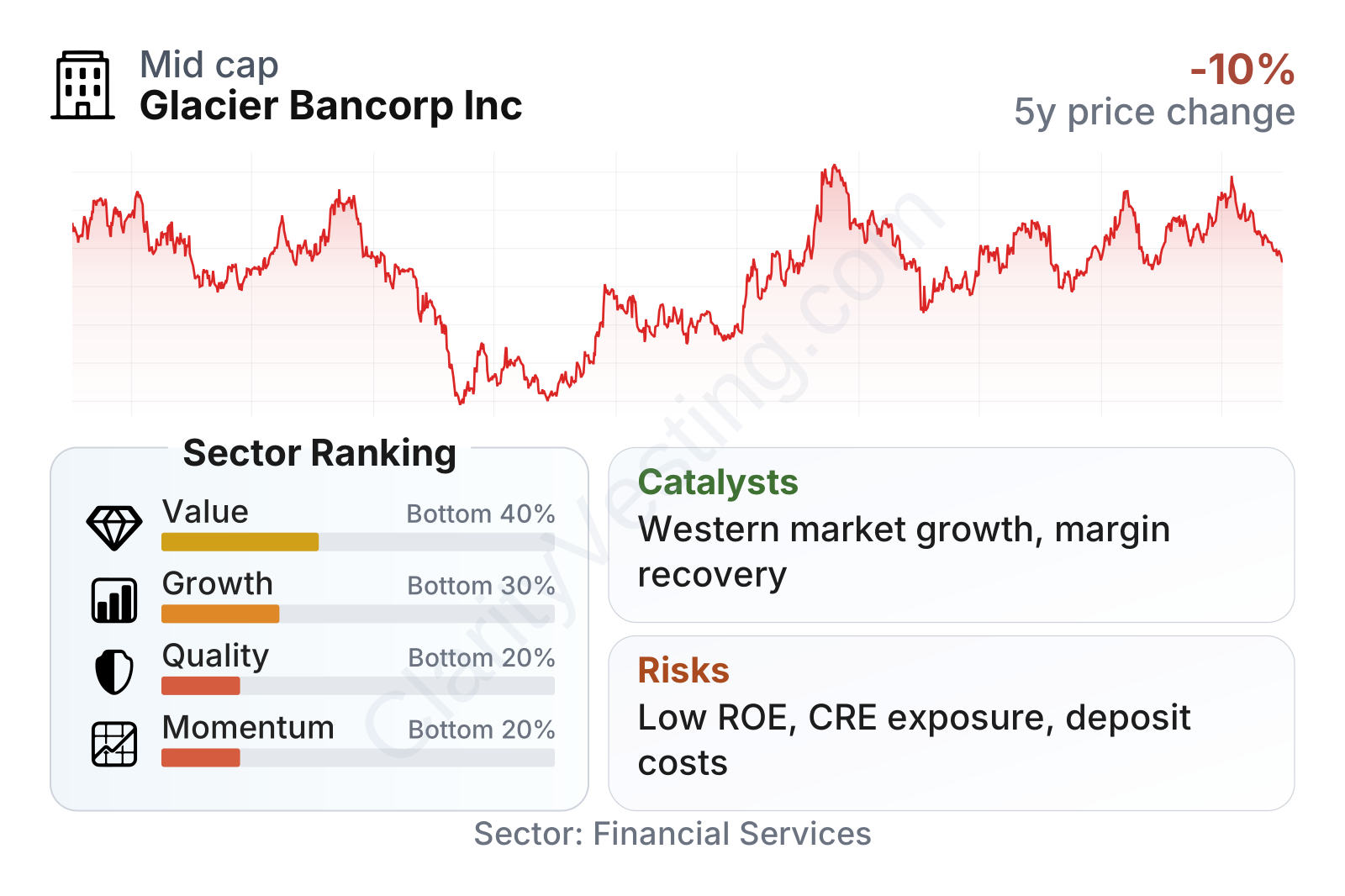
Glacier sits in the mid-sized range among regional banks and has a relatively low beta, which suggests the shares have historically moved less aggressively than the broader market. The current metric mix is more mixed than strong: valuation is not especially cheap versus the sector, growth ranks weak on a multi-year basis despite a recent rebound in revenue, and quality measures remain below many peers. The dividend yield is roughly in line with the sector, while profitability margins are decent but not enough to offset weaker returns on equity and assets.
The stock price history shows a sharp drop during the regional banking stress period in 2023, followed by a substantial recovery through 2024, 2025, and into 2026. Even so, the recovery has come with uneven momentum rather than a clean rerating.
Growth
Glacier operates in a sector that should continue to matter for the long run: local and regional banking remains essential for small businesses, commercial real estate borrowers, professionals, and households that prefer relationship-based banking. That said, banking is not a high-growth industry in the way software or semiconductors can be. Growth tends to come from gaining deposits, expanding loan balances, improving margins, and making acquisitions at sensible prices.
Glacier’s strategy is coherent for that environment. The company has long emphasized community banking in attractive Western markets with population growth that has often outpaced the national average. Those states can offer favorable demographic support, including business formation, migration, housing demand, and infrastructure development. This geographic focus is one of the clearest reasons the franchise can keep expanding over time even if the broader banking sector grows slowly.
A second growth lever is acquisition capacity. Glacier has historically used bank acquisitions to enter adjacent markets and scale existing ones. For a regional bank, this can be an efficient way to add deposits, customers, and local talent. If industry consolidation continues, Glacier could remain an active participant, especially because community banking remains fragmented across its footprint.
Earnings per share show why the market has been cautious. Profitability weakened from 2021 through 2024 as deposit costs and funding pressure rose, then improved in 2025. That pattern points more to recovery potential than to a steady compounding trend. For long-term analysis, that distinction matters: the business still needs to prove it can convert revenue growth into stronger and more consistent earnings growth.
Book value per share has recovered after the pressure that followed the rate shock period. For banks, book value is an important anchor because it reflects the capital base supporting lending and deposit operations. Glacier’s rebound here is constructive, especially because it suggests balance sheet resilience after a difficult industry stretch, but the five-year growth rate remains modest compared with many peers.
A practical catalyst for future growth would be a more favorable interest-rate environment. If deposit competition eases faster than asset yields decline, the bank’s net interest margin could improve. Another potential tailwind is continued population and business migration into the Mountain West and nearby states, which can support loan demand, new branches, and deposit gathering. Recent company updates have also pointed to ongoing balance sheet management and loan growth efforts rather than a major strategic reset, which suggests the current path is focused on execution rather than reinvention.
Risks
This article is for informational purposes only and does not constitute financial advice. Some content is AI-generated. See Disclaimer