Stock Analysis · GATX Corporation (GATX)
Overview
GATX Corporation is a long-established asset leasing company focused mainly on transportation equipment. Its core business is owning railcars and locomotives and leasing them to customers that need freight capacity without buying the equipment outright. That makes GATX less like a manufacturer and more like a specialized landlord for rail assets. The company also has an aircraft spare engine leasing business through Engine Leasing and other smaller investment activities.
Its business model is built on long-lived assets, recurring lease income, and redeployment of equipment across customers and cycles. This can create durable revenue streams when fleet utilization is strong, but it also requires large upfront capital spending and significant borrowing.
Based on recent annual reporting, GATX’s revenue mix is concentrated in rail, with a much smaller contribution from aviation and other activities.
- Rail North America: approximately 60% to 70% of revenue. This is the largest business and includes leasing railcars to shippers, railroads, and industrial customers across commodity categories.
- Rail International: approximately 15% to 25% of revenue. This includes railcar leasing operations and investments in Europe, India, and other international markets.
- Engine Leasing: approximately 10% to 15% of revenue. This business leases spare aircraft engines, mainly to airlines and aviation customers that need backup capacity during maintenance cycles.
- Other: usually a small single-digit share of revenue, including portfolio management and other asset-related activities.
That concentration matters. GATX is primarily a rail leasing company, and the long-term case depends largely on freight rail demand, lease pricing, fleet utilization, and the company’s ability to keep placing capital into attractive rail assets.
The profit flow over the last several years shows a business that has expanded revenue steadily and lifted net income, but interest expense has also climbed meaningfully as the company has funded growth with more debt. Operating profitability remains solid, yet financing costs take a large share of that operating income.
Key Figures
| Metric | Value | Sector ⓘ |
|---|---|---|
| Date | Oct 24, 2026 | |
| Context | ||
| Sector | Industrials | |
| Industry | Rental & Leasing Services | |
| Market Cap ⓘ | $5.71B | |
| Beta ⓘ | 1.20 | |
Value (Cheapness) | ||
| P/E Ratio ⓘ | 16.01 | 22.29 |
| P/B Ratio ⓘ | 2.11 | 1.98 |
| FCF Yield ⓘ | -82.13% | 6.26% |
| Dividend Yield ⓘ | 1.55% | 1.92% |
| EBIT / EV ⓘ | 2.60% | 4.83% |
| PEG ⓘ | 0.64 | |
Growth (Business expansion) | ||
| Revenue Growth ⓘ | 34.80% | 9.30% |
| RPS Growth (5Y CAGR) ⓘ | 8.62% | 7.76% |
| EPS Growth (5Y CAGR) ⓘ | -4.09% | -13.17% |
| BVPS Growth (5Y CAGR) ⓘ | -1.82% | 6.13% |
| Margin Growth (5Y Trend) ⓘ | 15.25% | 0.74% |
| FCF Growth (5Y CAGR) ⓘ | N/A | 10.79% |
| DPS Growth (5Y CAGR) ⓘ | 5.00% | 9.41% |
Quality (Business durability) | ||
| ROIC (Latest) ⓘ | N/A | 10.75% |
| ROA (Latest) ⓘ | 2.37% | 5.41% |
| ROIC (5Y Median) ⓘ | 4.89% | 9.37% |
| ROA (5Y Median) ⓘ | 2.18% | 4.95% |
| Net Debt / EBIT (Latest) ⓘ | 24.72 | 2.04 |
| Net Debt / EBIT (5Y Median) ⓘ | 13.29 | 2.27 |
| Net Debt / EBITDA (Latest) ⓘ | 11.20 | 1.39 |
| Net Debt / Assets ⓘ | 66.19% | 19.27% |
| EBITDA / Interest ⓘ | 1.20 | 9.58 |
| Operating Margin (Latest) ⓘ | 23.13% | 10.49% |
| Operating Margin (5Y Median) ⓘ | 37.99% | 10.30% |
| Debt to Equity (Latest) ⓘ | 448.11% | 64.82% |
| Profit Margin (Latest) ⓘ | 17.94% | 6.67% |
| Free Cash Flow (Latest) ⓘ | -$4.69B | |
Momentum (Price trend) | ||
| 3Y Return ⓘ | +62.05% | +67.77% |
| 12M Return (excl. last month) ⓘ | +6.40% | +12.05% |
| 6M Return ⓘ | -17.27% | 0.00% |
| Price vs. 200-Day MA ⓘ | -7.76% | +0.67% |
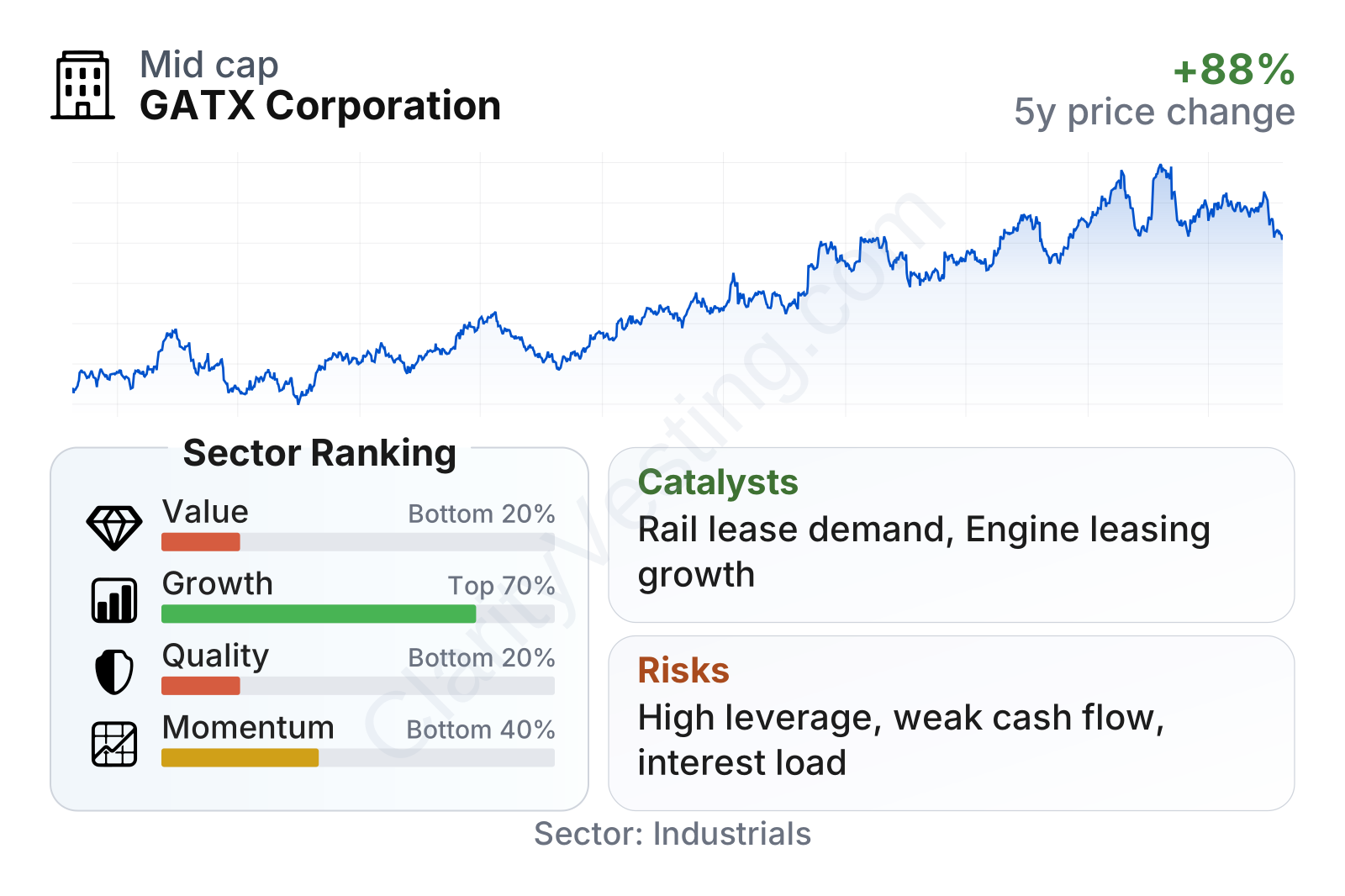
GATX is a mid-sized industrial company with a market value around the mid-single-digit billions of dollars. The stock has delivered a strong multiyear rise, although recent momentum has been more moderate. In the factor breakdown, growth looks better than many sector peers, helped by strong recent revenue gains and improving margin trends. By contrast, quality and value rank weaker, largely because the balance sheet is heavily leveraged and free cash flow is deeply negative during an aggressive investment phase. Profitability itself is stronger than the sector median, but that strength is offset by debt metrics that are far more stretched than most industrial companies.
Growth
GATX operates in a sector with steady long-term relevance rather than explosive expansion. Rail remains one of the most efficient ways to move bulk freight over land, and leasing is attractive because customers often prefer flexibility over owning large fleets outright. That gives GATX exposure to enduring infrastructure demand rather than fast-changing consumer trends.
The company’s strategy for growth is straightforward: keep investing in rail assets where lease demand and pricing are favorable, maintain high fleet utilization, and expand selectively in adjacent areas such as aircraft spare engines. This approach makes strategic sense because scale matters in leasing. A larger fleet improves customer reach, remarketing options, maintenance economics, and purchasing power.
Recent top-line growth has been notably strong. Revenue growth had already improved into the low-double-digit range through 2023 to 2025, and the latest year-over-year pace moved sharply higher into roughly the mid-30% range. That is well above the broader sector median. For a company in a mature industry, that kind of acceleration stands out and suggests that fleet expansion, favorable lease rates, and contributions from newer investments are currently working together.
The tradeoff is visible in cash generation. Free cash flow has been negative for several years and has become much more negative recently. For an asset-heavy lessor, that does not automatically signal business weakness because fleet purchases and portfolio growth consume large amounts of cash upfront while earnings arrive over long lease periods. Still, it shows that current growth is capital intensive and dependent on continued access to financing.
One of the clearest catalysts is persistent demand for railcar leasing in North America and internationally, especially if replacement needs, industrial activity, and tight equipment availability support lease rates. Another is the aircraft engine leasing business, where global air traffic and maintenance requirements can create attractive niche demand for spare engines. If GATX continues placing new investments at returns above its cost of capital, growth can remain durable even without a high-growth end market.
Recent company updates have also pointed to continued investment activity and a healthy lease environment in core rail markets. For long-term analysis, that is more important than short-term stock moves: GATX’s future depends on whether the current asset deployment cycle produces sustained earnings growth after the heavy spending phase.
Risks
This article is for informational purposes only and does not constitute financial advice. Some content is AI-generated. See Disclaimer


