Stock Analysis · Golden Agri-Resources (GARPY)
Overview
Golden Agri-Resources is a large palm oil group with operations spanning the full chain from plantations to processing, refining, branded edible oils, and global trading. The company is part of the broader agribusiness network linked to the Sinar Mas group and is headquartered in Singapore. Its business is heavily tied to palm-based products used in cooking oil, food manufacturing, oleochemicals, and biofuel feedstocks.
For long-term analysis, the important point is that this is not just a plantation owner. Golden Agri-Resources combines upstream activities, such as cultivating oil palm and producing crude palm oil and palm kernel, with downstream activities that refine and distribute finished products. That broader structure can reduce some volatility compared with a pure commodity producer, although earnings still move with palm oil prices, input costs, and regulation.
The latest annual disclosures indicate that revenue is primarily generated by palm and lauric-based downstream products, with a smaller contribution from plantation and palm product processing. Approximate revenue mix is as follows:
- Downstream products and trading: about 85% to 90% — refined palm products, cooking oils, margarine, shortening, oleochemicals inputs, and international merchandising activities.
- Plantation and palm product processing: about 10% to 15% — fresh fruit bunches, crude palm oil, palm kernel, and related mill output from the company’s plantation base.
This mix matters because it shows Golden Agri-Resources is much more exposed to processing and distribution volume than many readers may expect from a palm oil name. That can support revenue scale, but downstream operations often carry thinner margins than upstream production.
The multi-year financial flow also shows a business with large sales volume, high cost of goods sold, and modest final profit retention. Revenue recovered strongly after the 2023 downturn and reached a new high in 2025, while net income improved from 2023 lows but remained well below the peak seen during the exceptionally strong 2022 commodity cycle. In simple terms, the company has regained scale faster than profitability.
Key Figures
| Metric | Value | Sector ⓘ |
|---|---|---|
| Date | Oct 17, 2026 | |
| Context | ||
| Sector | Consumer Defensive | |
| Industry | Farm Products | |
| Market Cap ⓘ | $3.04B | |
| Beta ⓘ | -0.06 | |
Value (Cheapness) | ||
| P/E Ratio ⓘ | 7.48 | 17.88 |
| P/B Ratio ⓘ | 0.59 | 1.29 |
| FCF Yield ⓘ | 17.21% | 12.39% |
| Dividend Yield ⓘ | 3.09% | 2.85% |
| EBIT / EV ⓘ | 17.73% | 6.43% |
| PEG ⓘ | 46.78 | |
Growth (Business expansion) | ||
| Revenue Growth ⓘ | 8.20% | 4.10% |
| RPS Growth (5Y CAGR) ⓘ | 6.22% | 6.18% |
| EPS Growth (5Y CAGR) ⓘ | 39.59% | -13.59% |
| BVPS Growth (5Y CAGR) ⓘ | 2.22% | 3.20% |
| Margin Growth (5Y Trend) ⓘ | -1.55% | -0.15% |
| FCF Growth (5Y CAGR) ⓘ | 19.86% | 4.10% |
| DPS Growth (5Y CAGR) ⓘ | -9.03% | 6.79% |
Quality (Business durability) | ||
| ROIC (Latest) ⓘ | N/A | 12.34% |
| ROA (Latest) ⓘ | N/A | 6.30% |
| ROIC (5Y Median) ⓘ | 7.04% | 10.49% |
| ROA (5Y Median) ⓘ | 3.75% | 5.44% |
| Net Debt / EBIT (Latest) ⓘ | 3.10 | 1.96 |
| Net Debt / EBIT (5Y Median) ⓘ | 3.09 | 2.35 |
| Net Debt / EBITDA (Latest) ⓘ | 2.30 | 1.38 |
| Net Debt / Assets ⓘ | 27.17% | 21.51% |
| EBITDA / Interest ⓘ | N/A | 9.46 |
| Operating Margin (Latest) ⓘ | 7.48% | 8.87% |
| Operating Margin (5Y Median) ⓘ | 7.28% | 9.53% |
| Debt to Equity (Latest) ⓘ | 64.35% | 72.35% |
| Profit Margin (Latest) ⓘ | 3.04% | 5.40% |
| Free Cash Flow (Latest) ⓘ | $523.82M | |
Momentum (Price trend) | ||
| 3Y Return ⓘ | +31.20% | +20.92% |
| 12M Return (excl. last month) ⓘ | +7.26% | +2.13% |
| 6M Return ⓘ | +1.52% | +1.26% |
| Price vs. 200-Day MA ⓘ | +8.88% | +1.39% |
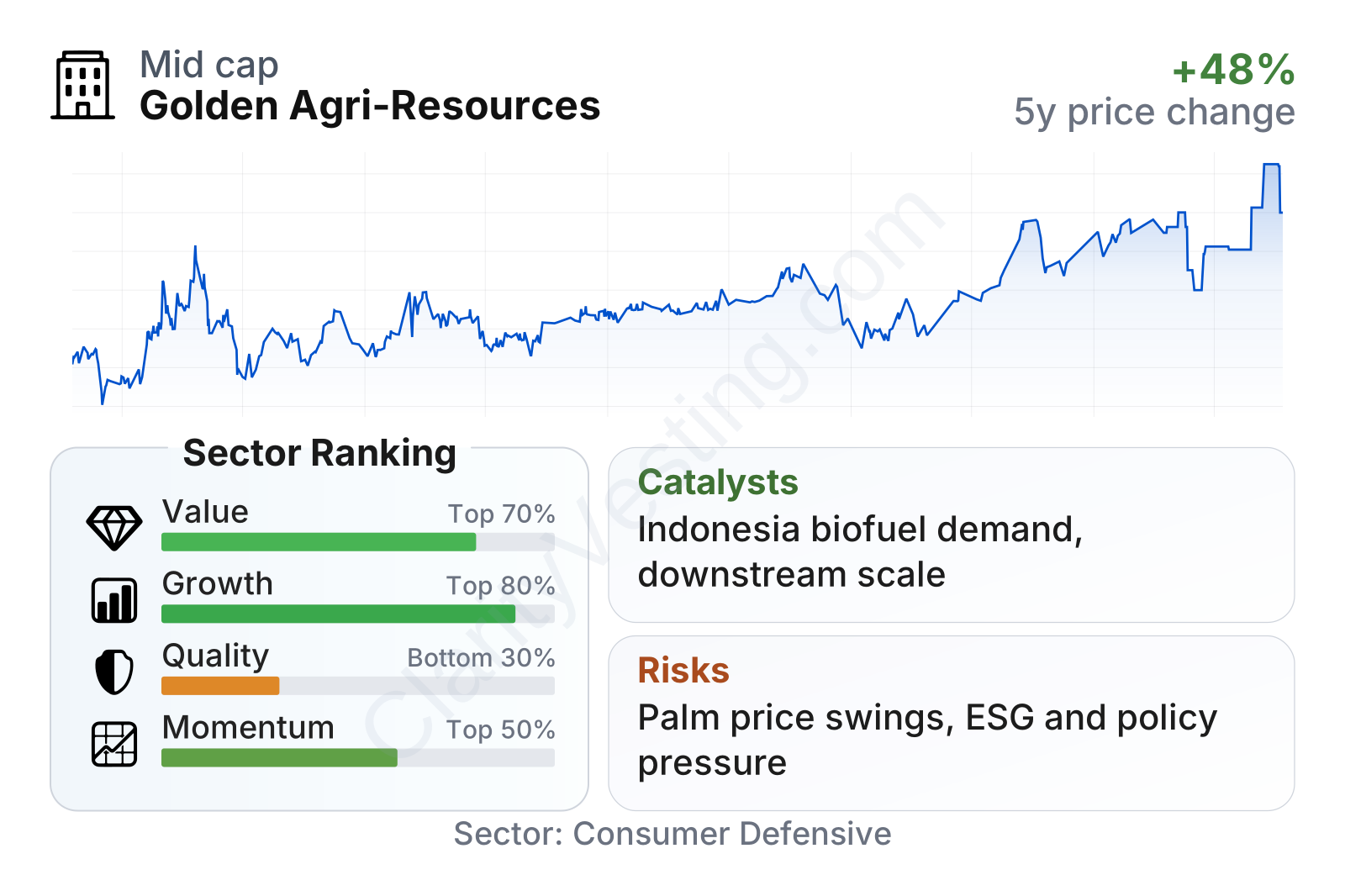
Golden Agri-Resources is a mid-sized public company by market value, and its recent metrics show a mixed but understandable profile. On valuation, the shares screen below sector medians on both earnings and book value, while free cash flow yield and EBIT relative to enterprise value look stronger than many peers. Growth indicators are better than the sector in several areas, especially recent revenue growth and five-year free cash flow expansion. However, quality metrics are weaker: profitability is below sector medians, leverage is meaningful, and margins remain relatively thin for a business that handles large commodity volumes.
Price performance has been solid over the last three years and stronger than the broader sector, which suggests the market has recognized the earnings recovery and firmer operating backdrop. Even so, the current profile still looks more like a cyclical agribusiness with improving momentum than a consistently high-return compounder.
Growth
Golden Agri-Resources operates in a sector with long-term structural demand. Palm oil remains one of the world’s most widely used vegetable oils because of its cost efficiency and broad applications across food, household goods, and industrial uses. Demand growth in emerging markets, ongoing food consumption trends, and biofuel blending programs in countries such as Indonesia provide a supportive backdrop for the industry over time.
The company’s strategy broadly makes sense for future growth because it is integrated across the value chain. A fully integrated model can help secure raw material supply, improve utilization of refining assets, and capture demand from both domestic and export markets. Golden Agri-Resources has also emphasized traceability, sustainability compliance, and downstream development, which are increasingly important as buyers in Europe and other markets impose stricter sourcing requirements.
A meaningful catalyst is the company’s exposure to Indonesia’s domestic downstream ecosystem. Policies encouraging local refining and biofuel consumption can support demand for processed palm products. Another positive factor is operational leverage: when palm oil prices, volumes, and mill utilization improve together, earnings can recover faster than revenue. The sharp improvement in free cash flow over five years and the rebound from the weak 2023 period show that this operating model still has earnings power when conditions are favorable.
Recent company communications have also continued to highlight sustainability progress, responsible sourcing, and supply chain traceability. That may sound secondary, but it is strategically important because access to premium export markets increasingly depends on verified compliance rather than just low-cost production. In this industry, better compliance can become a competitive advantage as regulation tightens.
Risks
This article is for informational purposes only and does not constitute financial advice. Some content is AI-generated. See Disclaimer


