Stock Analysis · Golden Agri-Resources Ltd (GARPF)
Overview
Golden Agri-Resources Ltd is a large palm oil company headquartered in Singapore with plantation operations mainly in Indonesia. Its business stretches from growing oil palm trees and processing fresh fruit bunches into crude palm oil and palm kernel products, to refining, making consumer and industrial food ingredients, and distributing those products in multiple markets. In simple terms, it is an integrated agricultural and edible oils group: it produces the raw commodity, processes it further, and sells both bulk and value-added products.
The company’s revenue is mainly tied to palm-based products, with downstream processing and merchandising usually contributing the largest share of sales because refined products and traded volumes are high, while plantation operations tend to contribute a smaller share of revenue but can matter more for margins when commodity prices are favorable. Based on the company’s recent annual reporting structure, the main sources of revenue can be summarized as follows:
- Downstream products and trading: approximately 70% to 85% of revenue. This includes refined palm oil products, edible oils, oleochemicals, specialty fats, biodiesel-related sales, and merchandising or distribution activities.
- Plantation and palm processing: approximately 15% to 30% of revenue. This covers cultivation, harvesting, and milling activities, including crude palm oil and palm kernel output from its estates and mills.
That mix means Golden Agri is not simply a land owner benefiting from crop prices. It also relies heavily on processing and distribution, which can support volume growth and customer relationships, but also keeps the business exposed to thinner margins and working-capital needs.
Over the last five reported years, revenue moved from roughly $10.2 billion in 2021 to nearly $13.0 billion in 2025, but profitability was much more volatile. Net income climbed strongly in 2022, dropped sharply in 2023, then recovered partly in 2024 and 2025. This pattern is typical for commodity-linked agribusinesses: sales can remain large while earnings swing with palm oil prices, export policies, financing costs, and processing spreads.
The business flow shows a company with very high production and sourcing costs relative to sales, which is normal in edible oils, but it also highlights how sensitive profit is to margin changes. Revenue rebounded well by 2025, while net income recovered more slowly, suggesting that scale alone does not guarantee strong bottom-line improvement.
Key Figures
| Metric | Value | Sector ⓘ |
|---|---|---|
| Date | Oct 03, 2026 | |
| Context | ||
| Sector | Consumer Defensive | |
| Industry | Farm Products | |
| Market Cap ⓘ | $3.30B | |
| Beta ⓘ | -0.06 | |
Value (Cheapness) | ||
| P/E Ratio ⓘ | 8.67 | 18.16 |
| P/B Ratio ⓘ | 0.64 | 1.27 |
| FCF Yield ⓘ | 15.97% | 12.39% |
| Dividend Yield ⓘ | 2.69% | 2.83% |
| EBIT / EV ⓘ | 17.72% | 6.45% |
| PEG ⓘ | 47.67 | |
Growth (Business expansion) | ||
| Revenue Growth ⓘ | 8.20% | 3.80% |
| RPS Growth (5Y CAGR) ⓘ | 6.22% | 6.20% |
| EPS Growth (5Y CAGR) ⓘ | 27.68% | -14.64% |
| BVPS Growth (5Y CAGR) ⓘ | 2.22% | 3.26% |
| Margin Growth (5Y Trend) ⓘ | -1.52% | -0.25% |
| FCF Growth (5Y CAGR) ⓘ | 19.86% | 4.65% |
| DPS Growth (5Y CAGR) ⓘ | -9.03% | 6.86% |
Quality (Business durability) | ||
| ROIC (Latest) ⓘ | N/A | 12.58% |
| ROA (Latest) ⓘ | N/A | 6.35% |
| ROIC (5Y Median) ⓘ | 6.78% | 10.36% |
| ROA (5Y Median) ⓘ | 3.75% | 5.44% |
| Net Debt / EBIT (Latest) ⓘ | 3.10 | 1.91 |
| Net Debt / EBIT (5Y Median) ⓘ | 3.09 | 2.32 |
| Net Debt / EBITDA (Latest) ⓘ | 2.30 | 1.36 |
| Net Debt / Assets ⓘ | 27.17% | 21.25% |
| EBITDA / Interest ⓘ | N/A | 9.61 |
| Operating Margin (Latest) ⓘ | 7.48% | 8.96% |
| Operating Margin (5Y Median) ⓘ | 7.00% | 9.53% |
| Debt to Equity (Latest) ⓘ | 64.35% | 71.66% |
| Profit Margin (Latest) ⓘ | 3.04% | 5.40% |
| Free Cash Flow (Latest) ⓘ | $526.70M | |
Momentum (Price trend) | ||
| 3Y Return ⓘ | +58.05% | +15.25% |
| 12M Return (excl. last month) ⓘ | +23.40% | +2.63% |
| 6M Return ⓘ | +31.78% | +2.43% |
| Price vs. 200-Day MA ⓘ | +25.39% | +0.43% |
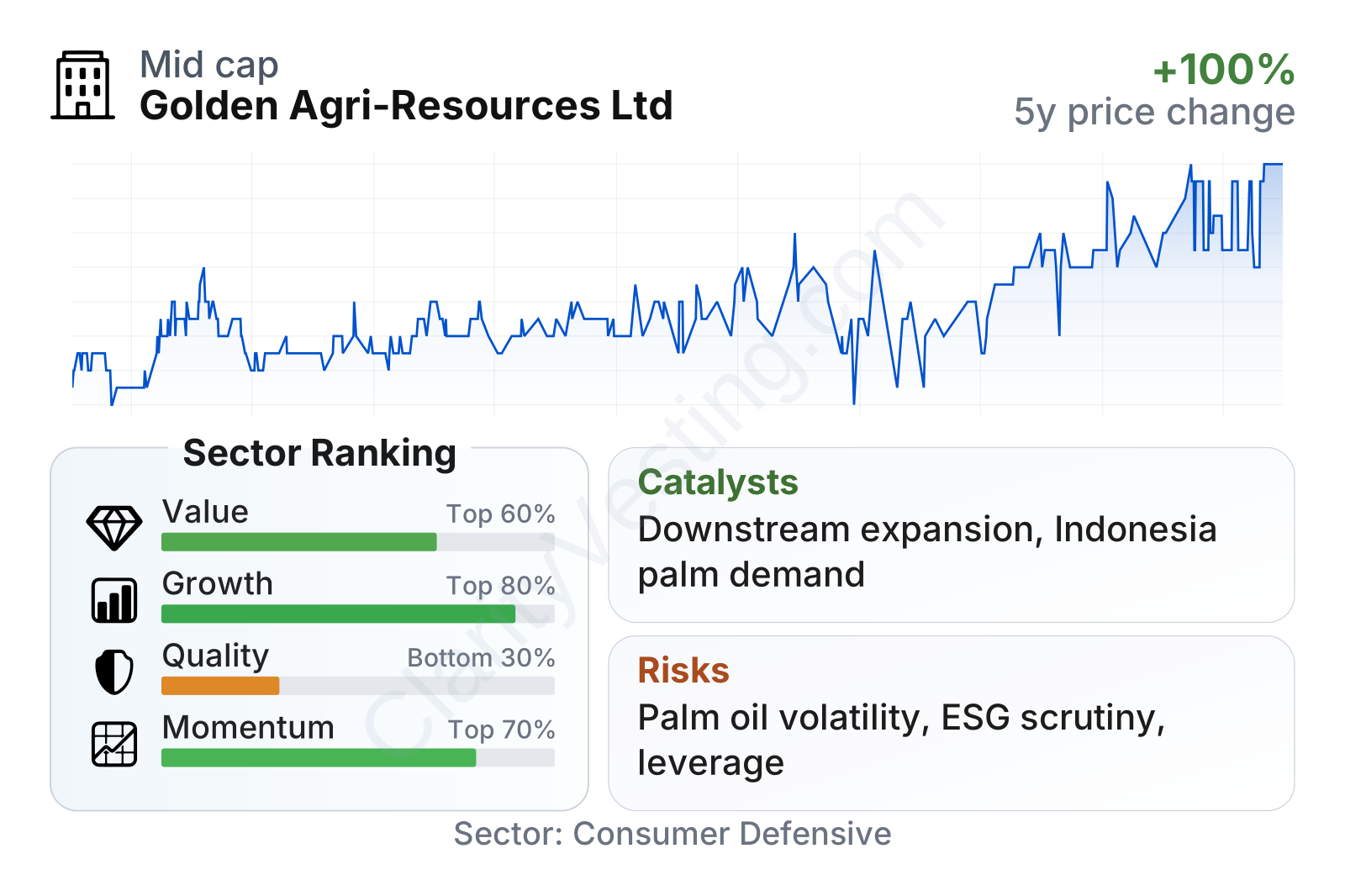
Golden Agri sits in the mid-cap range and has recently shown stronger share-price momentum than much of its sector. On valuation, several measures look low versus sector norms, including earnings and book value multiples, while free cash flow generation appears solid relative to its size. Growth metrics are generally better than the sector median, especially over a multi-year earnings and cash flow view. The weaker area is business quality: returns on capital and assets trail many peers, and leverage measured against operating profit remains elevated even if debt-to-equity itself is not extreme for the industry.
Growth
Palm oil remains a large and strategically important global crop because it is widely used in food, personal care products, oleochemicals, and energy-related applications. It is one of the most productive vegetable oils per hectare, which helps preserve long-term demand despite regulatory and sustainability pressures. That gives Golden Agri exposure to a sector with structural relevance, especially in Asia, where edible oil consumption and processed food demand continue to expand.
The company’s strategy also has a practical logic for future growth. By combining plantations with refining, specialty ingredients, and distribution, Golden Agri can capture value across more stages of the chain than a pure upstream producer. This integrated model can improve resilience when raw commodity prices weaken, because downstream volumes may still move even if plantation margins soften. It also gives the company a platform to supply food manufacturers and consumer markets more directly rather than depending only on bulk commodity sales.
Recent growth indicators are constructive. Revenue growth has been running above the sector median, and the longer-term growth profile in earnings and free cash flow is notably stronger than many farm-product peers. The bigger point, though, is that growth quality matters here: expansion in processing, refining, and specialty products is usually more strategically valuable than simple exposure to rising crude palm oil prices.
A meaningful catalyst is Indonesia’s role in global palm oil supply. Golden Agri operates at scale in the world’s most important palm oil producing country, so any favorable combination of strong export demand, stable domestic policy, and firmer palm oil pricing can lift results quickly. Another catalyst is the ongoing need for traceable and more sustainably sourced palm oil among multinational customers. Large integrated groups with established supply chains, certification efforts, and downstream capabilities are generally better positioned to capture that demand than smaller producers.
Recent company communication has also pointed to continued focus on downstream expansion, operational efficiency, and sustainability commitments. None of these removes cyclicality, but they do support the case that Golden Agri is trying to move beyond a pure commodity profile toward a broader edible oils platform.
Risks
This article is for informational purposes only and does not constitute financial advice. Some content is AI-generated. See Disclaimer