Stock Analysis · Gamma Communications plc (GAMCF)
Overview
Gamma Communications plc is a U.K.-based business communications provider focused on cloud telephony, unified communications, connectivity, mobile, and related managed services. In simple terms, it helps businesses run their phone systems, internet connections, mobile fleets, customer contact tools, and parts of their digital communications through subscription-based services. Its customer base is mainly business and public-sector organizations, with distribution split between direct sales and a broad network of channel partners.
The business model is attractive for long-term analysis because much of its revenue is recurring. Customers usually sign up for ongoing services rather than one-time product purchases, which can make revenue more stable than in hardware-heavy telecom models. Gamma has also expanded through acquisitions and by broadening its software and cloud capabilities, especially in unified communications and customer engagement tools.
Based on recent annual reporting, revenue is mainly generated from services rather than equipment, with a strong weighting toward U.K. operations and a growing contribution from Europe. Exact product-level percentages are not always broken out in a way that allows a precise ranking across every line, but the broad picture is clear:
- Cloud communications and unified communications services – the largest contributor, including hosted telephony, Microsoft Teams-related voice solutions, SIP trunking, PBX replacement, and collaboration services.
- Connectivity services – a major revenue stream, including broadband, leased lines, wide-area networking, and related network services for business customers.
- Mobile services – business mobile subscriptions, airtime, and managed mobile offerings.
- Customer contact and software solutions – contact center, customer experience tools, and communication software capabilities, an area that has become more important as Gamma adds software-led products.
- Equipment and other non-recurring items – typically a smaller share, including handsets and installation-related activity.
Geographically, the U.K. remains the core market, but continental Europe has become a more meaningful part of the group following acquisitions. That matters because it gives Gamma a wider addressable market while still staying close to its core capability: business communications infrastructure delivered as a service.
The financial flow over the last several years shows a business that has steadily increased revenue from roughly £448 million in 2021 to about £646 million in 2025. Profitability has also remained solid, although 2025 appears to show some pressure from higher costs and interest expense compared with the very strong 2024 outcome.
The trend above suggests that Gamma has been able to expand sales while preserving a healthy gross profit base. Operating profit has grown meaningfully since 2021, even if the most recent year shows that scaling up through expansion and acquisitions can bring some cost friction.
Key Figures
| Metric | Value | Sector ⓘ |
|---|---|---|
| Date | Oct 03, 2026 | |
| Context | ||
| Sector | Communication Services | |
| Industry | Telecom Services | |
| Market Cap ⓘ | $1.35B | |
| Beta ⓘ | 0.91 | |
Value (Cheapness) | ||
| P/E Ratio ⓘ | 15.14 | 18.20 |
| FCF Yield ⓘ | 12.54% | 14.71% |
| Dividend Yield ⓘ | 0.98% | 2.86% |
| EBIT / EV ⓘ | N/A | 4.85% |
| PEG ⓘ | N/A | |
Growth (Business expansion) | ||
| Revenue Growth ⓘ | 4.20% | 5.50% |
| RPS Growth (5Y CAGR) ⓘ | 10.56% | 4.55% |
| EPS Growth (5Y CAGR) ⓘ | -6.74% | -18.01% |
| Margin Growth (5Y Trend) ⓘ | -0.73% | 1.32% |
| FCF Growth (5Y CAGR) ⓘ | 8.73% | 5.96% |
| DPS Growth (5Y CAGR) ⓘ | 13.73% | 5.09% |
Quality (Business durability) | ||
| ROIC (Latest) ⓘ | 38.32% | 8.64% |
| ROIC (5Y Median) ⓘ | 18.36% | 8.11% |
| Net Debt / EBIT (Latest) ⓘ | 0.10 | 1.92 |
| Net Debt / EBIT (5Y Median) ⓘ | -1.23 | 2.85 |
| Net Debt / EBITDA (Latest) ⓘ | 0.07 | 1.25 |
| Net Debt / Assets ⓘ | 3.22% | 18.77% |
| EBITDA / Interest ⓘ | 30.32 | 8.75 |
| Operating Margin (Latest) ⓘ | 15.52% | 15.58% |
| Operating Margin (5Y Median) ⓘ | 14.53% | 13.53% |
| Debt to Equity (Latest) ⓘ | 11.50% | 59.53% |
| Profit Margin (Latest) ⓘ | 10.50% | 8.78% |
| Free Cash Flow (Latest) ⓘ | $169.22M | |
Momentum (Price trend) | ||
| 3Y Return ⓘ | +21.65% | +43.39% |
| 12M Return (excl. last month) ⓘ | +17.92% | +1.92% |
| 6M Return ⓘ | +17.02% | +2.94% |
| Price vs. 200-Day MA ⓘ | +14.16% | +0.74% |
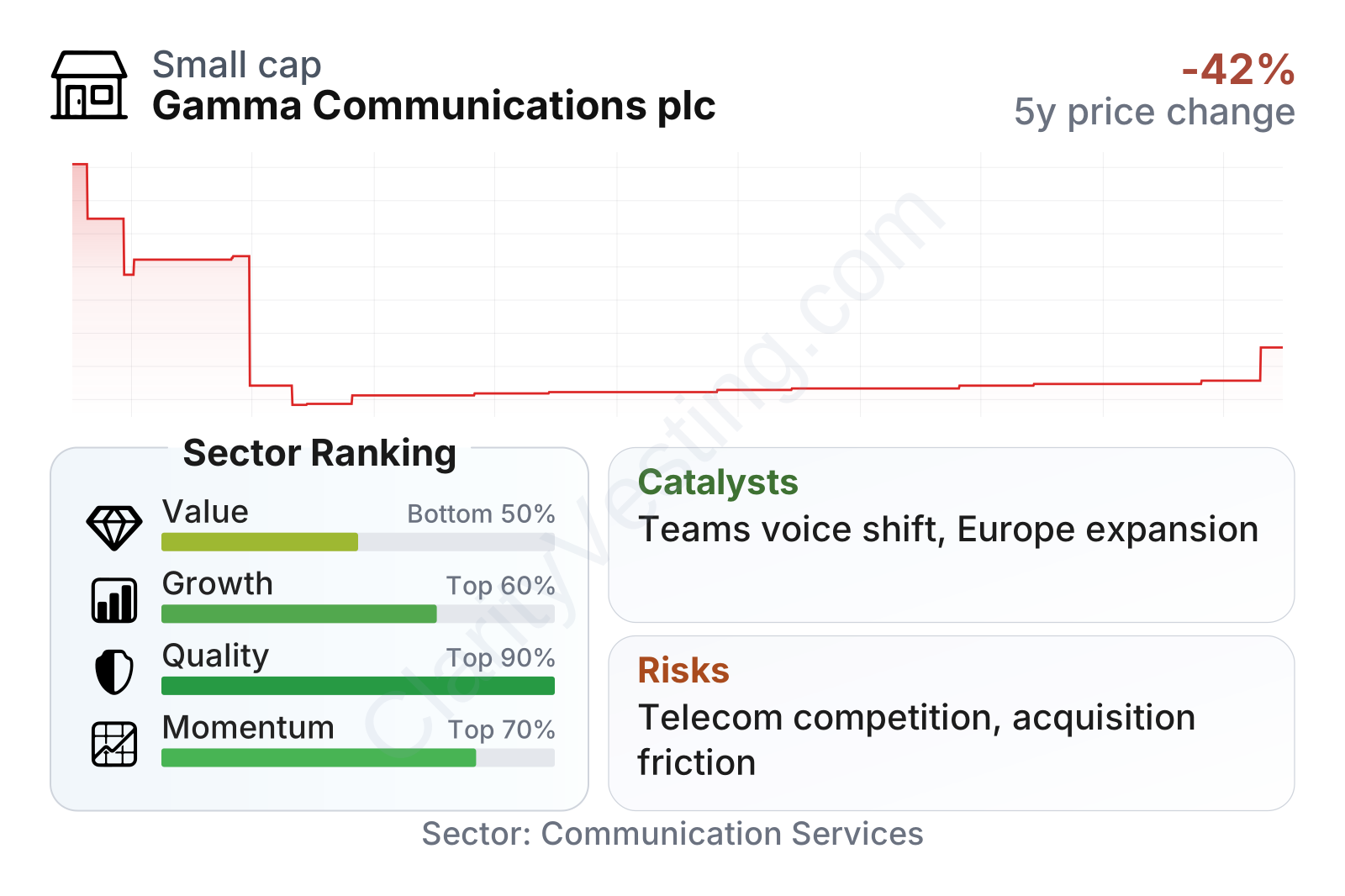
Gamma sits in the mid-cap range, with a share price history that looks very different from many faster-moving technology names. After a sharp derating in 2022, the stock has spent a long period rebuilding rather than surging. More recently, price momentum has improved, with returns over the last 6 to 12 months stronger than the sector median, even though the 3-year return still trails many peers.
The most notable feature in the metrics table is quality. Gamma ranks in the top 10% of its sector on that factor, supported by high returns on invested capital, low leverage, solid margins, and strong interest coverage. Return on invested capital is particularly strong, far above the sector median, which usually points to a business with either efficient operations, favorable market positioning, or both.
Growth is more mixed but still respectable. Recent year-over-year revenue growth is positive, though a bit below the sector median, while the 5-year growth in revenue per share and free cash flow is clearly stronger than the median. Earnings growth over five years has been negative, but still much better than the sector median, suggesting Gamma has handled a difficult industry period better than many peers.
Valuation looks moderate rather than aggressive. The earnings multiple is below the sector median, but the free cash flow yield is also slightly less favorable than the median. In plain language, the market is not putting an extreme premium on the company, yet it is also recognizing that Gamma is a higher-quality business than a typical telecom name.
Growth
Gamma operates in a part of the communications market that still has room to grow because businesses continue shifting from legacy phone systems to cloud-based communications, integrated collaboration platforms, software-led customer contact tools, and managed connectivity. This is not a brand-new market, but it remains a durable one because communication systems are essential, sticky, and increasingly software-driven.
The company’s strategy appears coherent for that backdrop. Gamma has built around recurring business communications services, added software and cloud layers, and used acquisitions to extend both capabilities and geography. That is a sensible path in a market where customers often prefer bundled providers that can handle voice, connectivity, mobile, and contact solutions together.
Over the longer term, revenue expansion has been steady. Sales have moved up materially since 2021, and the 5-year revenue-per-share growth rate is well above the sector median. Free cash flow has also compounded at a healthy pace. Those are encouraging signs because they suggest growth has not depended only on accounting profits; cash generation has followed.
One meaningful catalyst is Gamma’s position around Microsoft Teams telephony and broader unified communications migration. Many organizations are still modernizing communications systems, and Gamma is one of the providers helping customers connect cloud telephony into the software environments they already use. Another catalyst is cross-selling: a business customer that starts with connectivity can later add mobile, cloud voice, and contact center tools, which can lift revenue per customer without the same customer acquisition cost as winning a new account from scratch.
Its European expansion is another area to watch. If Gamma can replicate its U.K. model across a wider footprint while keeping service quality and disciplined integration, the addressable market becomes larger without a complete change to the operating model. Recent company communications have also emphasized continued investment in cloud communications, customer experience offerings, and partner channels, which supports the idea that growth is expected to come from both product depth and distribution reach.
Risks
This article is for informational purposes only and does not constitute financial advice. Some content is AI-generated. See Disclaimer


