Stock Analysis · German American Bancorp Inc (GABC)
Overview
German American Bancorp is a regional bank based in the Midwest. Through its main banking subsidiary, German American Bank, the company provides traditional community banking services such as taking deposits, making loans, managing payments, and offering wealth management products. Its branch network is concentrated in Indiana and neighboring Kentucky, giving it a local-market focus rather than a nationwide footprint.
Like most regional banks, German American earns most of its money from the spread between what it collects on loans and securities and what it pays on deposits and other funding. It also generates fee income from services that do not depend directly on interest rates.
The main revenue sources are approximately:
- Net interest income: about 75% to 85% of total revenue in a typical recent year. This is the core banking engine and includes income from commercial loans, residential mortgages, agricultural lending, consumer lending, and the securities portfolio, minus interest paid on deposits and borrowings.
- Wealth advisory and trust fees: about 5% to 10%. This includes investment management, trust administration, brokerage-related services, and retirement-plan related activity.
- Service charges and card-related fees: about 5% to 10%. This includes deposit account fees, interchange income from debit and card activity, ATM-related fees, and treasury management services.
- Mortgage banking, insurance, and other noninterest income: about 3% to 8%. This category can include gains on loan sales, insurance-related commissions where applicable, and other miscellaneous banking fees.
The business mix is fairly straightforward: gathering deposits locally, lending within its communities, and adding fee businesses that deepen customer relationships. That is usually a constructive setup for a long-term bank franchise, especially when credit quality and funding discipline remain intact.
The long-term pattern shows a bank whose revenue base has expanded meaningfully, but with profitability shaped by the interest-rate cycle. Revenue and net income improved notably by 2025, while higher interest expense over the last several years shows how much deposit costs matter in the current environment.
Key Figures
| Metric | Value | Sector ⓘ |
|---|---|---|
| Date | Oct 03, 2026 | |
| Context | ||
| Sector | Financial Services | |
| Industry | Banks - Regional | |
| Market Cap ⓘ | $1.82B | |
| Beta ⓘ | 0.57 | |
Value (Cheapness) | ||
| P/E Ratio ⓘ | 12.73 | 12.60 |
| P/B Ratio ⓘ | 1.51 | 1.23 |
| FCF Yield ⓘ | 10.04% | 10.16% |
| Dividend Yield ⓘ | 2.50% | 2.96% |
| EBIT / EV ⓘ | N/A | 7.77% |
| PEG ⓘ | 1.46 | |
Growth (Business expansion) | ||
| Revenue Growth ⓘ | 11.00% | 9.50% |
| RPS Growth (5Y CAGR) ⓘ | 11.21% | 12.10% |
| EPS Growth (5Y CAGR) ⓘ | -9.74% | -9.45% |
| BVPS Growth (5Y CAGR) ⓘ | 5.82% | 5.01% |
| Margin Growth (5Y Trend) ⓘ | -15.98% | -4.07% |
| FCF Growth (5Y CAGR) ⓘ | 12.50% | 4.96% |
| DPS Growth (5Y CAGR) ⓘ | 8.87% | 8.79% |
Quality (Business durability) | ||
| ROIC (Latest) ⓘ | N/A | 9.60% |
| ROE (Latest) ⓘ | 12.19% | 13.84% |
| ROA (Latest) ⓘ | 1.69% | 1.53% |
| ROIC (5Y Median) ⓘ | 10.41% | 7.86% |
| ROE (5Y Median) ⓘ | 13.01% | 12.20% |
| ROA (5Y Median) ⓘ | 1.40% | 1.29% |
| Net Debt / EBIT (Latest) ⓘ | N/A | 0.91 |
| Net Debt / EBIT (5Y Median) ⓘ | 1.11 | 0.74 |
| Net Debt / EBITDA (Latest) ⓘ | 0.40 | 0.97 |
| Operating Margin (Latest) ⓘ | N/A | 22.12% |
| Operating Margin (5Y Median) ⓘ | 33.01% | 24.39% |
| Debt to Equity (Latest) ⓘ | 14.37% | 60.37% |
| Profit Margin (Latest) ⓘ | 37.41% | 26.62% |
| Free Cash Flow (Latest) ⓘ | $182.40M | |
Momentum (Price trend) | ||
| 3Y Return ⓘ | +97.93% | +89.23% |
| 12M Return (excl. last month) ⓘ | +20.22% | +17.35% |
| 6M Return ⓘ | +16.96% | +10.00% |
| Price vs. 200-Day MA ⓘ | +10.18% | +3.73% |
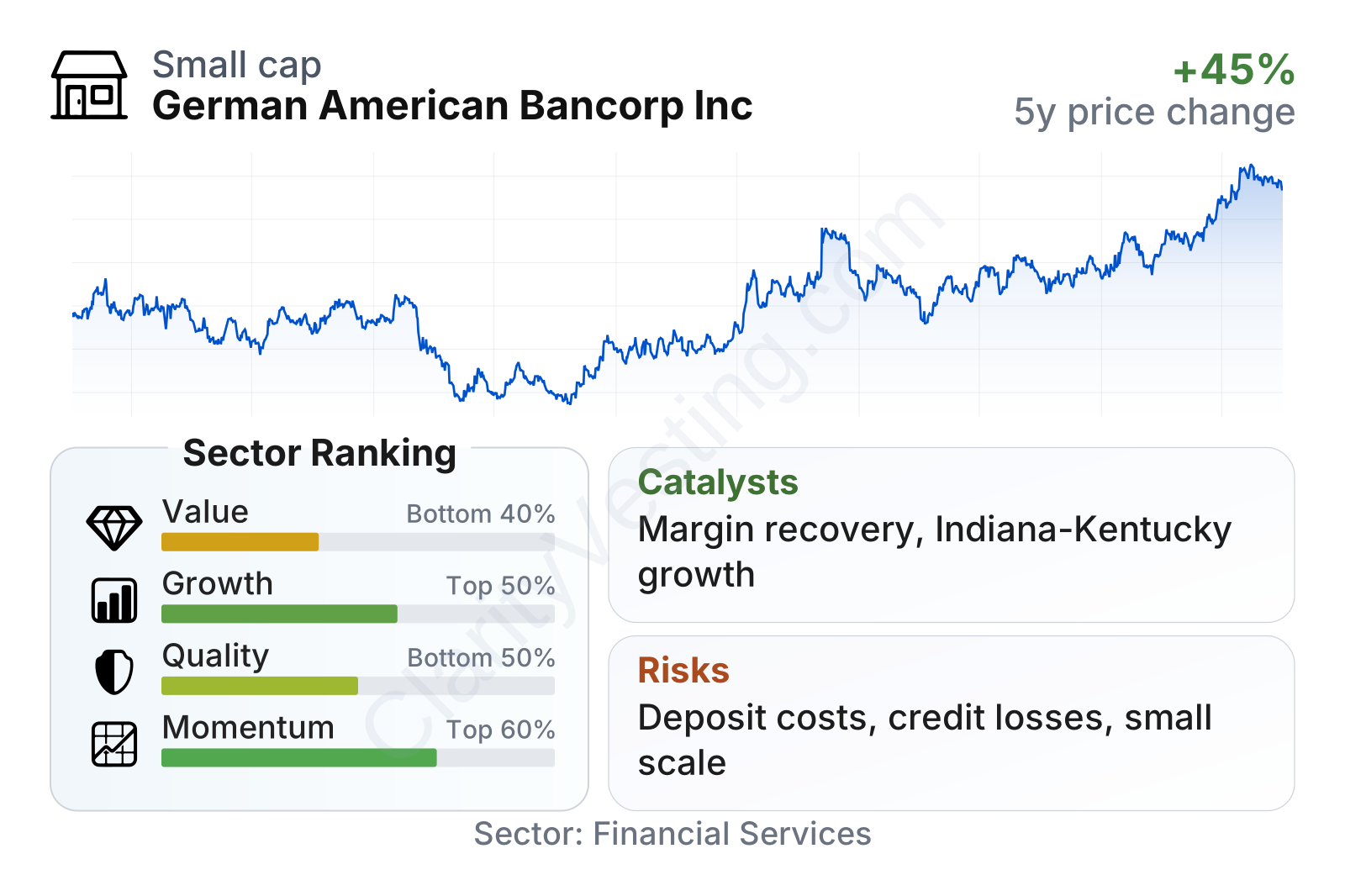
German American sits in the small-cap regional bank category, with a relatively low share-price volatility profile as shown by its beta below 1. On valuation, the earnings multiple is close to the sector median, while the price-to-book ratio is somewhat higher than many peers. Growth indicators are mixed but respectable: recent revenue growth is slightly ahead of the sector median, book value growth has been solid over five years, and dividend growth has also been steady. Quality measures are uneven in the latest snapshot, with return on equity around the sector median and return on assets slightly above it, while leverage appears conservative with debt-to-equity well below the peer median. Price momentum has been better than average over the last several measured periods, reflecting improved market confidence after the regional bank stress of 2023.
Growth
Regional banking is not a fast-growth sector in the way software or semiconductors can be, but it remains an essential part of the economy. Banks like German American grow by gaining deposits, expanding lending in attractive local markets, adding fee-based services, and occasionally using acquisitions to broaden their footprint. The company operates in community and commercial banking, which tends to benefit from population growth, small-business activity, housing demand, and stable local relationships rather than from a single disruptive trend.
German American’s strategy appears coherent for that kind of industry. It combines relationship banking with adjacent businesses such as wealth management and mortgage-related services, which can raise revenue per customer without requiring a dramatic increase in branch count. Its footprint in Indiana and Kentucky also gives it exposure to markets that are generally less overheated than some coastal banking regions, which can help risk control.
Earnings per share have been fairly steady over the last several years rather than consistently accelerating. That matters because it suggests the company has been resilient through changing rate conditions, but it also shows that growth has not been linear. The more encouraging point is that earnings recovered after softer periods instead of showing a prolonged decline.
Book value per share has moved upward over time, especially after the dip that affected many banks when rates reset asset values and funding costs changed. For a bank, rising book value is important because it reflects balance-sheet compounding and capital retention. In German American’s case, the five-year trend remains positive and compares favorably with the sector median.
A notable catalyst in the current setup is the company’s ability to benefit if deposit costs stabilize while loan yields remain healthy. That would support net interest margin improvement. Another growth support is the broader normalization of sentiment toward regional banks after the pressure seen in 2023. The company’s recent share-price recovery suggests the market has become more comfortable with its funding profile and earnings durability.
Recent company filings and investor communications have also pointed to continued commercial and consumer banking activity, along with a still-profitable fee base. For a bank of this size, consistent execution in local lending and deposit gathering can be more meaningful than headline expansion plans.
Risks
This article is for informational purposes only and does not constitute financial advice. Some content is AI-generated. See Disclaimer