Stock Analysis · H B Fuller Company (FUL)
Overview
H.B. Fuller is a specialty chemicals company focused mainly on adhesives, sealants, coatings, and other formulation-based materials used in industrial and consumer products. In simple terms, it makes the materials that help products stick together, stay sealed, protect surfaces, and perform reliably in manufacturing. Its products are used in packaging, hygiene items, electronics, construction, woodworking, automotive applications, medical products, and infrastructure.
The business is not built around one consumer brand. Instead, H.B. Fuller sells to manufacturers and industrial customers that integrate its products into their own goods and production processes. That tends to make demand more closely tied to broader industrial activity, packaging volumes, construction trends, and customer manufacturing output than to retail consumer sentiment alone.
Based on the company’s recent annual reporting, revenue is mainly generated from the following operating segments:
- Hygiene, Health and Consumable Adhesives: about 37% of revenue. This includes adhesives used in hygiene products, packaging, labels, tapes, tissues, towels, and other high-volume consumable applications.
- Engineering Adhesives: about 36% of revenue. This segment serves durable goods and higher-specification applications such as electronics, automotive, clean energy, aerospace, medical, industrial assembly, and appliance markets.
- Construction Adhesives: about 27% of revenue. This includes roofing systems, flooring, panels, windows, doors, insulating glass, and other building-related uses.
Geographically, H.B. Fuller operates globally, with the largest exposure in the Americas, followed by Europe, India, Middle East and Africa, and Asia Pacific. That global footprint helps diversify demand, but it also exposes the company to currency swings and regional industrial cycles.
Over the last several years, the company’s sales base has stayed relatively stable in the low-to-mid $3 billion range, while gross profit has gradually improved. At the same time, interest expense has remained meaningful, showing that debt still matters to the equity case even as operations have held up.
Key Figures
| Metric | Value | Sector ⓘ |
|---|---|---|
| Date | Oct 24, 2026 | |
| Context | ||
| Sector | Basic Materials | |
| Industry | Specialty Chemicals | |
| Market Cap ⓘ | $2.72B | |
| Beta ⓘ | 0.99 | |
Value (Cheapness) | ||
| P/E Ratio ⓘ | 14.09 | 16.92 |
| P/B Ratio ⓘ | 1.28 | 1.66 |
| FCF Yield ⓘ | 3.47% | 5.83% |
| Dividend Yield ⓘ | 1.88% | 2.07% |
| EBIT / EV ⓘ | 8.64% | 6.38% |
| PEG ⓘ | 2.20 | |
Growth (Business expansion) | ||
| Revenue Growth ⓘ | 5.20% | 11.25% |
| RPS Growth (5Y CAGR) ⓘ | 0.98% | 4.49% |
| EPS Growth (5Y CAGR) ⓘ | -3.56% | -15.24% |
| BVPS Growth (5Y CAGR) ⓘ | 5.11% | 5.49% |
| Margin Growth (5Y Trend) ⓘ | 1.04% | -1.54% |
| FCF Growth (5Y CAGR) ⓘ | 0.84% | 0.37% |
| DPS Growth (5Y CAGR) ⓘ | 9.07% | 5.91% |
Quality (Business durability) | ||
| ROIC (Latest) ⓘ | 7.07% | 9.59% |
| ROA (Latest) ⓘ | 3.73% | 4.92% |
| ROIC (5Y Median) ⓘ | 6.31% | 7.91% |
| ROA (5Y Median) ⓘ | 3.15% | 3.92% |
| Net Debt / EBIT (Latest) ⓘ | 4.86 | 1.36 |
| Net Debt / EBIT (5Y Median) ⓘ | 5.27 | 1.69 |
| Net Debt / EBITDA (Latest) ⓘ | 3.62 | 0.93 |
| Net Debt / Assets ⓘ | 36.07% | 13.69% |
| EBITDA / Interest ⓘ | 3.88 | 12.38 |
| Operating Margin (Latest) ⓘ | 11.32% | 13.24% |
| Operating Margin (5Y Median) ⓘ | 9.16% | 11.82% |
| Debt to Equity (Latest) ⓘ | 94.77% | 40.30% |
| Profit Margin (Latest) ⓘ | 5.56% | 6.38% |
| Free Cash Flow (Latest) ⓘ | $94.50M | |
Momentum (Price trend) | ||
| 3Y Return ⓘ | -20.96% | +73.47% |
| 12M Return (excl. last month) ⓘ | -17.07% | +27.59% |
| 6M Return ⓘ | -18.78% | -4.02% |
| Price vs. 200-Day MA ⓘ | -12.88% | -0.65% |
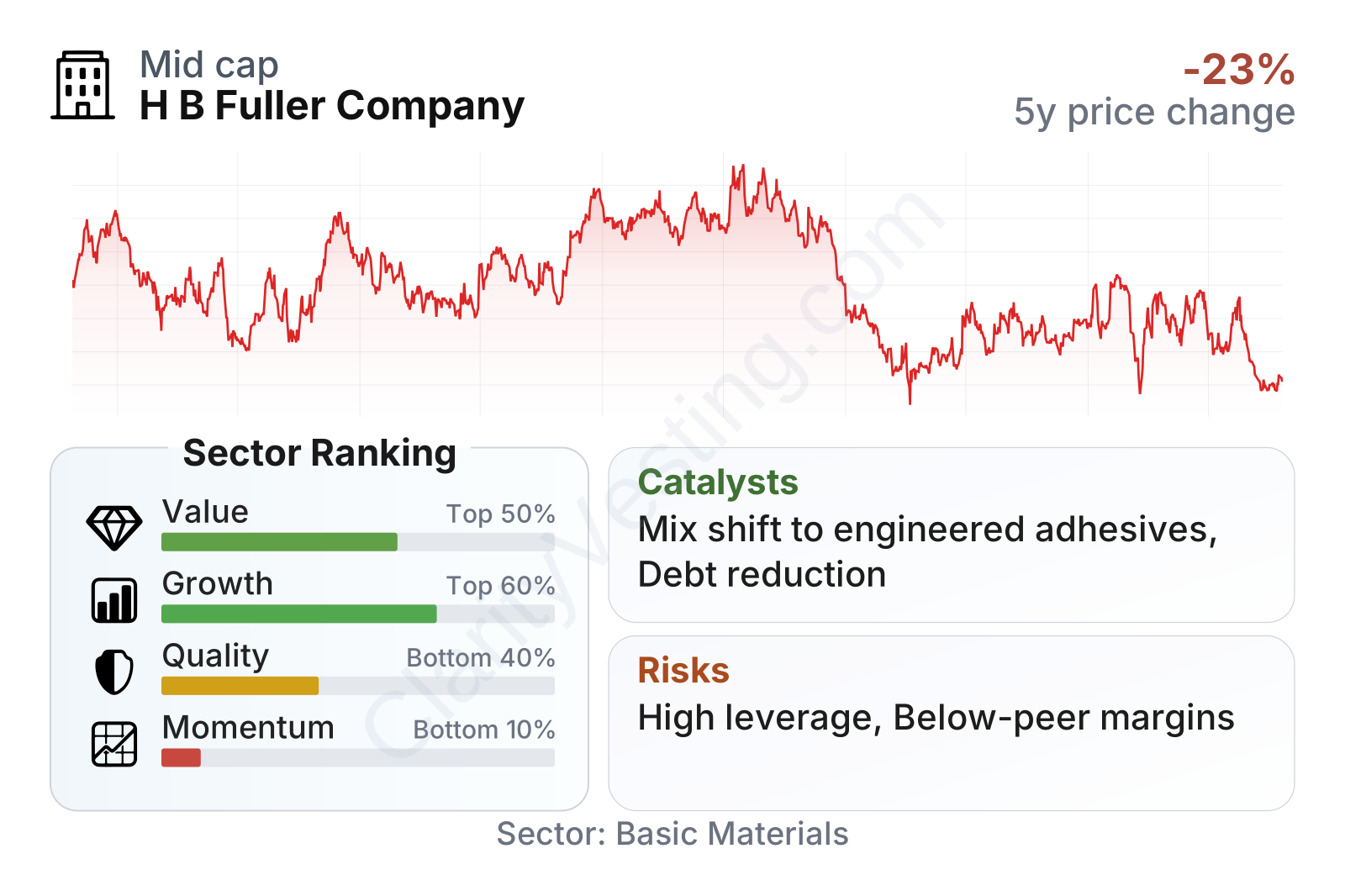
H.B. Fuller is a mid-sized specialty chemicals company with share-price volatility close to the broader market rather than extreme cyclical behavior. On valuation, the stock screens below the sector median on earnings and book value multiples, while its EBIT-to-enterprise-value measure is slightly stronger than the sector median. Growth metrics are mixed: recent year-over-year sales growth has returned to positive territory, but the longer five-year revenue trend remains modest. Quality is the weaker part of the profile, largely because leverage is elevated and returns on capital trail the sector median. Momentum is currently the softest area, with the shares lagging the sector over the last several measured periods.
Growth
H.B. Fuller operates in a part of the chemicals industry that benefits from long-term demand rather than a single fast-moving trend. Adhesives and sealants are used across packaging, hygiene, electronics, transportation, construction, and medical applications. That gives the company exposure to several durable end markets. The strongest structural themes are packaging efficiency, lightweight materials, miniaturization in electronics, cleaner transportation technologies, and higher-performance building materials.
The strategy also makes industrial sense. Specialty adhesive businesses can gain from formulation know-how, customer qualification processes, and switching costs. Once an adhesive is approved for a production line, customers are often reluctant to change suppliers unless there is a strong reason, because reformulation and requalification can disrupt operations. That can support repeat business and pricing resilience, especially in engineered applications.
Recent growth has not been smooth. After a strong inflation-driven revenue phase in 2021 and 2022, sales growth turned negative during 2023 and parts of 2025, reflecting softer volumes and industrial demand pressures. More recently, growth has turned positive again, suggesting some stabilization. Even so, the company’s longer-term top-line expansion remains slower than the sector median, so the growth case depends more on mix improvement, margin execution, and targeted acquisitions than on rapid organic expansion alone.
Cash generation has also been uneven. Free cash flow rose sharply into early 2024, then dropped and partially recovered. For a long-term view, that matters because H.B. Fuller’s ability to turn earnings into cash supports debt reduction, dividends, and internal investment. The company has continued to invest in research and development while also increasing its dividend over time, which signals a degree of confidence in underlying cash generation, but the fluctuations show that this is not a consistently high-cash-flow compounder.
One important catalyst is portfolio positioning toward higher-value, less commoditized adhesive applications. Engineering adhesives and hygiene-related products generally offer better technical differentiation than simpler bulk chemical categories. Another possible catalyst is margin improvement from manufacturing productivity, raw-material management, and product mix. In recent company communications, management has also emphasized disciplined pricing, operational efficiency, and debt reduction, all of which are important if industrial demand remains moderate rather than strong.
Recent company-hosted updates indicate continued focus on integrating acquired assets, simplifying operations, and prioritizing businesses where technical performance matters most. That does not create a dramatic near-term step change by itself, but it can gradually improve resilience and profitability if execution stays consistent.
Risks
This article is for informational purposes only and does not constitute financial advice. Some content is AI-generated. See Disclaimer


