Stock Analysis · First Resources Limited (FTROF)
Overview
First Resources Limited is a palm oil producer with operations centered in Indonesia. The company manages the full chain from cultivating oil palms to processing fresh fruit bunches into crude palm oil and palm kernel products. In simple terms, it grows the crop, processes it, and sells the resulting ingredients that are widely used in food, household products, and other consumer goods.
Its business is mainly tied to palm-based products, with earnings influenced by both production volumes and commodity prices. Based on the company’s reporting structure and business description, revenue is primarily generated from the sale of plantation and mill products, while a smaller portion comes from downstream processing and related activities.
- Palm oil products: approximately the large majority of revenue. This includes crude palm oil, processed palm products, and related sales derived from the company’s plantations and mills.
- Palm kernel products: a smaller but still meaningful share. This typically includes palm kernel and palm kernel oil, which are by-products of the milling process.
- Refinery and downstream sales: a limited share compared with upstream plantation activities, depending on the period and product mix.
Over the last several years, the business has shown how strongly profitability can swing with commodity cycles. Revenue moved from about $1.0 billion in 2021 to about $1.7 billion in 2025, while net income rose from roughly $161 million to about $359 million over the same period. The broad pattern is not a straight line: 2023 was weaker, then 2024 and especially 2025 showed a rebound in both sales and earnings.
Margins have remained unusually strong for a food-related company. In 2025, operating income was a little above $515 million on revenue of about $1.69 billion, showing that the company benefits from vertical integration and control over its supply base. That said, this is still a commodity-linked business, so strong results should be viewed alongside the sector’s natural volatility.
The business mix highlights an important trait: most costs sit in production, but once palm oil prices are favorable, a large part of additional revenue can flow through to operating profit. The latest multi-year trend also shows recovery after a softer 2023, with revenue and profit both climbing materially by 2025.
Key Figures
| Metric | Value | Sector ⓘ |
|---|---|---|
| Date | Oct 17, 2026 | |
| Context | ||
| Sector | Consumer Defensive | |
| Industry | Packaged Foods | |
| Market Cap ⓘ | $5.26B | |
| Beta ⓘ | 0.07 | |
Value (Cheapness) | ||
| P/E Ratio ⓘ | 12.14 | 17.88 |
| P/B Ratio ⓘ | 3.78 | 1.29 |
| FCF Yield ⓘ | 0.28% | 12.39% |
| Dividend Yield ⓘ | 4.15% | 2.85% |
| EBIT / EV ⓘ | 8.42% | 6.43% |
| PEG ⓘ | 1.33 | |
Growth (Business expansion) | ||
| Revenue Growth ⓘ | 44.50% | 4.10% |
| RPS Growth (5Y CAGR) ⓘ | 13.58% | 6.18% |
| EPS Growth (5Y CAGR) ⓘ | -48.70% | -13.59% |
| BVPS Growth (5Y CAGR) ⓘ | 4.59% | 3.20% |
| Margin Growth (5Y Trend) ⓘ | 6.82% | -0.15% |
| FCF Growth (5Y CAGR) ⓘ | -32.66% | 4.10% |
| DPS Growth (5Y CAGR) ⓘ | 34.14% | 6.79% |
Quality (Business durability) | ||
| ROIC (Latest) ⓘ | N/A | 12.34% |
| ROA (Latest) ⓘ | 13.93% | 6.30% |
| ROIC (5Y Median) ⓘ | 16.87% | 10.49% |
| ROA (5Y Median) ⓘ | 13.19% | 5.44% |
| Net Debt / EBIT (Latest) ⓘ | 1.51 | 1.96 |
| Net Debt / EBIT (5Y Median) ⓘ | 0.48 | 2.35 |
| Net Debt / EBITDA (Latest) ⓘ | 1.25 | 1.38 |
| Net Debt / Assets ⓘ | 28.30% | 21.51% |
| EBITDA / Interest ⓘ | N/A | 9.46 |
| Operating Margin (Latest) ⓘ | 31.56% | 8.87% |
| Operating Margin (5Y Median) ⓘ | 30.55% | 9.53% |
| Debt to Equity (Latest) ⓘ | 58.03% | 72.35% |
| Profit Margin (Latest) ⓘ | 22.42% | 5.40% |
| Free Cash Flow (Latest) ⓘ | $14.85M | |
Momentum (Price trend) | ||
| 3Y Return ⓘ | +249.11% | +20.92% |
| 12M Return (excl. last month) ⓘ | +212.31% | +2.13% |
| 6M Return ⓘ | +58.82% | +1.26% |
| Price vs. 200-Day MA ⓘ | +47.85% | +1.39% |
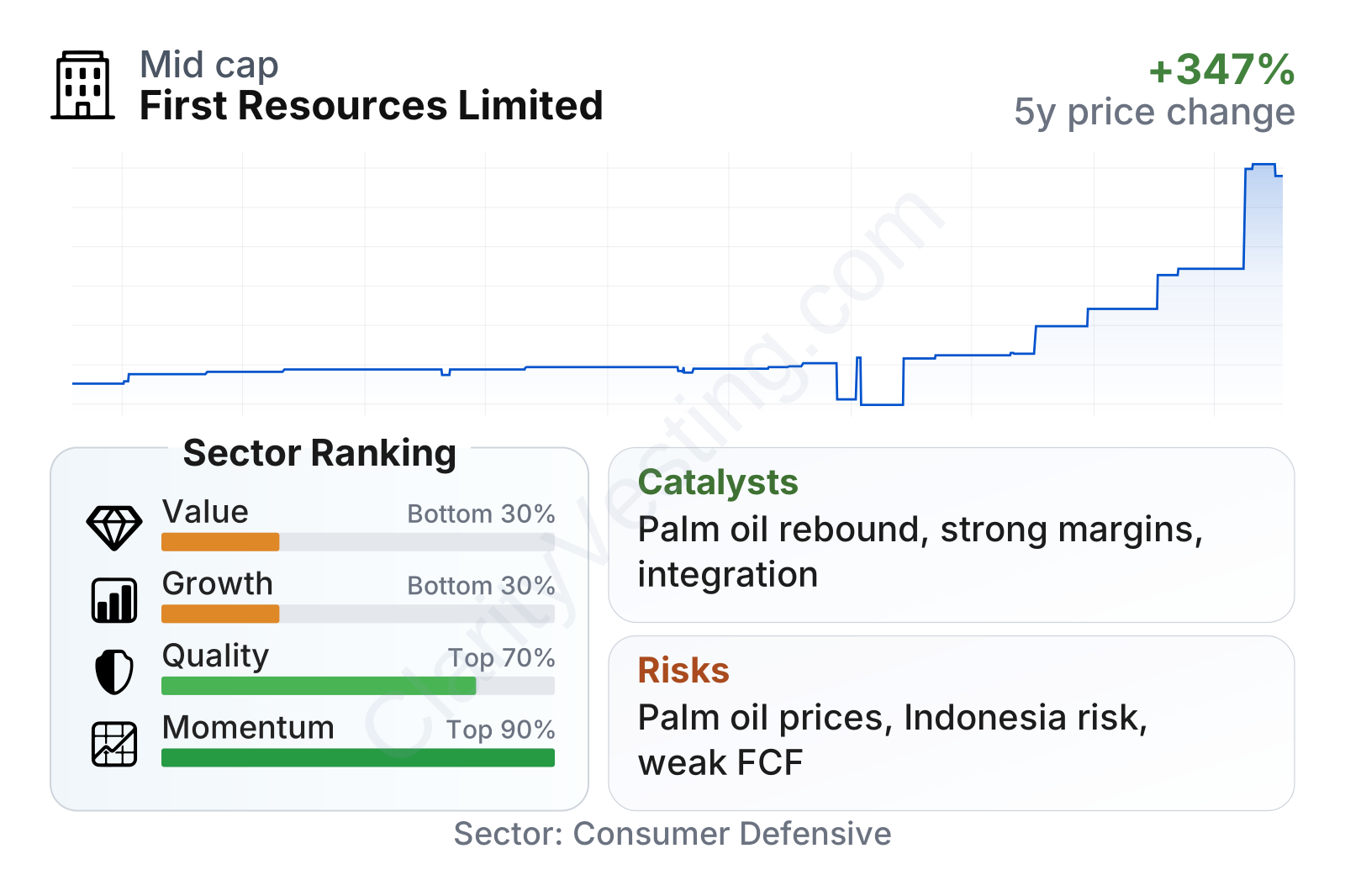
First Resources stands out for profitability and share-price momentum, while growth and valuation signals are more mixed. Operating margin is far above the sector median, profit margin is also well ahead of peers, and returns on assets have been consistently strong. Balance-sheet leverage looks manageable rather than aggressive, with debt-to-equity below the sector median and net debt ratios still within a reasonable range for a plantation group.
On the other hand, free cash flow is currently very thin relative to the company’s size, which weakens the value profile despite a dividend yield near 4%. The growth picture also needs careful interpretation: recent revenue growth has been strong, and five-year revenue per share growth is solid, but five-year earnings per share and free cash flow trends are less favorable. The stock’s momentum has been exceptional, with gains over 6 months, 12 months, and 3 years far above the broader sector, so the market has already recognized the recent improvement.
Growth
First Resources operates in a sector with durable long-term demand, even if annual conditions can be uneven. Palm oil remains one of the world’s most widely used vegetable oils because of its high yield per hectare and its broad use in packaged food, personal care products, and industrial applications. That gives the industry structural relevance, especially in Asia, where food consumption and population growth continue to support edible oil demand.
The company’s strategy makes sense for long-term expansion because it is vertically integrated. Owning plantations and mills gives it more control over supply, cost structure, and margins than a pure trader or refiner would typically have. This setup also means that when production improves and selling prices are favorable, earnings can scale quickly. The rebound visible in 2024 and 2025 suggests that this operating structure is working when market conditions cooperate.
Another growth driver is productivity rather than just land expansion. For plantation businesses, gains can come from better yields, replanting programs, improved age profile of trees, and efficient milling. That tends to be more sustainable than aggressive acreage growth, especially as environmental scrutiny around palm oil remains high. A company that can raise output from existing assets without overstretching the balance sheet is often in a stronger position over a full cycle.
Recent financial performance points to a significant near-term catalyst: earnings recovery has been much stronger than the company’s longer-term averages. Revenue growth over the latest year is far above the sector median, and margins remain robust. If palm oil prices stay supportive and production execution remains stable, the company has room to continue converting sales into strong operating income.
There is also a market-based catalyst. The stock has rerated sharply, which usually reflects stronger expectations for profitability, improved sentiment toward commodity producers, or both. While that does not guarantee future performance, it signals that the company is no longer being treated like a stagnant agricultural name.
Risks
This article is for informational purposes only and does not constitute financial advice. Some content is AI-generated. See Disclaimer


