Stock Analysis · FTAI Aviation Ltd (FTAI)
Overview
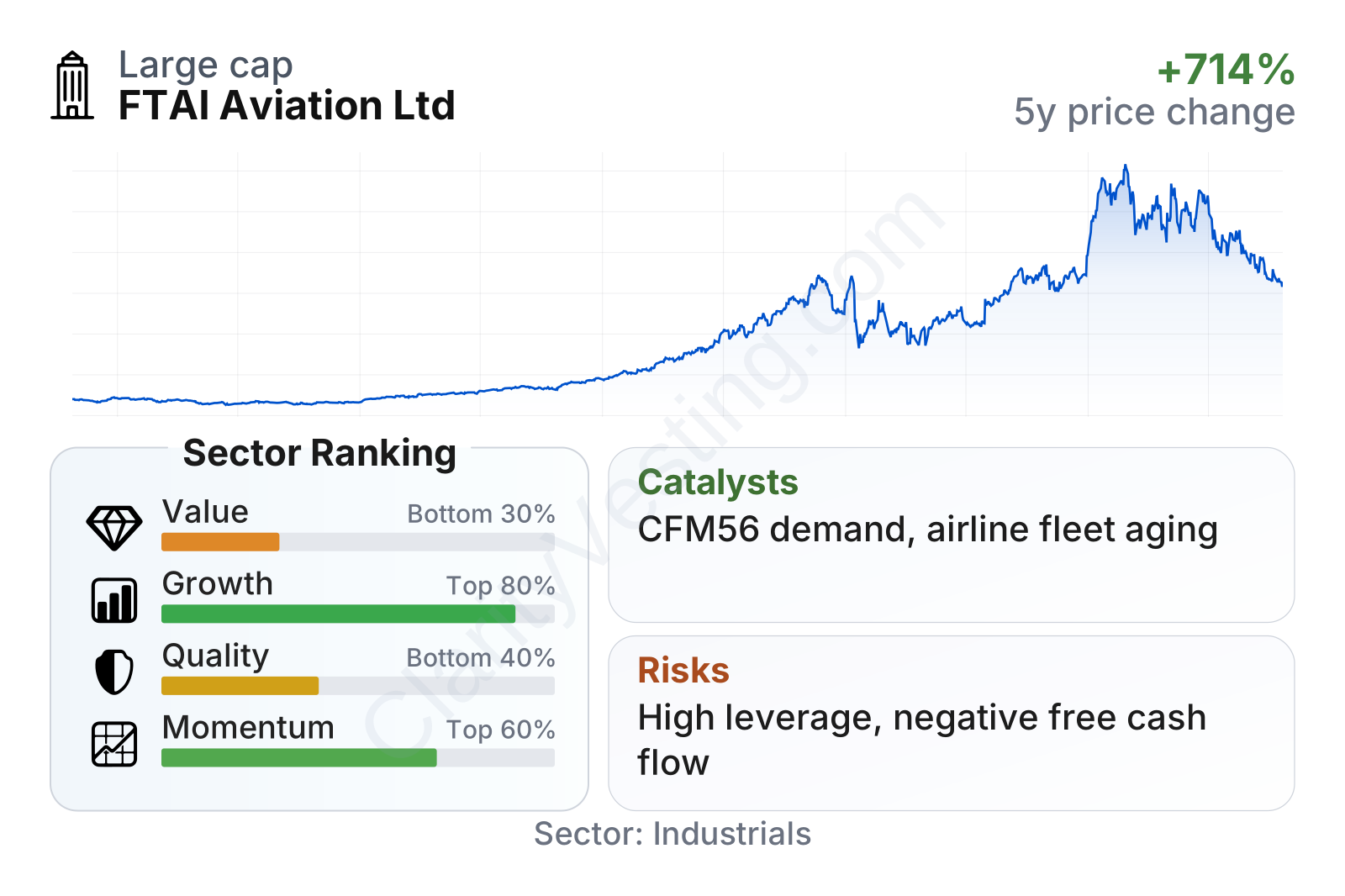
FTAI Aviation Ltd is an aerospace company focused on commercial aircraft engines, aircraft leasing, and aviation services. In simple terms, it buys and leases aircraft and engines, sells parts and modules, and provides maintenance-related solutions that help airlines, lessors, and maintenance shops keep aircraft flying. The company has increasingly centered its business on CFM56 engines, one of the most widely used engine families in commercial aviation.
Its business model is more specialized than a traditional airline supplier. Rather than building aircraft or engines from scratch, FTAI aims to make money from owning aviation assets, repairing or parting them out, and supplying lower-cost alternatives to full engine overhauls. That can create attractive economics when air travel demand is healthy and airlines want to extend the life of existing fleets.
Based on company reporting, FTAI’s revenue is primarily generated from its Aerospace Products segment, with a smaller contribution from Aviation Leasing. Approximate revenue mix has shifted meaningfully toward aerospace activities in recent years.
- Aerospace Products: about 80% to 90% of revenue recently. This includes engine module sales, used serviceable material, maintenance and repair solutions, and other aftermarket aviation products tied largely to CFM56 engines.
- Aviation Leasing: about 10% to 20% of revenue recently. This includes leasing aircraft and engines, asset sales, and related income from the company’s portfolio of owned aviation assets.
The broad financial flow also shows a business that has expanded revenue quickly over the last several years, while interest costs remain meaningful because the company uses a large amount of debt. Revenue rose from roughly $336 million in 2021 to about $2.5 billion in 2025, with gross profit also increasing substantially, but bottom-line results have been more uneven from year to year.
The visual highlights a major change in scale: revenue and gross profit have grown sharply since 2021, and operating income improved significantly by 2025. At the same time, interest expense has remained large throughout the period, which helps explain why strong operating performance does not always translate into equally smooth net income or cash generation.
Key Figures
| Metric | Value | Sector ⓘ |
|---|---|---|
| Date | Oct 24, 2026 | |
| Context | ||
| Sector | Industrials | |
| Industry | Aerospace & Defense | |
| Market Cap ⓘ | $16.22B | |
| Beta ⓘ | 1.57 | |
Value (Cheapness) | ||
| P/E Ratio ⓘ | 34.34 | 22.29 |
| P/B Ratio ⓘ | 42.11 | 1.98 |
| FCF Yield ⓘ | -7.71% | 6.26% |
| Dividend Yield ⓘ | 1.04% | 1.92% |
| EBIT / EV ⓘ | 3.74% | 4.83% |
| PEG ⓘ | 3.22 | |
Growth (Business expansion) | ||
| Revenue Growth ⓘ | 40.90% | 9.30% |
| RPS Growth (5Y CAGR) ⓘ | 59.49% | 7.76% |
| EPS Growth (5Y CAGR) ⓘ | N/A | -13.17% |
| BVPS Growth (5Y CAGR) ⓘ | -28.77% | 6.13% |
| Margin Growth (5Y Trend) ⓘ | -0.28% | 0.74% |
| FCF Growth (5Y CAGR) ⓘ | N/A | 10.79% |
| DPS Growth (5Y CAGR) ⓘ | -3.09% | 9.41% |
Quality (Business durability) | ||
| ROIC (Latest) ⓘ | 18.13% | 10.75% |
| ROA (Latest) ⓘ | 11.37% | 5.41% |
| ROIC (5Y Median) ⓘ | 4.65% | 9.37% |
| ROA (5Y Median) ⓘ | 0.25% | 4.95% |
| Net Debt / EBIT (Latest) ⓘ | 3.75 | 2.04 |
| Net Debt / EBIT (5Y Median) ⓘ | 14.10 | 2.27 |
| Net Debt / EBITDA (Latest) ⓘ | 3.05 | 1.39 |
| Net Debt / Assets ⓘ | 69.41% | 19.27% |
| EBITDA / Interest ⓘ | 4.13 | 9.58 |
| Operating Margin (Latest) ⓘ | 26.70% | 10.49% |
| Operating Margin (5Y Median) ⓘ | 29.14% | 10.30% |
| Debt to Equity (Latest) ⓘ | 854.81% | 64.82% |
| Profit Margin (Latest) ⓘ | 15.94% | 6.67% |
| Free Cash Flow (Latest) ⓘ | -$1.25B | |
Momentum (Price trend) | ||
| 3Y Return ⓘ | +405.78% | +67.77% |
| 12M Return (excl. last month) ⓘ | +8.58% | +12.05% |
| 6M Return ⓘ | -30.66% | 0.00% |
| Price vs. 200-Day MA ⓘ | -30.09% | +0.67% |
FTAI is now a large-cap company with a stock that has been extremely strong over the last three years, even after a meaningful pullback from more recent highs. Relative to the broader Industrials and Aerospace & Defense universe, growth and momentum remain strong, but the value profile looks expensive and the balance sheet is much more leveraged than the sector median. Profitability is currently above many peers on an operating and net margin basis, yet free cash flow remains negative, which is an important contrast for long-term analysis.
Growth
FTAI operates in a part of aviation that benefits from long-lived global demand. Commercial air travel has continued to recover and expand, while aircraft delivery delays and supply chain constraints across the industry have encouraged airlines to keep older fleets in service for longer. That matters because older fleets need more engine maintenance, replacement modules, and used parts. This is the exact area where FTAI is trying to build a stronger position.
The company’s strategy is fairly easy to understand: focus on high-demand engine platforms, especially CFM56, accumulate inventory and technical capabilities around those engines, and offer lower-cost solutions than a full traditional shop visit. If that model works at scale, it can benefit from recurring aftermarket demand rather than depending only on one-time asset sales.
Revenue growth has been consistently strong, though not smooth. The latest year-over-year pace is still far above the sector median, and the multiyear trend shows that FTAI has expanded much faster than most peers. That supports the view that the company is not just riding a cyclical rebound, but also gaining operating scale in the engine-focused aftermarket business.
The weaker point is cash conversion. Free cash flow has remained negative and recently became more negative, which suggests that growth is still consuming substantial capital. For this company, that is likely tied to asset purchases, inventory build, and investment in expanding its aviation platform. Long term, the key question is whether these investments mature into durable cash generation rather than only accounting profits.
A notable catalyst is the continued shortage of new aircraft and spare engines across commercial aviation. When airlines cannot easily replace planes or engines, they tend to maintain existing equipment longer. That can increase demand for engine modules, repairs, and used serviceable material. FTAI’s recent emphasis on integrated engine offerings and maintenance solutions appears well aligned with that environment.
Recent company announcements and investor communications have also emphasized continued expansion of the aerospace business, including maintenance capacity and product offerings around CFM56 engines. For a long-term reader, this is probably the most important strategic point: FTAI is evolving away from being seen mainly as a leasing business and toward a more specialized aviation aftermarket company with a larger addressable market.
Risks
This article is for informational purposes only and does not constitute financial advice. Some content is AI-generated. See Disclaimer