Stock Analysis · Fortescue Metals Group Ltd (FSUMF)
Overview
Fortescue Metals Group Ltd is an Australian mining company best known for producing and exporting iron ore from Western Australia. Its core business is digging iron ore, processing it, transporting it through its rail network, and shipping it to steelmakers around the world. The company has built large-scale operations around this single commodity, which makes the business relatively easy to understand: Fortescue’s results are driven mainly by how much iron ore it ships, the grades it sells, and the market price of iron ore.
In recent years, Fortescue has also been developing an energy transition business under Fortescue Energy, focused on green hydrogen, green ammonia, renewable power, battery systems, and decarbonization technologies for heavy industry and mining. However, this newer activity is still much smaller than the mining operation and remains more important strategically than financially at this stage.
The company’s revenue mix is highly concentrated. Based on recent annual reporting, the business is overwhelmingly tied to iron ore sales, with only a small contribution from other activities.
- Iron ore sales: approximately 98% to 99% of revenue. This includes hematite products such as Fortescue Blend fines and lump, as well as higher-grade products including Iron Bridge magnetite concentrate.
- Other revenue: approximately 1% to 2%. This generally includes shipping-related items, service income, and smaller non-core activities.
That concentration is both a strength and a limitation. It gives Fortescue a very clear operating identity and scale in one market, but it also means the company has less diversification than larger global miners that spread earnings across copper, aluminum, coal, or other minerals.
Geographically, sales are also concentrated. China has historically been the dominant destination for Fortescue’s iron ore, reflecting China’s large steel industry. That exposure links Fortescue closely to Chinese construction activity, infrastructure spending, and steel production trends.
The company’s cost structure still looks favorable for a miner of its size. Over the last five fiscal years, revenue has moved up and down with commodity prices, but gross profit has remained substantial and interest costs have stayed very low. What stands out more recently is that earnings have come under pressure faster than revenue, showing how sensitive profits are when iron ore prices soften and operating costs rise.
The profitability flow shows a business that still converts a large share of sales into gross profit, but net income has fallen much more sharply than revenue since the 2022 peak. That pattern is typical of cyclical miners: a modest change in selling prices can produce a much larger change in bottom-line profit.
Key Figures
| Metric | Value | Sector ⓘ |
|---|---|---|
| Date | Oct 03, 2026 | |
| Context | ||
| Sector | Basic Materials | |
| Industry | Other Industrial Metals & Mining | |
| Market Cap ⓘ | $36.95B | |
| Beta ⓘ | 0.76 | |
Value (Cheapness) | ||
| P/E Ratio ⓘ | 12.37 | 17.61 |
| P/B Ratio ⓘ | 1.82 | 1.77 |
| FCF Yield ⓘ | N/A | 5.87% |
| Dividend Yield ⓘ | 6.51% | 2.06% |
| EBIT / EV ⓘ | 21.32% | 6.43% |
| PEG ⓘ | N/A | |
Growth (Business expansion) | ||
| Revenue Growth ⓘ | 7.90% | 11.30% |
| RPS Growth (5Y CAGR) ⓘ | -0.72% | 4.46% |
| EPS Growth (5Y CAGR) ⓘ | N/A | -13.11% |
| BVPS Growth (5Y CAGR) ⓘ | 4.02% | 5.51% |
| Margin Growth (5Y Trend) ⓘ | -26.40% | -1.57% |
| FCF Growth (5Y CAGR) ⓘ | -1.94% | 0.55% |
| DPS Growth (5Y CAGR) ⓘ | -21.63% | 6.02% |
Quality (Business durability) | ||
| ROIC (Latest) ⓘ | N/A | 9.31% |
| ROA (Latest) ⓘ | N/A | 4.94% |
| ROIC (5Y Median) ⓘ | 24.65% | 7.91% |
| ROA (5Y Median) ⓘ | 16.96% | 3.93% |
| Net Debt / EBIT (Latest) ⓘ | 0.03 | 1.40 |
| Net Debt / EBIT (5Y Median) ⓘ | 0.04 | 1.70 |
| Net Debt / EBITDA (Latest) ⓘ | N/A | 0.91 |
| Net Debt / Assets ⓘ | 0.72% | 13.69% |
| EBITDA / Interest ⓘ | N/A | 11.93 |
| Operating Margin (Latest) ⓘ | N/A | 13.07% |
| Operating Margin (5Y Median) ⓘ | 46.24% | 11.86% |
| Debt to Equity (Latest) ⓘ | N/A | 40.43% |
| Profit Margin (Latest) ⓘ | 16.92% | 6.57% |
| Free Cash Flow (Latest) ⓘ | N/A | |
Momentum (Price trend) | ||
| 3Y Return ⓘ | +36.66% | +65.06% |
| 12M Return (excl. last month) ⓘ | +13.28% | +36.05% |
| 6M Return ⓘ | -10.80% | +1.89% |
| Price vs. 200-Day MA ⓘ | -5.47% | +1.03% |
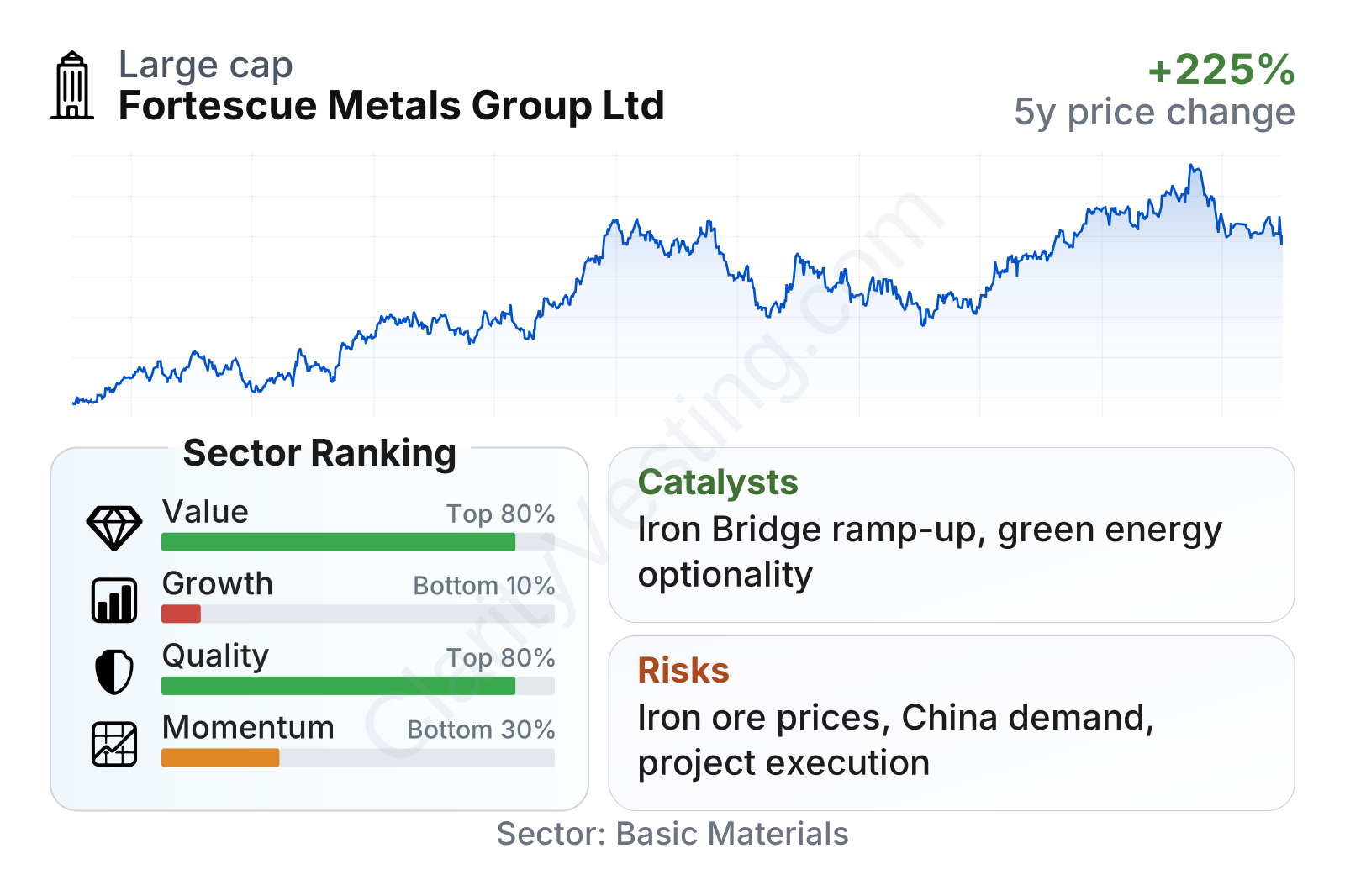
Fortescue is a large mining company with a market value around the large-cap range and a beta below 1, which suggests the stock has been somewhat less volatile than the broader market. On valuation, the shares trade at an earnings multiple below the sector median, while the dividend yield is notably above the sector median. Operating earnings relative to enterprise value also look strong compared with many peers.
On business quality, the picture is stronger than the growth profile. Profitability and returns on assets are well above sector norms, and balance-sheet leverage is unusually low for a miner. Net debt is close to negligible relative to earnings and assets, which gives Fortescue meaningful financial flexibility if commodity conditions weaken or if capital spending remains elevated.
The weaker area is growth. Recent year-over-year revenue growth has been positive, but the longer five-year trend in revenue per share and free cash flow has been soft relative to the sector. Share-price momentum has also lagged parts of the mining group over the medium term, which fits with a company that is financially solid but operating in a market that investors currently view with caution.
Growth
Fortescue operates in a sector with two very different time horizons. The first is iron ore, a mature industry that will likely remain essential as long as the world needs steel for buildings, transport, and infrastructure. The second is green energy and industrial decarbonization, where Fortescue is trying to build a longer-term platform beyond mining. For long-term analysis, that combination matters: the existing business generates cash today, while the newer energy projects are intended to create relevance in a lower-carbon industrial system.
In iron ore, future growth is less about discovering a new market and more about protecting volume, improving product mix, and lowering unit costs. Fortescue has been doing this through projects such as Iron Bridge, which gives it access to higher-grade magnetite concentrate, and through continuing mine development in the Pilbara to sustain shipments over time. Higher-grade products can matter because they may attract better pricing and fit better with steelmakers trying to improve furnace efficiency and reduce emissions.
Recent revenue growth has been positive, but not exceptional versus the broader materials sector. That makes strategic execution especially important. If shipment volumes improve, higher-grade output grows, and operating reliability stays strong, Fortescue can still expand cash generation even without a major structural increase in iron ore demand.
The more ambitious growth angle is Fortescue’s energy and decarbonization effort. Management has spent the past few years positioning the company around green hydrogen, green ammonia, clean power, battery-electric mining equipment, and zero-emissions transport solutions. The industrial logic is understandable: mining companies consume large amounts of diesel and power, and heavy industry is under increasing pressure to reduce emissions. If Fortescue can successfully deploy clean technologies in its own operations and commercialize parts of that capability, it could gradually create a second business platform.
A meaningful catalyst is that governments, utilities, and industrial groups in many regions continue to support low-carbon energy infrastructure through incentives, permitting frameworks, and public funding programs. Another catalyst is internal decarbonization: replacing diesel consumption in mines, rail, and port operations could eventually lower fuel exposure and strengthen Fortescue’s environmental positioning with customers and regulators.
Recent company updates have also emphasized operational continuity in the Pilbara and progress on decarbonization initiatives rather than a dramatic near-term transformation. That is important context: Fortescue’s biggest opportunity still comes from disciplined execution in iron ore, with energy transition projects offering optionality rather than a fully proven earnings engine today.
Risks
This article is for informational purposes only and does not constitute financial advice. Some content is AI-generated. See Disclaimer