Stock Analysis · Federal Signal Corporation (FSS)
Overview
Federal Signal Corporation is an industrial company focused on equipment used by municipalities, utilities, contractors, and public safety agencies. In simple terms, it sells products that help cities clean streets, maintain sewer systems, respond to emergencies, and operate work trucks. The company also provides safety and warning systems such as sirens, lights, and related equipment.
Its business is organized mainly into two segments. The larger one is Environmental Solutions, which includes street sweepers, sewer cleaners, vacuum trucks, hydro-excavation equipment, dump bodies, trailers, and related aftermarket parts and service. The smaller segment is Safety and Security Systems, which includes warning sirens, public safety communication systems, emergency lights, and industrial signaling equipment.
Based on the latest annual filing, revenue is heavily concentrated in Environmental Solutions, while Safety and Security Systems remains a smaller but still meaningful contributor. Approximate revenue mix is as follows:
- Environmental Solutions: about 85% of revenue. This includes brands serving municipal maintenance, infrastructure cleaning, industrial vacuuming, and specialized truck-mounted equipment.
- Safety and Security Systems: about 15% of revenue. This includes outdoor warning sirens, emergency vehicle lighting, signaling devices, and communication systems.
The business mix matters because Environmental Solutions gives Federal Signal exposure to steady municipal and infrastructure spending, while the safety segment adds recurring demand tied to emergency preparedness and public warning systems. Over the last several years, the company has also expanded through acquisitions, which has broadened its product lineup and increased its presence in specialty vehicle markets.
The long-term financial picture has improved noticeably: revenue has climbed from roughly $1.2 billion in 2021 to about $2.2 billion in 2025, while operating income and net income have grown faster than sales. That suggests the company is not only getting larger, but also becoming more efficient.
The profit flow has become stronger over time. Revenue has increased sharply since 2021, but gross profit, operating income, and net income have risen even faster, pointing to better pricing, product mix, and operating discipline rather than growth coming only from volume.
Key Figures
| Metric | Value | Sector ⓘ |
|---|---|---|
| Date | Oct 24, 2026 | |
| Context | ||
| Sector | Industrials | |
| Industry | Farm & Heavy Construction Machinery | |
| Market Cap ⓘ | $7.00B | |
| Beta ⓘ | 1.23 | |
Value (Cheapness) | ||
| P/E Ratio ⓘ | 24.34 | 22.29 |
| P/B Ratio ⓘ | 4.76 | 1.98 |
| FCF Yield ⓘ | 4.85% | 6.26% |
| Dividend Yield ⓘ | 0.51% | 1.92% |
| EBIT / EV ⓘ | 5.36% | 4.83% |
| PEG ⓘ | 1.41 | |
Growth (Business expansion) | ||
| Revenue Growth ⓘ | 18.70% | 9.30% |
| RPS Growth (5Y CAGR) ⓘ | 15.97% | 7.76% |
| EPS Growth (5Y CAGR) ⓘ | 7.68% | -13.17% |
| BVPS Growth (5Y CAGR) ⓘ | 15.41% | 6.13% |
| Margin Growth (5Y Trend) ⓘ | 6.18% | 0.74% |
| FCF Growth (5Y CAGR) ⓘ | 37.04% | 10.79% |
| DPS Growth (5Y CAGR) ⓘ | 11.76% | 9.41% |
Quality (Business durability) | ||
| ROIC (Latest) ⓘ | 16.23% | 10.75% |
| ROA (Latest) ⓘ | 13.04% | 5.41% |
| ROIC (5Y Median) ⓘ | 13.70% | 9.37% |
| ROA (5Y Median) ⓘ | 10.01% | 4.95% |
| Net Debt / EBIT (Latest) ⓘ | 1.08 | 2.04 |
| Net Debt / EBIT (5Y Median) ⓘ | 1.50 | 2.27 |
| Net Debt / EBITDA (Latest) ⓘ | 0.87 | 1.39 |
| Net Debt / Assets ⓘ | 17.34% | 19.27% |
| EBITDA / Interest ⓘ | 23.59 | 9.58 |
| Operating Margin (Latest) ⓘ | 16.06% | 10.49% |
| Operating Margin (5Y Median) ⓘ | 12.93% | 10.30% |
| Debt to Equity (Latest) ⓘ | 32.22% | 64.82% |
| Profit Margin (Latest) ⓘ | 11.66% | 6.67% |
| Free Cash Flow (Latest) ⓘ | $339.20M | |
Momentum (Price trend) | ||
| 3Y Return ⓘ | +104.27% | +67.77% |
| 12M Return (excl. last month) ⓘ | -7.66% | +12.05% |
| 6M Return ⓘ | +3.07% | 0.00% |
| Price vs. 200-Day MA ⓘ | +0.97% | +0.67% |
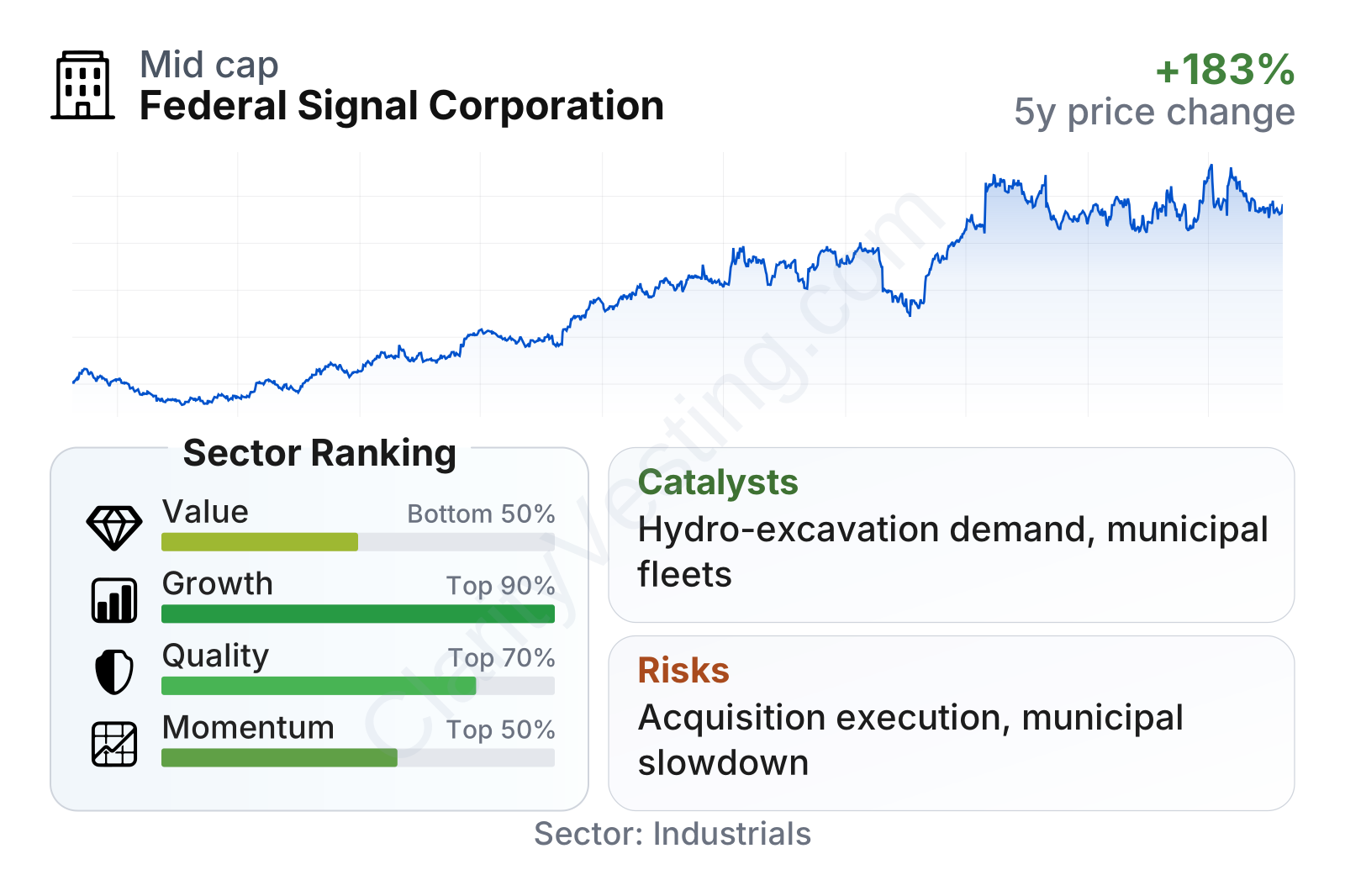
Federal Signal stands out more for business quality and growth than for cheap valuation. Growth metrics rank well within its sector, helped by strong multi-year gains in revenue, free cash flow, and margins. Quality is also solid, with returns on capital and assets above sector medians, while leverage remains moderate. By contrast, valuation metrics look less favorable: the stock trades around the sector average on earnings, but clearly above it on book value, and its cash flow yield and dividend yield are lower than many industrial peers.
The share price has delivered a strong multi-year advance, although recent performance has been more mixed. That combination usually means the market already recognizes the company’s strengths, so future returns are likely to depend more on continued execution than on a simple rerating from a depressed base.
Growth
Federal Signal operates in areas linked to infrastructure maintenance, environmental services, utility work, and emergency response. These are attractive long-term markets because cities and contractors cannot easily postpone all replacement and maintenance spending forever. Street sweeping, sewer cleaning, vacuum excavation, and public warning systems may not be glamorous, but they are operationally important and often tied to public budgets, fleet replacement cycles, and safety requirements.
The company’s strategy appears coherent for long-term expansion. Management has combined organic growth with acquisitions, especially in specialty vehicles and infrastructure-related equipment. This approach makes sense because it builds a broader platform around customers that already buy mission-critical equipment and aftermarket support. Once a municipality or contractor is operating a fleet, replacement parts, service, and future equipment purchases can create repeat business.
Revenue growth has been volatile from quarter to quarter, which is normal for an industrial manufacturer, but the broader pattern has remained favorable. Recent year-over-year growth has stayed above the sector median, and the five-year trend shows expansion that is clearly stronger than many peers.
Cash generation has also improved materially. Free cash flow has risen from a modest level a few years ago to roughly the low-$300 million range on a trailing basis. That is important because it gives the company flexibility to fund acquisitions, reduce debt, invest in capacity, and continue returning some capital to shareholders without depending heavily on external financing.
Several business catalysts support the current growth profile. Federal Signal has meaningful exposure to vacuum trucks and hydro-excavation equipment, categories that benefit from utility, telecom, and infrastructure work. Public infrastructure spending in North America, fleet replacement needs, and resilience-related demand for warning systems can all support order activity. The company has also highlighted backlog and acquisition integration as part of its expansion path in recent filings and investor materials.
A notable recent opportunity is the company’s continued positioning around infrastructure modernization and underground utility work. Hydro-excavation is often favored because it is more precise and can reduce the risk of damaging buried lines. That gives Federal Signal a practical angle into a market supported by utility maintenance, broadband buildouts, and public works activity.
Risks
This article is for informational purposes only and does not constitute financial advice. Some content is AI-generated. See Disclaimer


