Stock Analysis · Fortuna Silver Mines Inc (FSM)
Overview
Fortuna Silver Mines Inc. is a precious-metals mining company that operates mines in Latin America and West Africa. Despite its name, the business is no longer mainly a silver producer. In recent years, gold has become the main economic driver, helped by the acquisition and ramp-up of larger gold assets. The company explores for deposits, develops mines, extracts ore, and then sells processed gold and silver, along with smaller amounts of by-product metals.
Its revenue comes primarily from metal sales. Based on the latest annual mix reported by the company, the business is now dominated by gold, with silver in a secondary role and by-products adding smaller contributions.
- Gold: approximately 80% to 85% of revenue. This includes doré and concentrate sales from the company’s gold-focused operations, especially Séguéla, Lindero, and Yaramoko.
- Silver: approximately 10% to 15% of revenue. This mainly comes from the San Jose mine in Mexico and the Caylloma mine in Peru.
- Lead and zinc: together approximately 3% to 7% of revenue. These are by-products, mostly associated with Caylloma.
Geographically, Fortuna is diversified across several mining jurisdictions rather than depending on one country. That lowers single-asset concentration compared with many smaller miners, although individual mines still matter a lot because mining profitability can shift quickly when grades, costs, or local conditions change.
The business model is straightforward: produce precious metals at costs below realized selling prices, keep mines running efficiently, and use exploration or project development to extend mine life. For a long-term view, the most important question is not whether Fortuna can sell gold and silver—there is always a market—but whether it can maintain strong margins while replacing reserves over time.
The financial flow over the last few years shows how cyclical this company can be. Revenue climbed sharply from 2021 to 2024, profitability collapsed in 2022 and stayed weak in 2023, then recovered strongly in 2024 and improved again afterward. That pattern suggests the current earnings power is much stronger than it was during the difficult middle period, but it also reminds readers that mining results can swing widely.
Key Figures
| Metric | Value | Sector ⓘ |
|---|---|---|
| Date | Oct 24, 2026 | |
| Context | ||
| Sector | Basic Materials | |
| Industry | Gold | |
| Market Cap ⓘ | $3.07B | |
| Beta ⓘ | 2.18 | |
Value (Cheapness) | ||
| P/E Ratio ⓘ | 8.88 | 16.92 |
| P/B Ratio ⓘ | 1.98 | 1.66 |
| FCF Yield ⓘ | 13.54% | 5.83% |
| Dividend Yield ⓘ | N/A | 2.07% |
| EBIT / EV ⓘ | 20.26% | 6.38% |
| PEG ⓘ | N/A | |
Growth (Business expansion) | ||
| Revenue Growth ⓘ | 38.20% | 11.25% |
| RPS Growth (5Y CAGR) ⓘ | 4.49% | 4.49% |
| EPS Growth (5Y CAGR) ⓘ | 44.11% | -15.24% |
| BVPS Growth (5Y CAGR) ⓘ | -3.28% | 5.49% |
| Margin Growth (5Y Trend) ⓘ | 25.05% | -1.54% |
| FCF Growth (5Y CAGR) ⓘ | N/A | 0.37% |
| DPS Growth (5Y CAGR) ⓘ | N/A | 5.91% |
Quality (Business durability) | ||
| ROIC (Latest) ⓘ | 22.93% | 9.59% |
| ROA (Latest) ⓘ | 16.01% | 4.92% |
| ROIC (5Y Median) ⓘ | 5.49% | 7.91% |
| ROA (5Y Median) ⓘ | 3.76% | 3.92% |
| Net Debt / EBIT (Latest) ⓘ | -0.60 | 1.36 |
| Net Debt / EBIT (5Y Median) ⓘ | 0.25 | 1.69 |
| Net Debt / EBITDA (Latest) ⓘ | -0.46 | 0.93 |
| Net Debt / Assets ⓘ | -14.92% | 13.69% |
| EBITDA / Interest ⓘ | 34.14 | 12.38 |
| Operating Margin (Latest) ⓘ | 52.62% | 13.24% |
| Operating Margin (5Y Median) ⓘ | 19.97% | 11.82% |
| Debt to Equity (Latest) ⓘ | 13.25% | 40.30% |
| Profit Margin (Latest) ⓘ | 31.98% | 6.38% |
| Free Cash Flow (Latest) ⓘ | $416.45M | |
Momentum (Price trend) | ||
| 3Y Return ⓘ | +240.13% | +73.47% |
| 12M Return (excl. last month) ⓘ | +44.12% | +27.59% |
| 6M Return ⓘ | +2.58% | -4.02% |
| Price vs. 200-Day MA ⓘ | -0.06% | -0.65% |
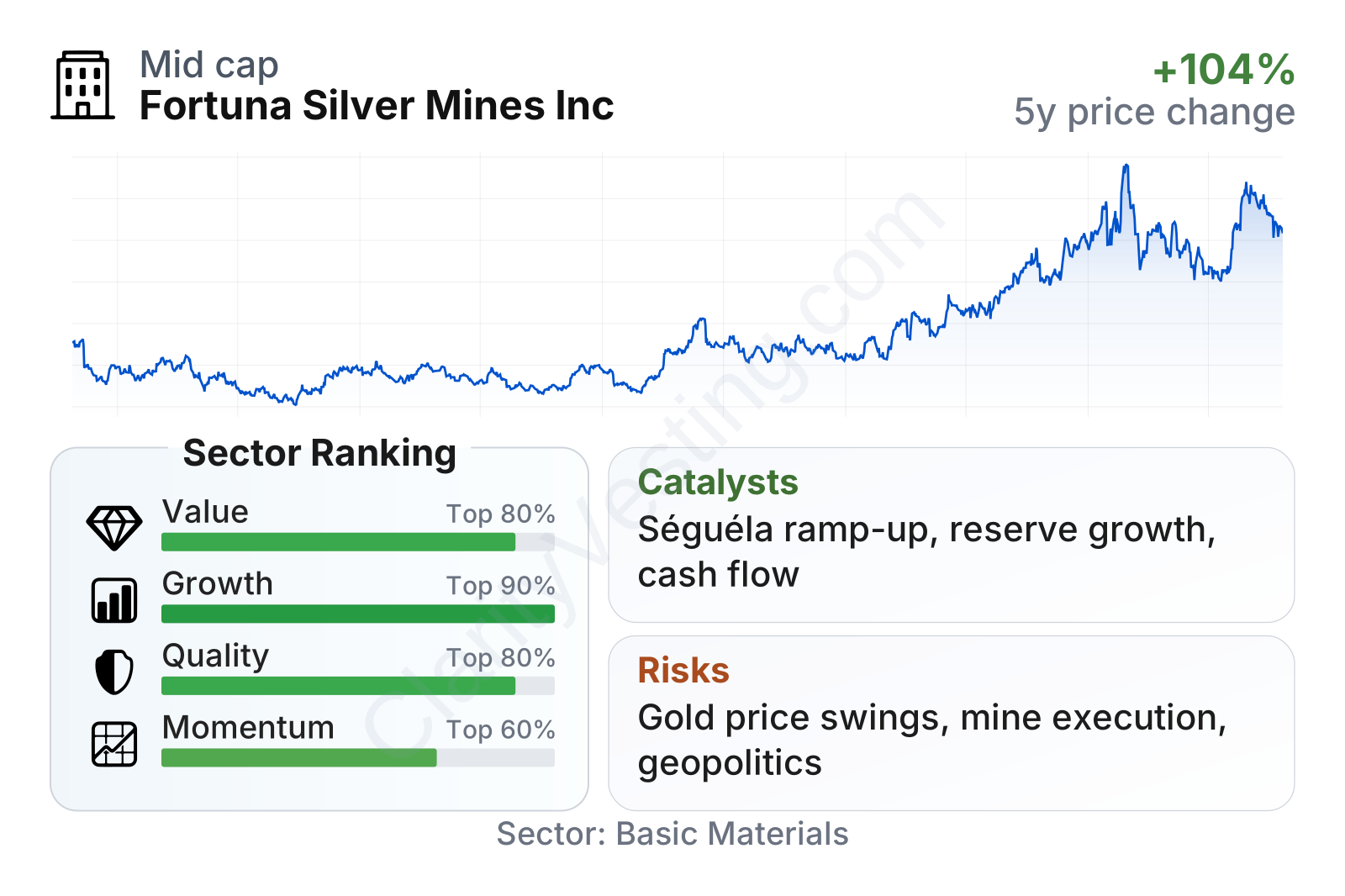
Fortuna is a mid-sized mining company with a stock that has been very volatile, which is not unusual for precious-metals producers. The balance sheet looks conservative, profitability is currently strong, and recent growth ranks well above much of the sector. On valuation measures tied to earnings and cash generation, the company screens cheaper than many peers, while its price-to-book ratio is somewhat richer than the sector median. That mix usually means the market is recognizing better operations, but not assigning a premium as large as the current profit recovery might suggest.
The share-price history also shows a classic mining pattern: a long weak stretch followed by a powerful rebound. Momentum has improved materially over the last one, three, and twelve-month periods, but the beta above 2 indicates that swings can be amplified compared with the broader market.
Growth
Fortuna operates in a sector that remains structurally relevant for long-term capital. Gold benefits from central-bank demand, its role as a store of value during macro uncertainty, and limited global supply growth from large new discoveries. Silver has a different profile: it is both a precious metal and an industrial input, especially in electronics and solar applications. That combination gives Fortuna exposure to two metal markets with different demand drivers.
The company’s recent strategy makes sense from a growth perspective. Fortuna has shifted from being a more silver-centered producer into a broader precious-metals company with stronger gold exposure. That matters because gold assets currently contribute most of the cash flow, and larger gold production has helped lift overall scale, margins, and resilience.
Revenue growth has been uneven, which is common in mining because output depends on grades, mine sequencing, and metal prices. Still, the broader direction has improved noticeably since the weaker 2022–2023 period. The latest year-over-year growth rate is well above the sector median, showing that Fortuna is currently expanding faster than many peers.
A key catalyst is Séguéla in Côte d’Ivoire, which has become one of the company’s most important assets. The mine changed Fortuna’s production profile by adding a lower-cost, higher-margin gold operation with room for optimization and nearby exploration. Another growth support is the continued development of exploration targets around existing operations, which can be more attractive than buying entirely new mines because existing infrastructure is already in place.
Cash generation has improved significantly. Free cash flow moved from negative territory in earlier periods to strongly positive levels more recently. That is important for long-term analysis because free cash flow gives a miner more flexibility to fund exploration, expand operations, reduce debt, or build liquidity without relying as much on issuing shares or taking on new borrowings.
Recent company updates have also pointed to ongoing drilling and mine-life extension work across the portfolio. For Fortuna, these are not side projects; they are central to the long-term case. A miner’s value depends heavily on how long its best assets can keep producing economically. If exploration continues to convert into additional reserves and resources near existing mines, that can support production durability beyond the current plan.
Risks
This article is for informational purposes only and does not constitute financial advice. Some content is AI-generated. See Disclaimer


