Stock Analysis · Frasers Centrepoint Trust (FRZCF)
Overview
Frasers Centrepoint Trust is a Singapore retail real estate investment trust, or REIT. In simple terms, it owns shopping malls and a mixed-use property, rents space to tenants, and distributes a large part of its cash flow to unitholders. Its portfolio is focused on suburban retail centers in Singapore, which means malls located close to residential neighborhoods rather than in the main tourist or luxury shopping districts. That positioning matters because suburban malls tend to benefit from recurring demand for groceries, food, services, education, health, and daily necessities.
The trust is sponsored by Frasers Property, a large Singapore-listed real estate group. As of the latest public disclosures, Frasers Centrepoint Trust’s portfolio includes malls such as Causeway Point, Northpoint City North Wing, Changi City Point, Tampines 1, Waterway Point, Century Square, Hougang Mall, White Sands, and an interest in the mixed-use property The Centrepoint.
Its revenue is mainly generated by rental and related property income. Based on portfolio disclosures in recent annual reporting, the largest property contributors are typically the biggest and highest-traffic malls. Approximate contribution by asset can shift over time, but the broad revenue mix has been led by:
- Causeway Point: about 20% to 25% of portfolio value and one of the trust’s largest income contributors; a major suburban mall in Woodlands.
- Northpoint City North Wing: roughly 15% to 20%; a dominant mall serving Yishun with strong everyday traffic.
- Waterway Point: roughly 10% to 15% attributable exposure through its stake; a family-oriented mall in Punggol.
- Tampines 1, Century Square, and White Sands: together around 20% to 30%; these strengthen the trust’s presence in the large eastern Singapore catchment.
- Changi City Point: roughly 8% to 12%; exposed to outlet retail and the business park area around Changi Business Park.
- Hougang Mall and The Centrepoint stake: together around 10% to 15%; smaller but still relevant contributors to rent and tenant sales.
From a business-model perspective, the income stream is usually split between base rent, variable rent linked to tenant performance for part of the portfolio, and other property income such as service charges and recoveries. Tenant mix is also important. Frasers Centrepoint Trust has meaningful exposure to necessity-based categories such as supermarkets, food and beverage, beauty, healthcare, education, and essential services, which makes cash flow more defensive than that of mall owners that rely heavily on discretionary luxury spending.
Over the last four reported fiscal years, revenue moved from about S$357 million to about S$391 million, while net income stayed near the S$200 million level. That indicates a stable income-producing platform, although financing costs have absorbed part of the operating improvement.
The business has remained highly profitable at the operating level, with property income expanding over time, but interest expense has also climbed materially since 2022. That is one of the clearest themes in the financial profile: rent growth and portfolio resilience on one side, higher borrowing costs on the other.
Key Figures
| Metric | Value | Sector ⓘ |
|---|---|---|
| Date | Oct 17, 2026 | |
| Context | ||
| Sector | Real Estate | |
| Industry | REIT - Retail | |
| Market Cap ⓘ | $3.53B | |
| Beta ⓘ | 0.35 | |
Value (Cheapness) | ||
| P/E Ratio ⓘ | 21.62 | 17.38 |
| P/B Ratio ⓘ | 0.74 | 0.85 |
| FCF Yield ⓘ | 7.73% | 7.38% |
| Dividend Yield ⓘ | 7.05% | 4.85% |
| EBIT / EV ⓘ | 5.99% | 3.78% |
| PEG ⓘ | 3.97 | |
Growth (Business expansion) | ||
| Revenue Growth ⓘ | 21.90% | 5.30% |
| RPS Growth (5Y CAGR) ⓘ | 6.48% | 6.02% |
| EPS Growth (5Y CAGR) ⓘ | -23.72% | -11.37% |
| BVPS Growth (5Y CAGR) ⓘ | 6.84% | 0.45% |
| Margin Growth (5Y Trend) ⓘ | -6.81% | -0.22% |
| FCF Growth (5Y CAGR) ⓘ | 5.35% | 5.40% |
| DPS Growth (5Y CAGR) ⓘ | 13.51% | 5.02% |
Quality (Business durability) | ||
| ROIC (Latest) ⓘ | N/A | 5.69% |
| ROE (Latest) ⓘ | 5.02% | 7.56% |
| ROA (Latest) ⓘ | 3.19% | 2.85% |
| ROIC (5Y Median) ⓘ | 4.51% | 4.22% |
| ROE (5Y Median) ⓘ | 5.22% | 6.03% |
| ROA (5Y Median) ⓘ | 3.44% | 2.44% |
| Net Debt / EBIT (Latest) ⓘ | N/A | 7.59 |
| Net Debt / EBIT (5Y Median) ⓘ | 7.22 | 8.40 |
| Net Debt / EBITDA (Latest) ⓘ | N/A | 5.27 |
| Net Debt / Assets ⓘ | 32.75% | 37.76% |
| EBITDA / Interest ⓘ | N/A | 4.10 |
| Operating Margin (Latest) ⓘ | 66.10% | 35.29% |
| Operating Margin (5Y Median) ⓘ | 70.25% | 37.31% |
| Debt to Equity (Latest) ⓘ | 55.65% | 88.87% |
| Profit Margin (Latest) ⓘ | 45.55% | 19.61% |
| Free Cash Flow (Latest) ⓘ | $272.55M | |
Momentum (Price trend) | ||
| 3Y Return ⓘ | +37.65% | +30.75% |
| 12M Return (excl. last month) ⓘ | +4.04% | +4.36% |
| 6M Return ⓘ | +2.86% | -2.52% |
| Price vs. 200-Day MA ⓘ | +1.22% | -2.34% |
Frasers Centrepoint Trust stands out for income generation and balance-sheet discipline relative to many retail REITs. Profitability is strong, with operating margin around the mid-60% range and profit margin well above the sector median. Leverage also looks more controlled than many peers, with debt-to-equity near 56% versus a sector median close to 89%, and net debt relative to assets below the sector norm.
On growth, recent revenue momentum has been strong, especially after the latest fiscal year, and book value per share has compounded faster than the sector median over five years. Dividend growth has also been notably stronger than the peer group over that period. The weaker area is earnings per share, which has been pressured by higher financing costs and margin compression from peak levels.
In market behavior, the units have been relatively steady rather than fast-moving. Beta is low at about 0.35, which suggests less volatility than the broader market. Price momentum has been mixed: recent six-month trading has been decent, but the longer comparison still trails the sector median.
Growth
Frasers Centrepoint Trust operates in a mature sector, not a high-growth one. Retail REITs are usually about steady rental cash flow, incremental redevelopment, disciplined acquisitions, and occupancy management rather than rapid expansion. That said, suburban Singapore retail is one of the more resilient parts of physical retail real estate. Dense residential catchments, limited land supply, and heavy reliance on neighborhood malls for daily spending provide a favorable backdrop.
The trust’s strategy is sensible for that environment. It concentrates on dominant suburban malls, where shoppers are visiting for recurring needs instead of occasional discretionary purchases. This tends to support occupancy, rent renewal, and tenant sales. In addition, the sponsor relationship with Frasers Property can create opportunities for future asset purchases, joint ventures, or redevelopments when market conditions are favorable.
Revenue per share has generally trended upward over the last several years, with a noticeable step-up in the latest period after a softer 2024. That pattern suggests the portfolio still has room for rental growth and operational recovery, even if the path is not perfectly smooth year to year.
Distributions per share dipped modestly in 2024 before rebounding strongly in 2025. Over five years, dividend per share growth has been much stronger than the sector median, which fits the picture of a trust that has restored cash distributions after the pandemic period and benefited from normalized mall traffic and tenant demand.
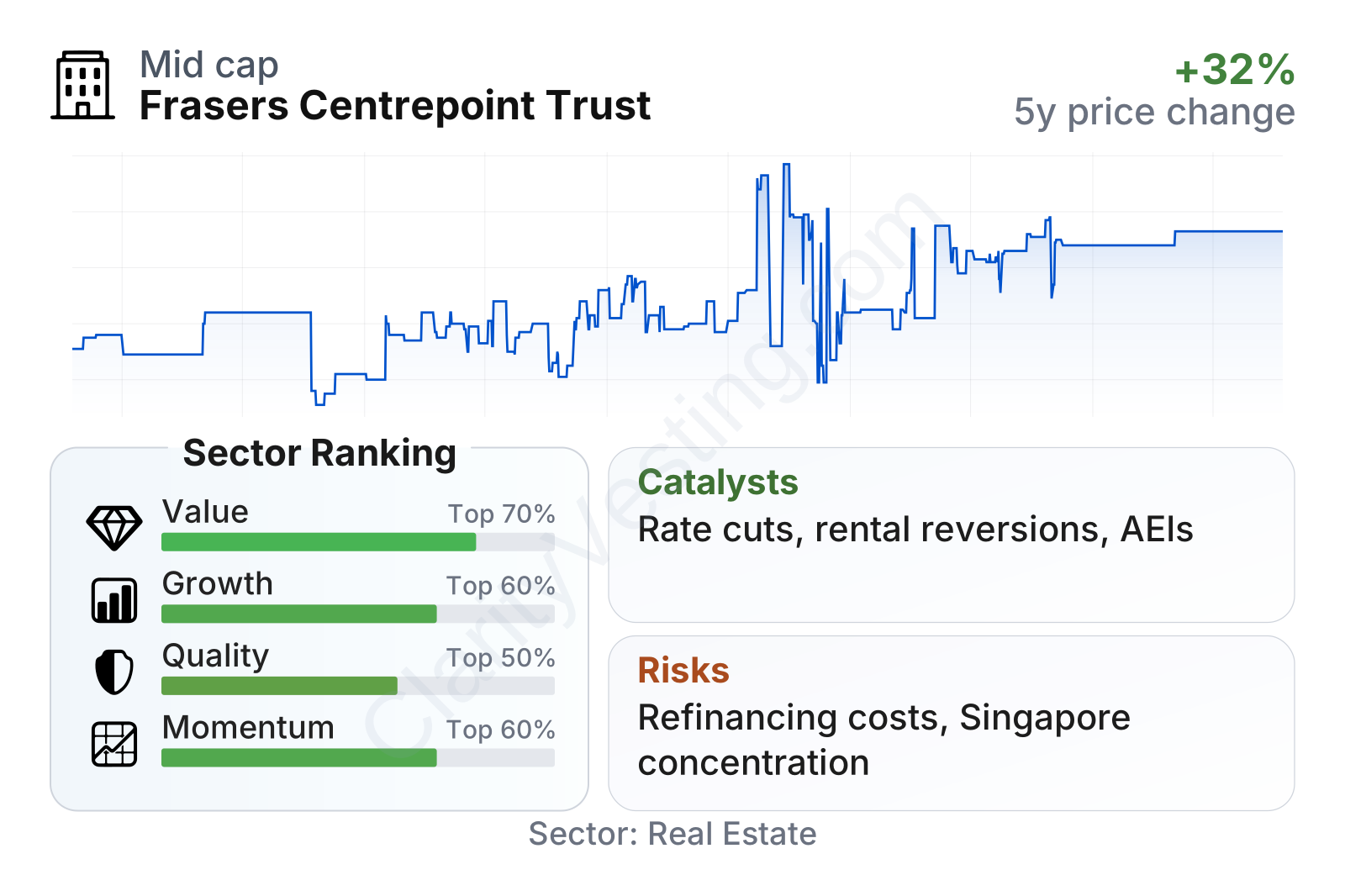
The most relevant catalysts for future growth are likely to come from a few areas. First, rental reversion and tenant remixing can gradually lift income if suburban consumer traffic stays healthy. Second, any easing in interest rates would matter disproportionately because financing costs have become a meaningful drag on earnings. Third, selective acquisitions from the sponsor or the broader market could expand the asset base if executed at attractive yields. Fourth, asset enhancement works at existing malls can raise rents and shopper productivity without requiring a major change to the business model.
Recent operating updates from the trust have continued to emphasize healthy portfolio occupancy, stable shopper traffic, and leasing demand in core suburban locations. That does not create a dramatic near-term growth narrative, but it does support the case for durable medium-term cash generation.
Risks
This article is for informational purposes only and does not constitute financial advice. Some content is AI-generated. See Disclaimer


