Stock Analysis · Federal Realty Investment Trust (FRT)
Overview
Federal Realty Investment Trust is a retail-focused real estate investment trust, or REIT. In simple terms, it owns shopping centers, mixed-use properties, and retail corridors in affluent, densely populated coastal markets, then earns money by leasing space to tenants. Its portfolio is concentrated in areas with high household income and limited land supply, especially in the Northeast, Mid-Atlantic, California, and South Florida. That positioning matters because well-located properties tend to attract stronger tenants, support higher rents, and recover faster when the broader retail market softens.
The business is built around owning and improving neighborhood and community shopping centers that often include grocery anchors, restaurants, fitness, entertainment, apartments, and offices. Federal Realty also develops and redevelops properties, which can lift rents and property values over time. The company has a long operating history and is one of the best-known names in high-quality retail real estate.
Its revenue mainly comes from recurring property income rather than one-time transactions. Based on recent annual filings, the main sources are approximately the following:
- Rental income from retail and mixed-use properties: about 88% to 92%. This is the core of the business and includes base rent paid by tenants occupying stores, restaurants, and other commercial space.
- Recoveries and other property-related revenue: about 7% to 10%. This generally includes reimbursements from tenants for common area maintenance, real estate taxes, insurance, and similar property operating costs.
- Mortgage and other income: usually below 3%. This is a much smaller category and can include fee income, financing-related items, and other miscellaneous real estate revenue.
Revenue has trended upward over the last several years, and operating income has also expanded despite higher interest costs. That pattern suggests the portfolio has been producing stronger cash flow as occupancy and rent levels improved.
The long-term direction has been favorable: total revenue has moved from just under $1.0 billion in 2021 to roughly $1.3 billion by 2025, while operating income has generally risen as well. Some line items appear volatile from year to year because property accounting can include gains, charges, and timing effects, but the bigger picture points to a business with growing rental income and disciplined expense control.
Key Figures
| Metric | Value | Sector ⓘ |
|---|---|---|
| Date | Oct 03, 2026 | |
| Context | ||
| Sector | Real Estate | |
| Industry | REIT - Retail | |
| Market Cap ⓘ | $9.47B | |
| Beta ⓘ | 0.92 | |
Value (Cheapness) | ||
| P/E Ratio ⓘ | 22.05 | 17.35 |
| P/B Ratio ⓘ | 2.99 | 0.86 |
| FCF Yield ⓘ | 5.94% | 7.47% |
| Dividend Yield ⓘ | 4.13% | 4.75% |
| EBIT / EV ⓘ | 4.45% | 3.81% |
| PEG ⓘ | 3.65 | |
Growth (Business expansion) | ||
| Revenue Growth ⓘ | 7.20% | 5.30% |
| RPS Growth (5Y CAGR) ⓘ | 4.91% | 5.96% |
| EPS Growth (5Y CAGR) ⓘ | 9.23% | -11.41% |
| BVPS Growth (5Y CAGR) ⓘ | 3.67% | 0.41% |
| Margin Growth (5Y Trend) ⓘ | 5.58% | 0.53% |
| FCF Growth (5Y CAGR) ⓘ | 81.01% | 5.40% |
| DPS Growth (5Y CAGR) ⓘ | 1.03% | 5.02% |
Quality (Business durability) | ||
| ROIC (Latest) ⓘ | 6.30% | 5.77% |
| ROE (Latest) ⓘ | 14.29% | 7.64% |
| ROA (Latest) ⓘ | 4.87% | 2.85% |
| ROIC (5Y Median) ⓘ | 5.05% | 4.20% |
| ROE (5Y Median) ⓘ | 10.60% | 6.03% |
| ROA (5Y Median) ⓘ | 3.48% | 2.45% |
| Net Debt / EBIT (Latest) ⓘ | 7.73 | 7.57 |
| Net Debt / EBIT (5Y Median) ⓘ | 9.25 | 8.41 |
| Net Debt / EBITDA (Latest) ⓘ | 4.80 | 5.12 |
| Net Debt / Assets ⓘ | 54.74% | 37.84% |
| EBITDA / Interest ⓘ | 5.32 | 4.11 |
| Operating Margin (Latest) ⓘ | 48.03% | 35.40% |
| Operating Margin (5Y Median) ⓘ | 41.71% | 36.59% |
| Debt to Equity (Latest) ⓘ | 144.21% | 89.06% |
| Profit Margin (Latest) ⓘ | 32.66% | 19.99% |
| Free Cash Flow (Latest) ⓘ | $561.99M | |
Momentum (Price trend) | ||
| 3Y Return ⓘ | +38.62% | +30.60% |
| 12M Return (excl. last month) ⓘ | +21.43% | +7.55% |
| 6M Return ⓘ | +3.91% | +0.69% |
| Price vs. 200-Day MA ⓘ | -1.90% | -2.30% |
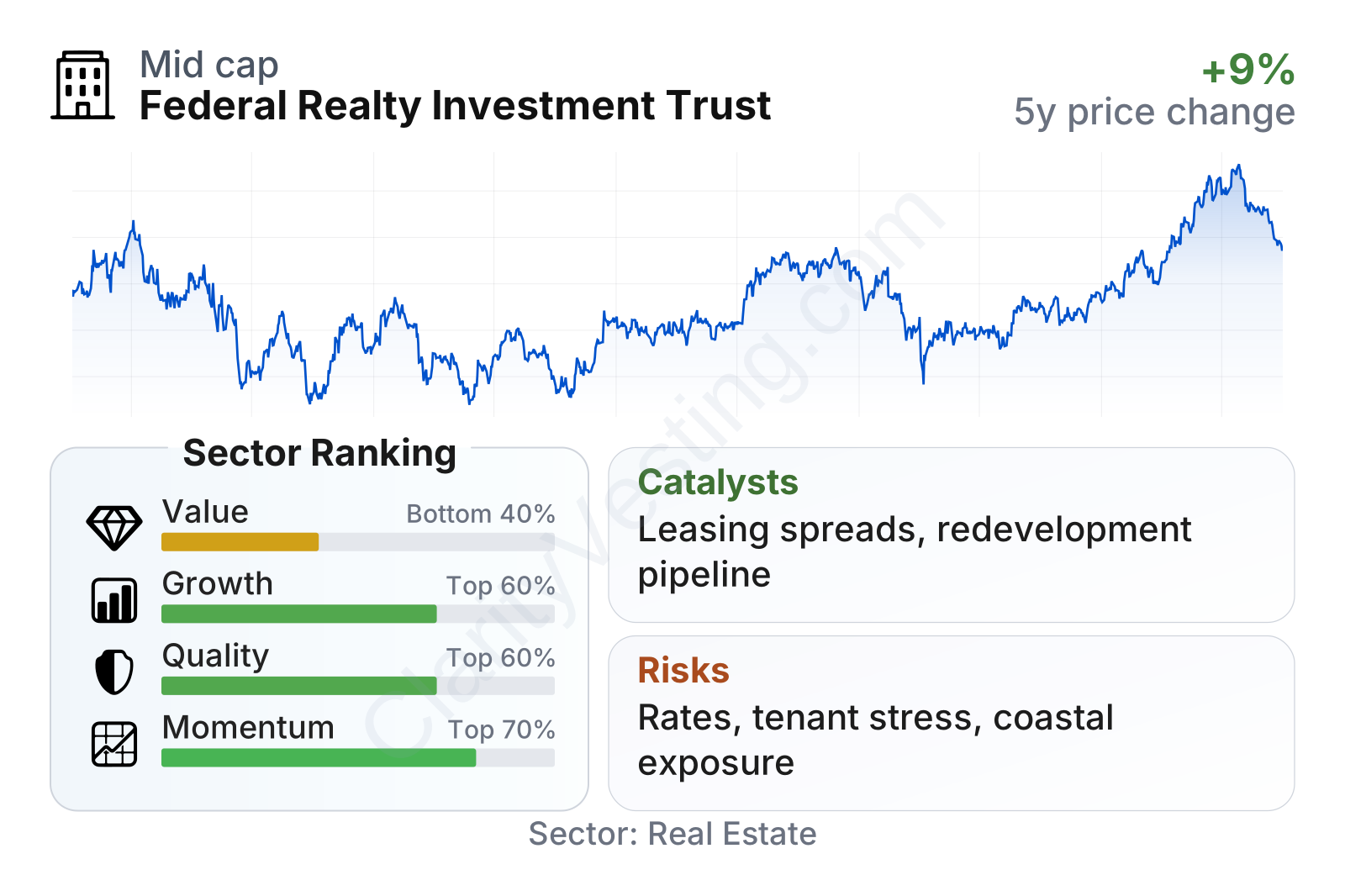
Federal Realty is a large public REIT with a market value around the large-cap range for retail real estate and a beta just below 1, meaning its share price has tended to move somewhat less than the broader stock market. The stock has rebounded strongly since the weaker points of 2022 and 2023, reflecting improving sentiment toward high-quality retail landlords.
The latest metrics show a mixed but understandable profile. On growth, the company sits around the middle-to-better part of the sector, supported by revenue growth above the sector median and a solid multi-year improvement in earnings, margins, and free cash flow. On quality, it also ranks better than many peers, with profitability measures such as return on equity, return on assets, and operating margin comfortably above sector medians.
The weaker area is value. Federal Realty trades at higher earnings and book multiples than the typical real estate company in its sector, while its dividend yield is slightly below the sector median. That usually means the market assigns a premium to the portfolio quality, locations, and balance between stability and growth.
Growth
Federal Realty operates in a part of real estate that is more selective than fast-growing. Retail real estate as a whole is not a high-growth sector in the same way as data centers or industrial logistics, but premium open-air shopping centers and mixed-use properties have held up better than many expected. Well-located centers with grocery anchors, restaurants, essential services, and experiential tenants remain relevant because they serve daily local demand and are harder to replace online.
The company’s strategy makes sense for long-term growth because it is focused on scarce, high-income trade areas where barriers to entry are high. In those markets, new retail supply is often limited by zoning, land cost, and local opposition. That can strengthen landlord pricing power when space becomes available. Federal Realty also has a redevelopment playbook: it can add apartments, offices, restaurants, or upgraded retail layouts to existing sites, increasing the value of properties it already owns.
Revenue per share has increased steadily over the last five years, which is an encouraging sign because it shows growth is not just coming from issuing more shares. The rise has been gradual rather than explosive, but for a REIT focused on mature, high-quality assets, consistency matters more than speed.
The dividend per share has also edged upward over time. The pace has been modest, but that fits Federal Realty’s profile: it has historically emphasized durability and a long record of dividend continuity rather than aggressive increases. For long-term analysis, that suggests a business oriented toward dependable property income.
Several catalysts support the outlook. First, leasing spreads and occupancy recovery can continue to lift rental income as older leases roll into newer terms. Second, redevelopment projects can unlock additional rent from existing land. Third, premium retail landlords have benefited from a period of limited new supply, which helps support rent growth. Recent company updates have also highlighted continued leasing activity, healthy tenant demand in its core markets, and progress in mixed-use development, all of which point to a still-active runway for incremental growth rather than a fully mature plateau.
Risks
This article is for informational purposes only and does not constitute financial advice. Some content is AI-generated. See Disclaimer


