Stock Analysis · China Jinmao Holdings Group Ltd (FRSHY)
Overview
China Jinmao Holdings Group Ltd is a Chinese real estate developer and urban operator. The group is best known for developing residential communities, large mixed-use projects, hotels, commercial properties, and city-development projects, mainly in higher-tier Chinese cities. It is ultimately connected to the state-owned Sinochem group, which matters because state backing can improve financing access and business credibility in a stressed property market.
The company’s business model is still centered on property development, but it also includes investment properties, hotel operations, and urban development services. In simple terms, it earns most of its money by building and selling real estate, while a smaller portion comes from owning and operating properties and related services.
Based on recent annual disclosures, the main revenue sources are approximately:
- Property development and sales: about 85% to 90% — sale of residential units, commercial units, and development projects delivered to buyers.
- Hotel operations and commercial leasing: about 5% to 10% — recurring income from hotels, shopping areas, office buildings, and investment properties.
- City operations, property-related services, and other segments: about 3% to 7% — urban planning and development support, management-related activities, and other smaller business lines.
This revenue mix explains both the opportunity and the risk: China Jinmao has some recurring income, but its results are still heavily tied to China’s housing market, project delivery pace, and land-development economics.
Over the last several years, the broad earnings flow has become much tighter. Revenue has declined meaningfully from 2021 to 2025, while gross profit stayed positive but at lower levels. Operating profit recovered in 2025 after a weak 2023, yet the business remains far smaller and less profitable than it was earlier in the cycle.
Key Figures
| Metric | Value | Sector ⓘ |
|---|---|---|
| Date | Oct 03, 2026 | |
| Context | ||
| Sector | Real Estate | |
| Industry | Real Estate - Development | |
| Market Cap ⓘ | $2.03B | |
| Beta ⓘ | 0.94 | |
Value (Cheapness) | ||
| P/E Ratio ⓘ | 20.83 | 17.35 |
| P/B Ratio ⓘ | 0.05 | 0.86 |
| FCF Yield ⓘ | 180.98% | 7.47% |
| Dividend Yield ⓘ | N/A | 4.75% |
| EBIT / EV ⓘ | N/A | 3.81% |
| PEG ⓘ | 0.12 | |
Growth (Business expansion) | ||
| Revenue Growth ⓘ | -14.70% | 5.30% |
| RPS Growth (5Y CAGR) ⓘ | -11.80% | 5.96% |
| EPS Growth (5Y CAGR) ⓘ | -2.22% | -11.41% |
| BVPS Growth (5Y CAGR) ⓘ | -7.99% | 0.41% |
| Margin Growth (5Y Trend) ⓘ | 1.55% | 0.53% |
| FCF Growth (5Y CAGR) ⓘ | N/A | 5.40% |
| DPS Growth (5Y CAGR) ⓘ | -40.68% | 5.02% |
Quality (Business durability) | ||
| ROIC (Latest) ⓘ | N/A | 5.77% |
| ROE (Latest) ⓘ | 11.41% | 7.64% |
| ROA (Latest) ⓘ | 0.49% | 2.85% |
| ROIC (5Y Median) ⓘ | 1.73% | 4.20% |
| ROE (5Y Median) ⓘ | 2.66% | 6.03% |
| ROA (5Y Median) ⓘ | 0.29% | 2.45% |
| Net Debt / EBIT (Latest) ⓘ | 10.03 | 7.57 |
| Net Debt / EBIT (5Y Median) ⓘ | 16.57 | 8.41 |
| Net Debt / EBITDA (Latest) ⓘ | 8.94 | 5.12 |
| Net Debt / Assets ⓘ | 21.10% | 37.84% |
| EBITDA / Interest ⓘ | 3.39 | 4.11 |
| Operating Margin (Latest) ⓘ | 8.64% | 35.40% |
| Operating Margin (5Y Median) ⓘ | 7.50% | 36.59% |
| Debt to Equity (Latest) ⓘ | 352.68% | 89.06% |
| Profit Margin (Latest) ⓘ | 1.87% | 19.99% |
| Free Cash Flow (Latest) ⓘ | $3.67B | |
Momentum (Price trend) | ||
| 3Y Return ⓘ | -47.49% | +30.60% |
| 12M Return (excl. last month) ⓘ | +2.63% | +7.55% |
| 6M Return ⓘ | 0.00% | +0.69% |
| Price vs. 200-Day MA ⓘ | 0.00% | -2.30% |
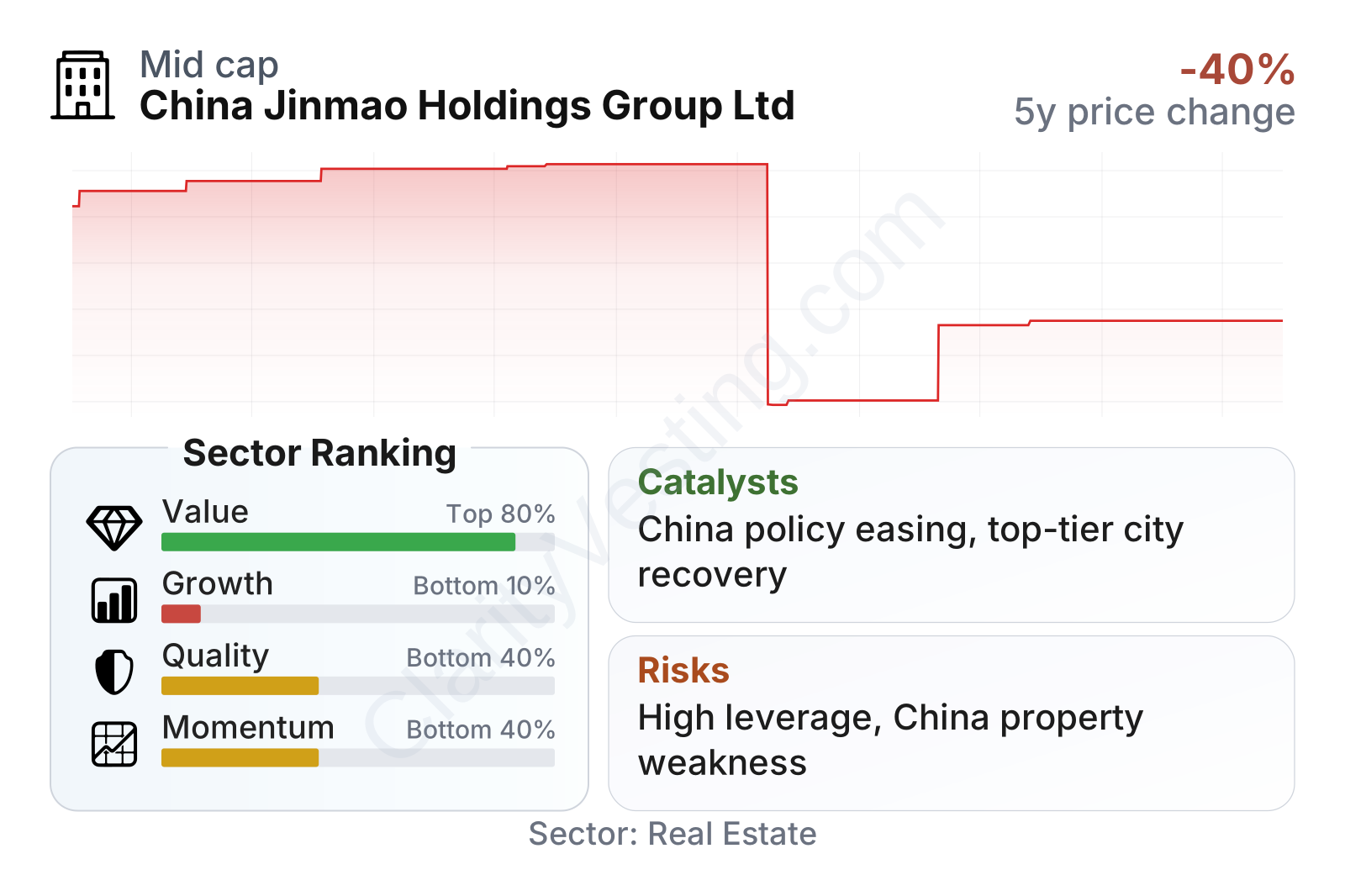
China Jinmao is a mid-sized listed real estate company by market value, and its share-price volatility has been close to the broader market rather than extremely speculative. The table points to a mixed profile. On valuation measures, the shares screen as very cheap on book value and low on PEG, but this comes with weak growth and only middling business quality.
The strongest standout is the gap between its price-to-book ratio and the sector norm. That usually means the market has deep doubts about the value of the company’s assets, future profitability, or both. Free cash flow is positive, which is helpful, but profitability remains thin: operating margin is below 10% and net margin is around 2%, both far below typical sector levels.
Balance-sheet pressure is still important. Debt-to-equity is very high, and leverage measured against EBIT or EBITDA remains elevated versus sector medians. Interest coverage is positive, but not especially comfortable for a developer operating in a still-fragile market.
Price performance also shows the market’s caution. The stock had a major reset in late 2024 and only a partial rebound afterward, which fits the broader re-rating of Chinese developers during the prolonged property downturn.
Growth
China Jinmao operates in a sector that is important to China’s economy but no longer in a broad easy-growth phase. Residential development in China has shifted from expansion to adjustment, with weaker homebuyer sentiment, tighter funding conditions for developers, and more policy focus on project completion, risk control, and inventory digestion rather than aggressive expansion. That means the company is not in a naturally high-growth sector today.
Its strategy is more sensible in that context than a pure volume-driven model. The company has focused on higher-tier cities, urban operation projects, premium positioning, and a more diversified mix including hotels, commercial assets, and city-development capabilities. In theory, this can produce better resilience than lower-quality developers concentrated in weaker cities. State affiliation may also support access to financing and land opportunities that private peers struggle to secure.
Still, the hard numbers show that growth has been weak. Revenue fell about 15% year over year in the latest metrics, and revenue per share has declined steadily over the last five years. That tells a simple story: the company has not yet returned to sustained expansion, even if profitability improved from the 2023 low point.
The declining revenue-per-share trend suggests that project delivery and sales have not replaced earlier volume, so future growth depends more on stabilization than on rapid expansion. For China Jinmao, the most credible catalysts are not explosive growth drivers but a combination of policy support for China’s property market, improved homebuyer confidence in major cities, and continued margin recovery through cost control and better project mix.
Dividend trends also show the reset. The payout was reduced sharply from earlier levels and has stayed much lower since then. That does not automatically signal weakness by itself, because many developers preserved cash during the downturn, but it does show management has prioritized flexibility over shareholder distributions.
A significant opportunity would come from a more durable recovery in China’s top-tier and strong second-tier housing markets, where Jinmao has meaningful exposure. If policy measures continue to support mortgage demand, inventory reduction, and financing access for relatively stronger developers, the company could benefit more than weaker peers because it still has operating scale and an established brand in premium developments.
Risks
This article is for informational purposes only and does not constitute financial advice. Some content is AI-generated. See Disclaimer