Stock Analysis · Freshpet Inc (FRPT)
Overview
Freshpet Inc. makes and sells fresh refrigerated pet food for dogs and cats. Instead of the traditional dry kibble or canned format used by most large pet food brands, Freshpet focuses on meals and treats sold from branded refrigerators placed in grocery stores, mass retailers, club stores, and pet specialty locations. The company’s pitch is simple: pet food made with fresh ingredients, kept refrigerated, and positioned as a more premium and natural option.
Its business model is concentrated, which makes it easy to understand. Freshpet manufactures the food, distributes it to retailers, and supports demand through marketing and its in-store refrigerator network. Revenue is generated almost entirely from product sales, with the United States representing the clear majority of the business and a smaller contribution from international markets such as Canada and parts of Europe.
Based on company filings, Freshpet reports one operating segment, so detailed revenue splits are limited. The most useful breakdown for a general reader is by channel and geography rather than by separate divisions.
- Net sales of fresh refrigerated pet food and treats: approximately 100% of revenue. This includes dog food, cat food, and treats sold under the Freshpet brand.
- United States: dominant share of revenue. The company’s filings indicate the U.S. is by far the main market, with international operations representing a much smaller portion.
- Retail distribution network: sales are driven through supermarkets, mass retailers, club channels, and pet specialty stores, supported by Freshpet-branded fridges installed at points of sale.
One notable financial change over the last several years is that revenue has climbed from roughly $425 million in 2021 to more than $1.1 billion in 2025, while profitability moved from losses to positive operating and net income. That shift matters because it suggests Freshpet is no longer only a growth company spending heavily for scale; it is increasingly showing the economics of a more mature consumer brand.
The business has become much larger while also keeping a bigger share of each sales dollar than it did a few years ago. Gross profit and operating income improved materially over time, which helps explain why the market now looks at Freshpet less as an early-stage disruptor and more as a branded food company trying to prove it can scale efficiently.
Key Figures
| Metric | Value | Sector ⓘ |
|---|---|---|
| Date | Oct 17, 2026 | |
| Context | ||
| Sector | Consumer Defensive | |
| Industry | Packaged Foods | |
| Market Cap ⓘ | $3.14B | |
| Beta ⓘ | 1.78 | |
Value (Cheapness) | ||
| P/E Ratio ⓘ | 17.22 | 17.88 |
| P/B Ratio ⓘ | 2.98 | 1.29 |
| FCF Yield ⓘ | 5.37% | 12.39% |
| Dividend Yield ⓘ | N/A | 2.85% |
| EBIT / EV ⓘ | 5.08% | 6.43% |
| PEG ⓘ | 2.47 | |
Growth (Business expansion) | ||
| Revenue Growth ⓘ | 15.50% | 4.10% |
| RPS Growth (5Y CAGR) ⓘ | 18.69% | 6.18% |
| EPS Growth (5Y CAGR) ⓘ | N/A | -13.59% |
| BVPS Growth (5Y CAGR) ⓘ | 6.50% | 3.20% |
| Margin Growth (5Y Trend) ⓘ | N/A | -0.15% |
| FCF Growth (5Y CAGR) ⓘ | N/A | 4.10% |
| DPS Growth (5Y CAGR) ⓘ | N/A | 6.79% |
Quality (Business durability) | ||
| ROIC (Latest) ⓘ | 13.30% | 12.34% |
| ROA (Latest) ⓘ | 11.44% | 6.30% |
| ROIC (5Y Median) ⓘ | -1.14% | 10.49% |
| ROA (5Y Median) ⓘ | -2.60% | 5.44% |
| Net Debt / EBIT (Latest) ⓘ | 0.91 | 1.96 |
| Net Debt / EBIT (5Y Median) ⓘ | N/A | 2.35 |
| Net Debt / EBITDA (Latest) ⓘ | 0.56 | 1.38 |
| Net Debt / Assets ⓘ | 7.88% | 21.51% |
| EBITDA / Interest ⓘ | 18.17 | 9.46 |
| Operating Margin (Latest) ⓘ | 13.38% | 8.87% |
| Operating Margin (5Y Median) ⓘ | -2.27% | 9.53% |
| Debt to Equity (Latest) ⓘ | 39.89% | 72.35% |
| Profit Margin (Latest) ⓘ | 17.28% | 5.40% |
| Free Cash Flow (Latest) ⓘ | $168.55M | |
Momentum (Price trend) | ||
| 3Y Return ⓘ | +16.15% | +20.92% |
| 12M Return (excl. last month) ⓘ | +16.27% | +2.13% |
| 6M Return ⓘ | -3.06% | +1.26% |
| Price vs. 200-Day MA ⓘ | +4.01% | +1.39% |
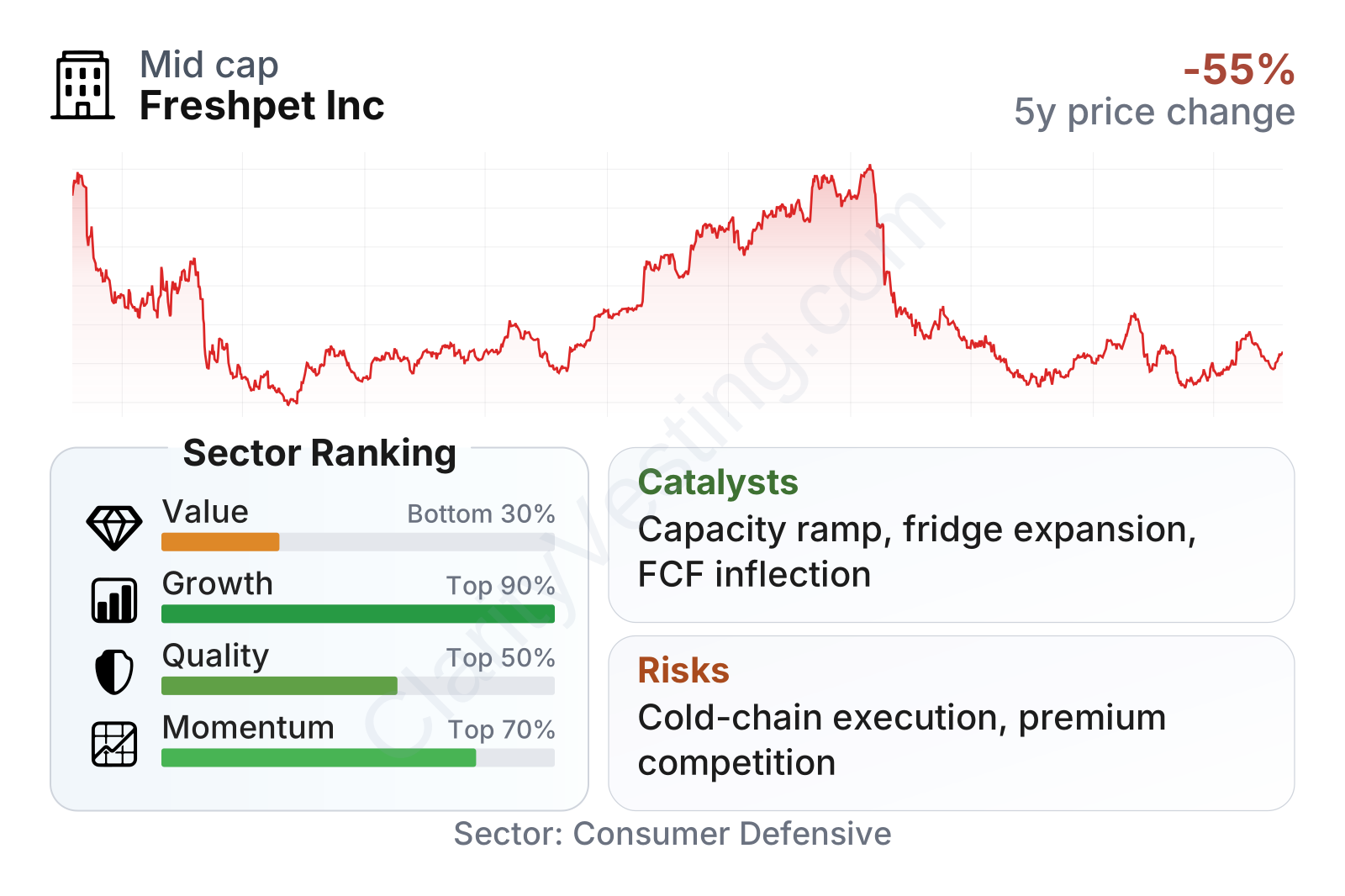
Freshpet is now a mid-sized public company with above-average share price volatility, as shown by a beta well above 1. Its profile is mixed but understandable: growth ranks near the top of the sector, quality is around the middle to upper range, while traditional value measures are weaker. In other words, the market is still paying for expansion and improving profitability, even if the stock no longer trades at the extreme earnings multiples seen earlier in its turnaround.
The stock history also shows how sensitive sentiment has been. After a sharp rise into 2024 and early 2025, the shares corrected heavily before stabilizing. That pattern is common for businesses moving from losses to profits: expectations can change faster than operating results.
Growth
Freshpet operates in a pet food category that has strong long-term support. Pet owners have steadily spent more on premium, natural, and health-oriented products, and many increasingly treat pets as family members. That broader trend has helped the premium pet food market grow faster than many traditional packaged food categories. Freshpet’s refrigerated format also gives it a different shelf presence from dry and canned competitors, which can help the brand stand out in stores.
The company’s strategy for future expansion is coherent. It is built around three levers: adding more retail locations, increasing sales per refrigerator, and expanding manufacturing capacity so supply does not limit demand. This is important because Freshpet’s category is not simply about launching another pet food line; it also requires dedicated cold-chain logistics and branded equipment in stores. That creates more execution complexity, but it also makes the model harder to replicate quickly.
Revenue growth has cooled from the very high rates seen in 2022 through 2024, but it remains strong for a consumer staples business. Recent year-over-year growth has been in the mid-teens, still far above the sector median of roughly 4%. For long-term analysis, the key point is not that growth is slowing from exceptional levels, but that it is still meaningfully ahead of most packaged food peers while the company is already above $1 billion in annual sales.
Another major improvement is cash generation. Freshpet moved from deeply negative free cash flow in earlier years to clearly positive territory by 2026. That change reduces dependence on outside capital and gives the company more room to fund capacity, marketing, and distribution from its own operations. For a company that spent years prioritizing expansion, this is one of the most important signs that the business model is strengthening.
A meaningful catalyst is the company’s ongoing capacity buildout and distribution expansion. Freshpet has spent heavily in recent years to increase production capabilities, including kitchen capacity designed to support future growth. If those assets are utilized efficiently, the next stage could bring a better mix of revenue growth and margin expansion rather than growth alone. Another favorable factor is that Freshpet’s current sales base remains small compared with the overall U.S. pet food market, leaving room for penetration gains if consumer adoption continues.
Risks
This article is for informational purposes only and does not constitute financial advice. Some content is AI-generated. See Disclaimer


