Stock Analysis · Fermi Inc (FRMI)
Overview
Fermi Inc is a specialty real estate investment trust, or REIT, operating in the cannabis property niche. In simple terms, it owns real estate used by state-licensed cannabis businesses and earns income mainly by leasing those properties to tenants. This model is designed to give cannabis operators access to capital without using traditional bank financing, while Fermi collects rent and, in some cases, financing-related income tied to those real estate transactions.
The business has historically been built around a fairly concentrated set of revenue drivers:
- Rental revenue: typically the largest source, generated from long-term leases on cultivation, processing, and dispensary-related facilities.
- Tenant reimbursements and property-related income: payments tied to property costs, when contract structures allow recovery of expenses.
- Financing or transaction-related income: depending on the structure of a deal, this can include interest or other income linked to capital provided alongside a real estate arrangement.
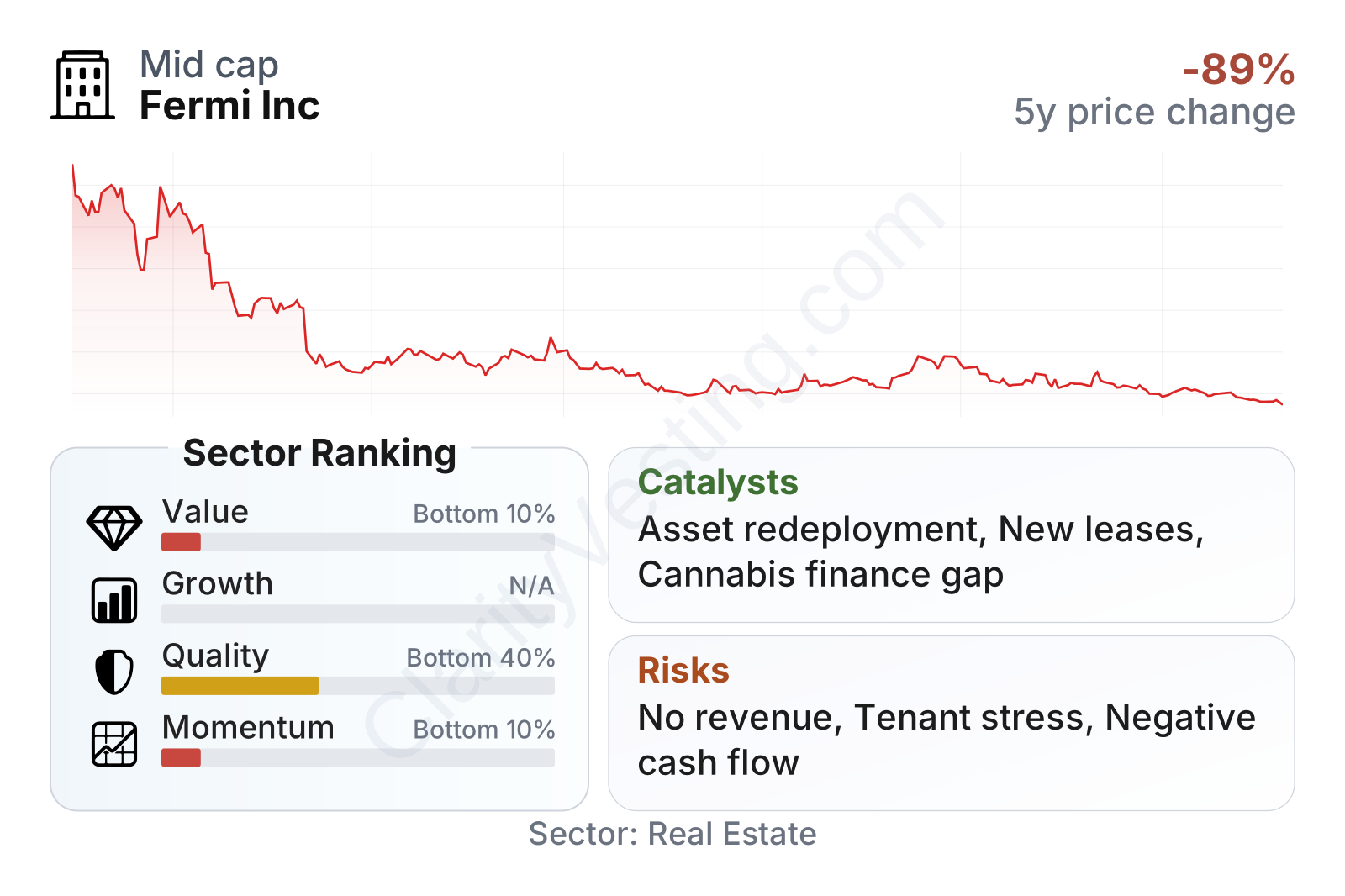
At the moment, recent financial information points to an unusual transition period. The latest annual profile reflected here shows no reported revenue and only operating expenses, which suggests the company has been going through a major portfolio reset, asset restructuring, or a reporting period in which prior revenue sources were no longer contributing in a normal way. That makes the current business mix less stable and less predictable than a typical income-producing REIT.
Fermi’s investment case therefore depends less on a mature, diversified rent stream today and more on whether management can rebuild a productive portfolio in a specialized property market that still has long-term demand potential but remains operationally difficult.
The latest annual flow underscores how far the company is from a normal REIT earnings profile: expenses were recorded without corresponding revenue, leading to a deep operating loss and a large net loss. For a property owner, that usually signals a major disruption in asset utilization rather than a routine weak quarter.
Key Figures
| Metric | Value | Sector ⓘ |
|---|---|---|
| Date | Oct 10, 2026 | |
| Context | ||
| Sector | Real Estate | |
| Industry | REIT - Specialty | |
| Market Cap ⓘ | $2.55B | |
| Beta ⓘ | N/A | |
Value (Cheapness) | ||
| P/E Ratio ⓘ | N/A | 17.21 |
| P/B Ratio ⓘ | 2.26 | 0.86 |
| FCF Yield ⓘ | -48.71% | 7.55% |
| Dividend Yield ⓘ | N/A | 4.84% |
| EBIT / EV ⓘ | -10.14% | 3.81% |
| PEG ⓘ | N/A | |
Growth (Business expansion) | ||
| Revenue Growth ⓘ | N/A | 5.30% |
| RPS Growth (5Y CAGR) ⓘ | N/A | 6.02% |
| EPS Growth (5Y CAGR) ⓘ | N/A | -11.37% |
| BVPS Growth (5Y CAGR) ⓘ | N/A | 0.61% |
| Margin Growth (5Y Trend) ⓘ | N/A | 0.40% |
| FCF Growth (5Y CAGR) ⓘ | N/A | 5.35% |
| DPS Growth (5Y CAGR) ⓘ | N/A | 5.05% |
Quality (Business durability) | ||
| ROIC (Latest) ⓘ | -24.46% | 5.69% |
| ROE (Latest) ⓘ | -104.11% | 7.56% |
| ROA (Latest) ⓘ | -61.30% | 2.85% |
| ROIC (5Y Median) ⓘ | N/A | 4.21% |
| ROE (5Y Median) ⓘ | N/A | 6.03% |
| ROA (5Y Median) ⓘ | N/A | 2.44% |
| Net Debt / EBIT (Latest) ⓘ | N/A | 7.66 |
| Net Debt / EBIT (5Y Median) ⓘ | N/A | 8.42 |
| Net Debt / EBITDA (Latest) ⓘ | N/A | 5.27 |
| Net Debt / Assets ⓘ | -3.55% | 37.76% |
| EBITDA / Interest ⓘ | N/A | 4.10 |
| Operating Margin (Latest) ⓘ | N/A | 35.18% |
| Operating Margin (5Y Median) ⓘ | N/A | 37.31% |
| Debt to Equity (Latest) ⓘ | N/A | 88.87% |
| Profit Margin (Latest) ⓘ | N/A | 19.61% |
| Free Cash Flow (Latest) ⓘ | -$1.24B | |
Momentum (Price trend) | ||
| 3Y Return ⓘ | N/A | +30.71% |
| 12M Return (excl. last month) ⓘ | N/A | +6.58% |
| 6M Return ⓘ | -23.75% | -1.74% |
| Price vs. 200-Day MA ⓘ | -47.16% | -3.29% |
The recent market picture is weak. The share price has been extremely volatile over the past year, with a sharp collapse followed by only a partial rebound. Relative to other real estate stocks, momentum ranks near the bottom of the sector, and the stock is trading well below its long-term trend line.
On fundamentals, the profile is also strained. Value metrics screen poorly because the company is not currently generating positive earnings or free cash flow, and its price-to-book ratio remains well above the sector median even after a large decline in the stock. Quality indicators are also weak, with negative returns on assets, equity, and invested capital. One unusual positive point is the balance sheet structure shown here: net debt relative to assets appears better than most peers, suggesting the company is not carrying the same level of leverage pressure seen in many REITs. Still, weak profitability currently outweighs that balance sheet advantage.
Growth
The broader sector Fermi targets still has a real long-term opening. Cannabis operators continue to need specialized cultivation and processing facilities, and access to traditional financing in the United States remains limited because of federal legal restrictions. That financing gap is the main reason cannabis-focused property owners emerged in the first place. If capital markets for the industry remain constrained, a landlord with sector expertise can still play an important role.
Strategically, the model makes sense in theory: acquire specialized facilities, lease them on long contracts, and benefit from rent escalators while tenants deploy their capital into operations instead of property ownership. If the company can restore occupancy, reposition assets, or place capital into stronger operators, that would be the clearest path back to recurring revenue.
The problem is that current growth evidence is limited. Recent metrics show no year-over-year revenue growth, which is a major concern for a REIT that depends on dependable rent collection. So while the addressable market may expand over time, the company first needs to demonstrate that its own platform can translate that market opportunity into stable cash generation.
The most important catalysts are likely to come from company-specific execution rather than broad sector optimism alone. These include new lease activity, redeployment of assets that are not currently productive, and any signs that tenant quality is improving. A secondary catalyst would be a friendlier regulatory or financing environment for the U.S. cannabis industry, since that could improve tenant health and support demand for specialized properties. In short, the sector has room to grow, but Fermi’s near-term outlook depends heavily on rebuilding operations from a weakened base.
Risks
This article is for informational purposes only and does not constitute financial advice. Some content is AI-generated. See Disclaimer