Stock Analysis · First Merchants Corporation (FRME)
Overview
First Merchants Corporation is a regional bank holding company headquartered in Indiana. Through First Merchants Bank, it provides traditional banking services to consumers, businesses, municipalities, and nonprofit organizations across the Midwest. Its model is straightforward: gather deposits, make loans, earn the spread between funding costs and loan yields, and add fee income from services such as wealth management, treasury management, and mortgage banking.
The company’s revenue mix is dominated by interest-related banking income, which is typical for a regional bank. Based on recent annual reporting, the main sources of revenue can be summarized as follows:
- Net interest income: about 75% to 85% of total revenue. This is the money earned from loans and securities after paying interest on deposits and borrowings.
- Service charges and customer fees: about 5% to 8%. This includes deposit account charges and other routine banking fees.
- Wealth management and trust fees: about 4% to 7%. These come from advisory, trust, and investment-related services.
- Card, treasury, and other payment-related fees: about 3% to 6%. This includes commercial treasury services, debit and credit card activity, and related processing income.
- Mortgage banking and other noninterest income: usually less than 5%. This can include gains on loan sales, mortgage servicing-related items, and miscellaneous banking income.
That revenue mix matters because it shows First Merchants is still primarily a spread-based lender, not a broadly diversified financial platform. Noninterest income helps, but the company remains heavily tied to credit demand, deposit pricing, and the level of interest rates.
The business has also grown through acquisitions in recent years, which helped expand its market presence in Indiana, Ohio, and neighboring states. At the same time, that larger footprint brings a familiar challenge for regional banks: integrating operations efficiently while protecting credit quality and maintaining customer relationships.
Over the last several years, total revenue moved meaningfully higher, but profit did not rise at the same pace. The main reason is that funding and interest costs climbed sharply as rates reset, while operating expenses also increased. In other words, the bank became larger, but each dollar of revenue has recently been less efficient than it was earlier in the cycle.
Key Figures
| Metric | Value | Sector ⓘ |
|---|---|---|
| Date | Oct 17, 2026 | |
| Context | ||
| Sector | Financial Services | |
| Industry | Banks - Regional | |
| Market Cap ⓘ | $2.44B | |
| Beta ⓘ | 0.88 | |
Value (Cheapness) | ||
| P/E Ratio ⓘ | 12.47 | 12.26 |
| P/B Ratio ⓘ | 0.92 | 1.23 |
| FCF Yield ⓘ | 12.93% | 10.40% |
| Dividend Yield ⓘ | 3.71% | 3.02% |
| EBIT / EV ⓘ | 5.98% | 8.14% |
| PEG ⓘ | 1.40 | |
Growth (Business expansion) | ||
| Revenue Growth ⓘ | 2.80% | 9.35% |
| RPS Growth (5Y CAGR) ⓘ | 15.29% | 12.19% |
| EPS Growth (5Y CAGR) ⓘ | -20.74% | -9.53% |
| BVPS Growth (5Y CAGR) ⓘ | 4.80% | 4.99% |
| Margin Growth (5Y Trend) ⓘ | -18.64% | -3.86% |
| FCF Growth (5Y CAGR) ⓘ | 18.65% | 4.81% |
| DPS Growth (5Y CAGR) ⓘ | 6.68% | 8.79% |
Quality (Business durability) | ||
| ROIC (Latest) ⓘ | N/A | 9.49% |
| ROE (Latest) ⓘ | 7.28% | 13.90% |
| ROA (Latest) ⓘ | 0.93% | 1.55% |
| ROIC (5Y Median) ⓘ | 7.36% | 7.86% |
| ROE (5Y Median) ⓘ | 10.51% | 12.17% |
| ROA (5Y Median) ⓘ | 1.23% | 1.30% |
| Net Debt / EBIT (Latest) ⓘ | 4.79 | 0.96 |
| Net Debt / EBIT (5Y Median) ⓘ | 2.84 | 0.73 |
| Net Debt / EBITDA (Latest) ⓘ | 4.14 | 0.92 |
| Operating Margin (Latest) ⓘ | 18.95% | 22.30% |
| Operating Margin (5Y Median) ⓘ | 25.94% | 24.63% |
| Debt to Equity (Latest) ⓘ | 59.46% | 58.56% |
| Profit Margin (Latest) ⓘ | 28.96% | 26.57% |
| Free Cash Flow (Latest) ⓘ | $314.90M | |
Momentum (Price trend) | ||
| 3Y Return ⓘ | +59.40% | +88.33% |
| 12M Return (excl. last month) ⓘ | +9.22% | +19.38% |
| 6M Return ⓘ | -0.79% | +4.75% |
| Price vs. 200-Day MA ⓘ | -1.32% | +3.50% |
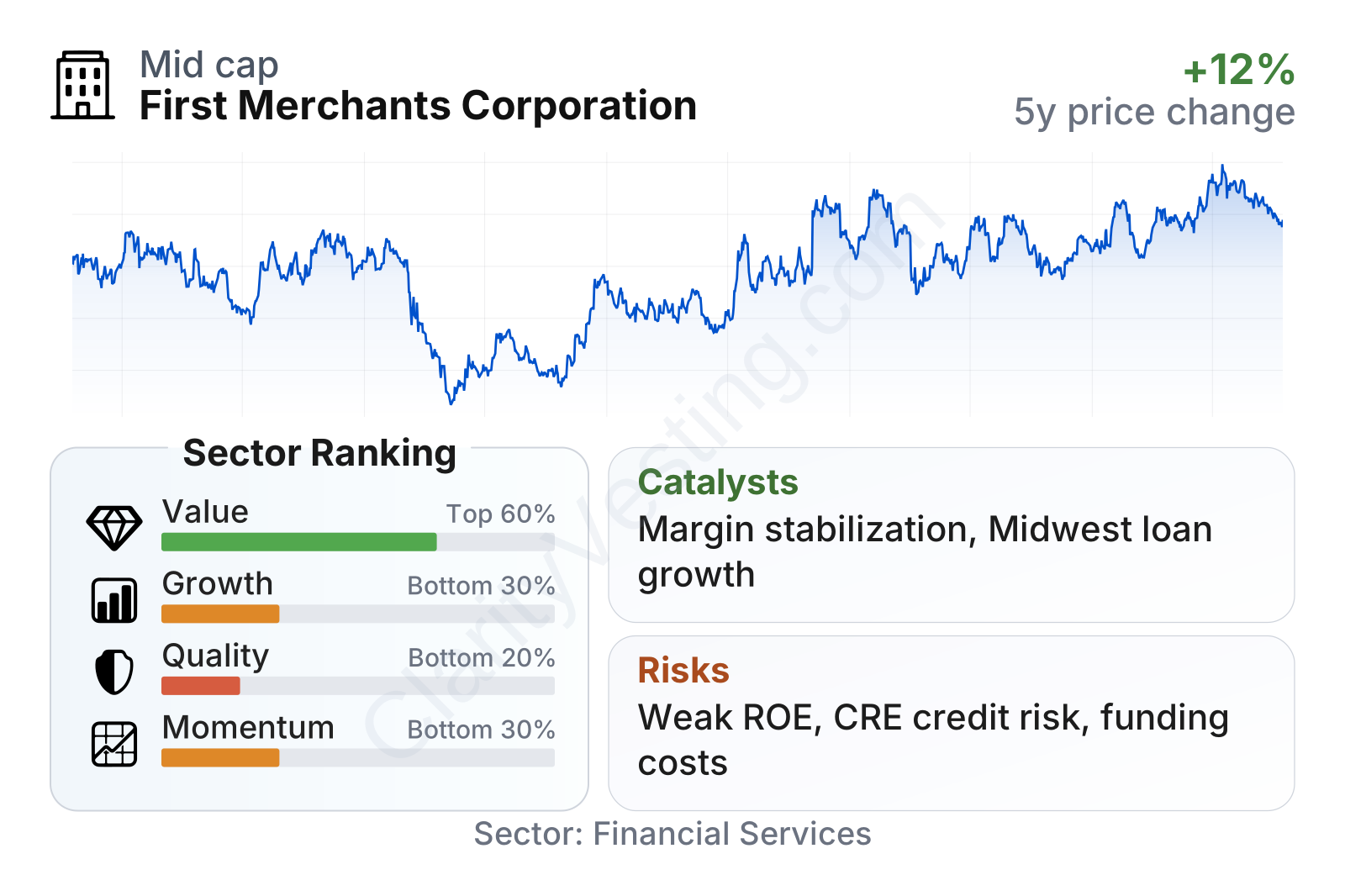
First Merchants sits in the mid-sized regional bank range, with a share price that has recovered well from the 2023 regional banking selloff and has climbed to new highs over the last year. On valuation, it looks close to the sector median on earnings but below the sector median on book value, which suggests the market is assigning a discount relative to many peers. Income characteristics are solid, with a dividend yield above the sector median. The weaker side of the picture is quality and growth: recent profitability measures rank below many regional banks, and near-term growth has been relatively modest even though longer-term revenue per share expansion has been respectable.
Growth
Regional banking is not a high-growth industry in the way software or semiconductors can be, but it remains a necessary part of the economy. Banks like First Merchants grow by adding customers, gaining deposits, expanding loans, acquiring smaller institutions, and widening fee-based services. In that sense, the company operates in a steady sector rather than a fast-growing one. Its opportunity depends more on execution and local market share gains than on a booming industry backdrop.
First Merchants’ strategy is sensible for that environment. It focuses on commercial banking relationships in Midwest markets, where long-standing customer ties can support lower-cost deposits and cross-selling of treasury management, wealth, and other services. This is usually a more durable approach than chasing rapid loan growth in unfamiliar markets. The bank also benefits from being large enough to spread technology and compliance costs across a broader base, while still remaining locally oriented.
Earnings per share show a business that has stayed profitable through a difficult rate and funding cycle, but growth has not been smooth. Earnings rose in 2022, then weakened in 2023 and 2024 before improving again in 2025. That pattern suggests the bank has resilience, but not strong momentum. For long-term analysis, the key question is whether earnings can compound from here as funding pressure eases and the company gets more leverage from its existing branch and loan platform.
Book value per share has trended upward over time, which is an encouraging sign for a bank because book value is a useful anchor for measuring the accumulation of capital. The pace has been moderate rather than exceptional, but the direction has been positive. That usually points to a franchise that is still adding value over time even when earnings growth is uneven.
A practical catalyst is the possibility of margin stabilization. If deposit costs stop rising faster than asset yields, net interest income can improve without requiring aggressive balance-sheet expansion. Another possible support is continued commercial activity in its Midwest footprint, especially if business formation, equipment financing, and local real estate lending remain healthy. Recent company updates have also emphasized capital strength and ongoing shareholder distributions, which can matter for how the market views a regional bank during periods of uncertainty.
Risks
This article is for informational purposes only and does not constitute financial advice. Some content is AI-generated. See Disclaimer


