Stock Analysis · First Industrial Realty Trust Inc (FR)
Overview
First Industrial Realty Trust is a real estate investment trust focused on industrial properties in the United States. In simple terms, it owns, develops, acquires, and leases warehouses and distribution buildings used for storage, logistics, e-commerce fulfillment, light manufacturing, and supply chain operations. Its portfolio is concentrated in major logistics markets where tenants need access to population centers, transportation networks, and large labor pools.
The business model is straightforward: the company collects rent from tenants, develops new industrial buildings for future rental income, and occasionally sells properties or land when pricing is attractive. Because it is organized as a REIT, real estate operations and cash flow generation are the core of the company rather than side activities.
Its revenue mix is still dominated by recurring property income, with smaller contributions from property transactions and development-related activities. Based on recent annual reporting, the main sources are approximately:
- Rental and tenant-related revenue: about 85% to 90% — base rent, reimbursements, and other income tied to operating leased industrial buildings.
- Sales of real estate and land: about 10% to 15% — gains or proceeds associated with selling stabilized assets, development sites, or other properties.
- Other sources: limited — items such as interest or miscellaneous real estate-related income.
Over the last several years, total revenue has trended upward, and operating income has also improved. One unusual point is that the latest annual cost breakdown appears distorted by accounting effects tied to property activity, so the cleaner takeaway is that the company’s underlying earnings still come mainly from leasing industrial space rather than from one-off financial engineering.
Key Figures
| Metric | Value | Sector ⓘ |
|---|---|---|
| Date | Oct 24, 2026 | |
| Context | ||
| Sector | Real Estate | |
| Industry | REIT - Industrial | |
| Market Cap ⓘ | $8.14B | |
| Beta ⓘ | 1.04 | |
Value (Cheapness) | ||
| P/E Ratio ⓘ | 21.52 | 17.85 |
| P/B Ratio ⓘ | 2.90 | 0.87 |
| FCF Yield ⓘ | 5.04% | 7.30% |
| Dividend Yield ⓘ | 3.19% | 4.83% |
| EBIT / EV ⓘ | 4.12% | 3.78% |
| PEG ⓘ | 3.74 | |
Growth (Business expansion) | ||
| Revenue Growth ⓘ | 8.40% | 5.35% |
| RPS Growth (5Y CAGR) ⓘ | 10.58% | 6.02% |
| EPS Growth (5Y CAGR) ⓘ | 7.59% | -10.65% |
| BVPS Growth (5Y CAGR) ⓘ | 4.27% | 0.43% |
| Margin Growth (5Y Trend) ⓘ | -15.76% | -0.69% |
| FCF Growth (5Y CAGR) ⓘ | 35.73% | 5.40% |
| DPS Growth (5Y CAGR) ⓘ | 12.83% | 5.07% |
Quality (Business durability) | ||
| ROIC (Latest) ⓘ | 9.12% | 5.69% |
| ROE (Latest) ⓘ | 13.20% | 7.37% |
| ROA (Latest) ⓘ | 6.23% | 2.85% |
| ROIC (5Y Median) ⓘ | 7.67% | 4.26% |
| ROE (5Y Median) ⓘ | 11.32% | 6.04% |
| ROA (5Y Median) ⓘ | 5.51% | 2.45% |
| Net Debt / EBIT (Latest) ⓘ | 5.16 | 7.55 |
| Net Debt / EBIT (5Y Median) ⓘ | 5.77 | 8.26 |
| Net Debt / EBITDA (Latest) ⓘ | 3.65 | 5.26 |
| Net Debt / Assets ⓘ | 43.89% | 37.45% |
| EBITDA / Interest ⓘ | 5.49 | 4.11 |
| Operating Margin (Latest) ⓘ | 56.56% | 33.86% |
| Operating Margin (5Y Median) ⓘ | 56.86% | 37.49% |
| Debt to Equity (Latest) ⓘ | 92.73% | 88.76% |
| Profit Margin (Latest) ⓘ | 47.92% | 18.94% |
| Free Cash Flow (Latest) ⓘ | $409.84M | |
Momentum (Price trend) | ||
| 3Y Return ⓘ | +45.29% | +36.33% |
| 12M Return (excl. last month) ⓘ | +23.02% | +4.32% |
| 6M Return ⓘ | -11.30% | -1.74% |
| Price vs. 200-Day MA ⓘ | -8.76% | -1.42% |
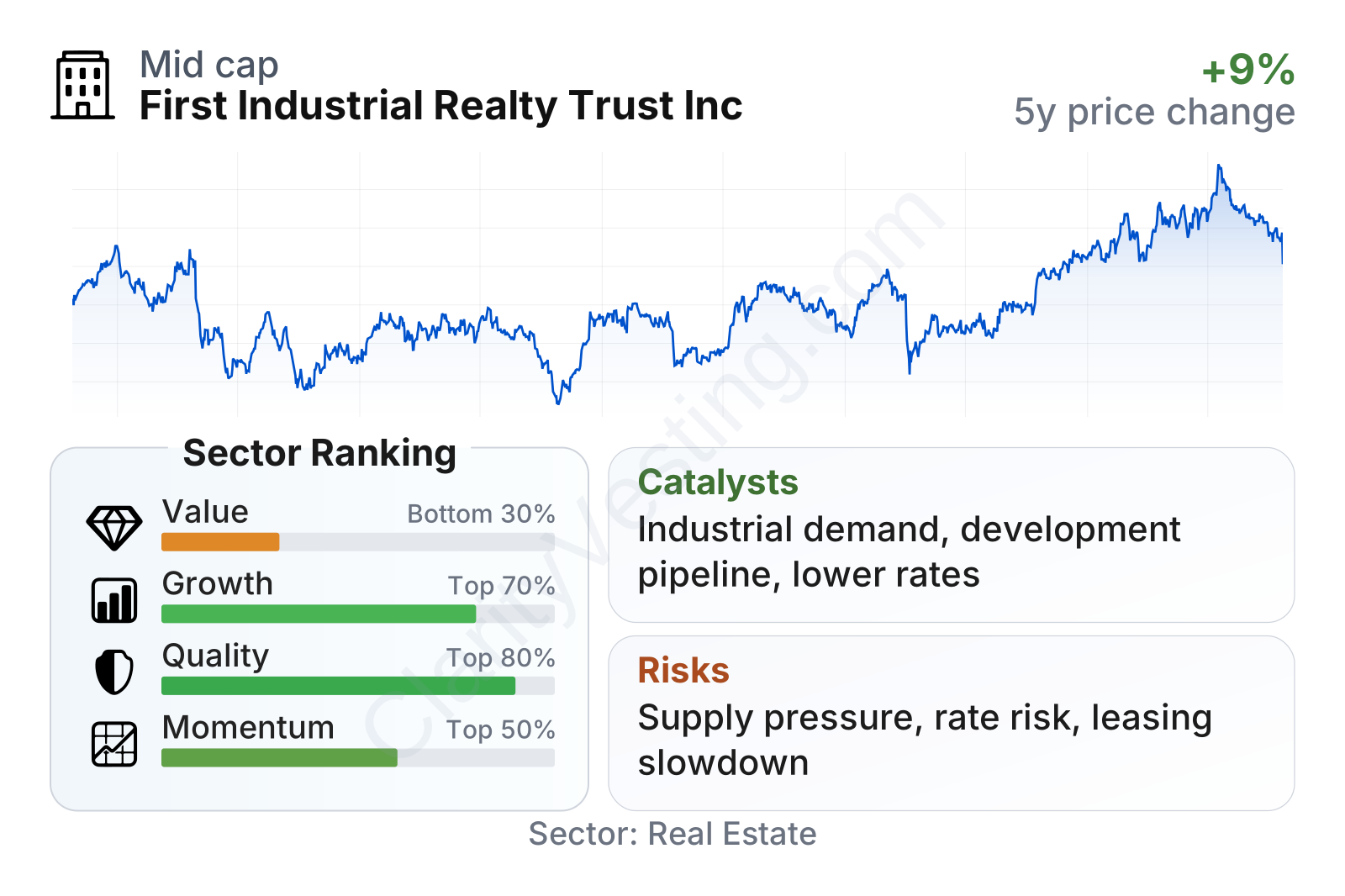
First Industrial Realty Trust is a mid-to-large industrial REIT with a market value in the multi-billion-dollar range. The overall picture from the latest metrics is mixed but fairly clear: growth, quality, and recent share-price momentum rank above much of the sector, while valuation looks less attractive. Profitability measures are strong for a REIT, leverage is controlled relative to peers, and revenue growth has been better than the sector median. On the other hand, the shares trade at noticeably higher P/E and P/B multiples than many other real estate names, while the dividend yield sits below the sector median.
Growth
Industrial real estate remains one of the more structurally attractive areas within commercial property. Demand has been supported by e-commerce, supply-chain redesign, inventory repositioning, and the need for modern logistics facilities near major customers. Even though the sector has cooled from the extraordinary pandemic-era surge, long-term demand drivers are still more favorable than in many office or retail segments.
First Industrial’s strategy fits that backdrop well. The company focuses on modern industrial assets in important logistics corridors, and it combines stable rental income with selective development. That matters because development can create value beyond simply buying already stabilized buildings, especially when new supply is targeted to markets with durable tenant demand. The company has also been active in portfolio recycling, which can help shift capital toward higher-growth locations and better buildings.
Revenue per share has increased steadily over the last five years, which is an encouraging sign because it suggests growth has not relied only on issuing more shares. The pace has been comfortably ahead of the sector median over that period. Free cash flow growth has also been strong, reinforcing the idea that expansion has translated into real cash generation rather than staying only on paper.
Dividend growth has also been strong, with the payout per share rising at a double-digit annual rate over five years. That does not make the current yield high compared with other REITs, but it does show that the company has been increasing shareholder distributions alongside business expansion. For a long-term view, rising dividends can be more meaningful than a headline yield if the underlying cash flow continues to build.
A recent and important catalyst is the continued normalization of interest-rate expectations after a period of elevated borrowing costs. Industrial REITs are sensitive to financing conditions, and a more stable or easier rate environment can support property values, development economics, and investor appetite for real estate. In addition, the company’s recent operational momentum, including stronger revenue growth than much of the sector and a rising share price over the last year, suggests the market has been recognizing that operating performance remains resilient.
Risks
This article is for informational purposes only and does not constitute financial advice. Some content is AI-generated. See Disclaimer


