Stock Analysis · Fevertree Drinks Plc (FQVTF)
Overview
Fevertree Drinks Plc is a premium mixer company best known for tonic water, ginger beer, ginger ale, soda water, and other carbonated mixers designed to pair with spirits. The business was built around a simple idea: if consumers spend more on premium gin, tequila, whiskey, or other spirits, they may also pay more for a better mixer. Over time, Fevertree has expanded beyond tonic into a broader range of adult soft drinks and cocktail-related products, but premium mixers remain the core of the brand.
The company sells primarily through retail stores and hospitality channels such as bars, restaurants, and hotels, using a brand-led model supported by third-party production and distribution partners in many markets. Geographically, Fevertree has historically been strongest in the United Kingdom, while the United States has become one of its most important growth priorities. A major strategic development is its long-term U.S. partnership with Molson Coors, which is intended to improve national distribution, local production, and brand reach.
Based on recent annual reporting, revenue is mainly organized by geography rather than by product line. The mix below is approximate and should be read as a geographic view of the business rather than a full product breakdown.
- United Kingdom: about 35% to 40% of revenue. This includes tonic water and other premium mixers sold through supermarkets, convenience, and on-premise locations.
- United States: about 30% to 35% of revenue. This is a key expansion market, with tonic and ginger products forming a large part of sales.
- Europe: about 15% to 20% of revenue. This covers continental European markets outside the U.K.
- Rest of World: about 10% to 15% of revenue. This includes international markets such as Australia and selected export territories.
From a product perspective, tonic water is still widely recognized as the largest category, followed by ginger beer and ginger ale, then soda, lemonade, sparkling soft drinks, and newer cocktail-focused offerings. Precise current percentages by product are not consistently disclosed in a way that supports a reliable exact split.
The financial flow over the last several years shows a business that has kept revenue broadly stable to modestly growing, but with profitability that has been more volatile. Cost pressure in 2022 and 2023 weighed on gross profit and earnings, while 2024 showed some margin recovery. That pattern matters because Fevertree’s investment case depends heavily on whether it can convert premium brand strength into steadier earnings growth.
Key Figures
| Metric | Value | Sector ⓘ |
|---|---|---|
| Date | Oct 17, 2026 | |
| Context | ||
| Sector | Consumer Defensive | |
| Industry | Beverages - Non-Alcoholic | |
| Market Cap ⓘ | $1.25B | |
| Beta ⓘ | 1.15 | |
Value (Cheapness) | ||
| P/E Ratio ⓘ | 38.90 | 17.88 |
| P/B Ratio ⓘ | 6.52 | 1.29 |
| FCF Yield ⓘ | 5.84% | 12.39% |
| Dividend Yield ⓘ | 1.54% | 2.85% |
| EBIT / EV ⓘ | 5.52% | 6.43% |
| PEG ⓘ | N/A | |
Growth (Business expansion) | ||
| Revenue Growth ⓘ | 14.40% | 4.10% |
| RPS Growth (5Y CAGR) ⓘ | 0.13% | 6.18% |
| EPS Growth (5Y CAGR) ⓘ | -38.02% | -13.59% |
| BVPS Growth (5Y CAGR) ⓘ | -6.56% | 3.20% |
| Margin Growth (5Y Trend) ⓘ | -8.83% | -0.15% |
| FCF Growth (5Y CAGR) ⓘ | -7.95% | 4.10% |
| DPS Growth (5Y CAGR) ⓘ | 2.00% | 6.79% |
Quality (Business durability) | ||
| ROIC (Latest) ⓘ | N/A | 12.34% |
| ROA (Latest) ⓘ | 17.17% | 6.30% |
| ROIC (5Y Median) ⓘ | 9.68% | 10.49% |
| ROA (5Y Median) ⓘ | 7.68% | 5.44% |
| Net Debt / EBIT (Latest) ⓘ | N/A | 1.96 |
| Net Debt / EBIT (5Y Median) ⓘ | -2.50 | 2.35 |
| Net Debt / EBITDA (Latest) ⓘ | N/A | 1.38 |
| Net Debt / Assets ⓘ | -23.95% | 21.51% |
| EBITDA / Interest ⓘ | 88.02 | 9.46 |
| Operating Margin (Latest) ⓘ | 9.55% | 8.87% |
| Operating Margin (5Y Median) ⓘ | 9.14% | 9.53% |
| Debt to Equity (Latest) ⓘ | 1.89% | 72.35% |
| Profit Margin (Latest) ⓘ | 7.29% | 5.40% |
| Free Cash Flow (Latest) ⓘ | $72.77M | |
Momentum (Price trend) | ||
| 3Y Return ⓘ | -5.54% | +20.92% |
| 12M Return (excl. last month) ⓘ | -11.20% | +2.13% |
| 6M Return ⓘ | +7.94% | +1.26% |
| Price vs. 200-Day MA ⓘ | +2.09% | +1.39% |
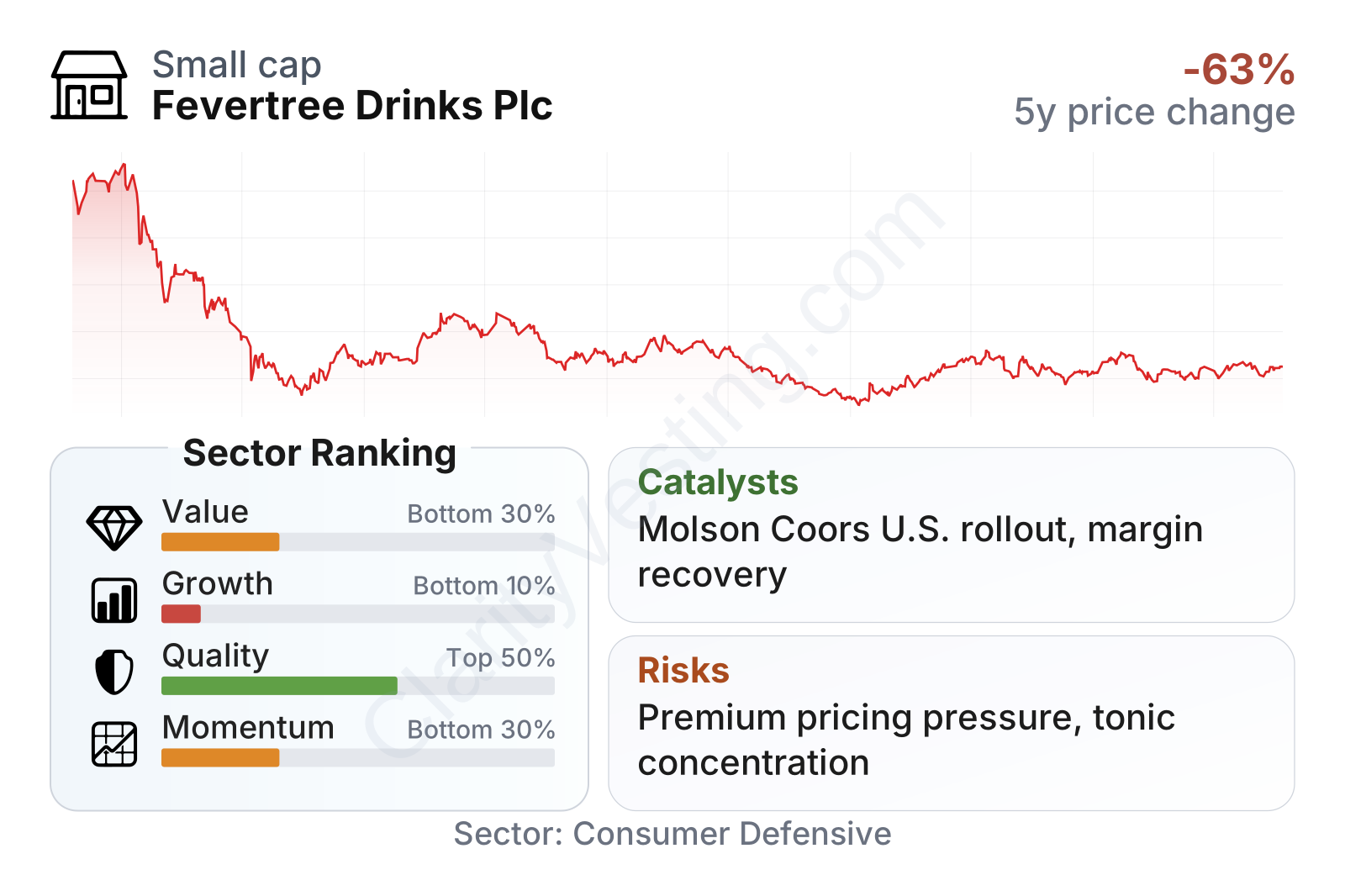
Fevertree is a mid-sized beverage company with a stock that has been much weaker over the last three years than the broader consumer defensive median, even though shorter-term performance has improved. The business currently screens well on balance-sheet strength and overall quality, helped by high returns on assets, very low leverage, and strong interest coverage. Profitability is respectable rather than exceptional, with operating margin near sector levels and net margin above the median.
The weaker part of the profile is valuation and long-term growth consistency. Multiples remain elevated versus the sector, while five-year revenue-per-share, earnings, free-cash-flow, and book-value trends all look soft. In other words, the company has a clean financial structure and a solid brand, but it has not yet translated that into a strong multi-year compounding record.
Growth
Fevertree operates in an attractive niche within beverages: premium mixers tied to cocktail culture and premium spirits. This segment benefits from long-term consumer trends such as premiumization, at-home entertaining, and demand for better-quality ingredients. Even when alcohol markets slow, mixers can still benefit if consumers continue trading up within a smaller number of occasions. That does not make the category recession-proof, but it does give Fevertree exposure to a part of beverages that can grow faster than basic carbonated soft drinks.
The company’s strategy is logical. Its brand is positioned at the premium end, and management has focused on broadening distribution rather than trying to become a mass-market soda company. The most important growth lever is the United States. Fevertree’s partnership with Molson Coors gives it access to deeper distribution, stronger retail execution, and local manufacturing support, which should help with both shelf presence and logistics. If that partnership works as intended, Fevertree could improve availability in grocery, liquor, and on-premise channels while reducing friction in the supply chain.
There is also room for growth outside classic gin-and-tonic occasions. The broader spirits market now includes strong demand for tequila, bourbon, and ready-made cocktails, and that opens more occasions for ginger beer, club soda, and other premium mixers. Product innovation can help, but distribution matters more than novelty in this category. Fevertree’s opportunity is not just launching new flavors; it is becoming the default premium mixer brand across more drinking occasions and more markets.
Recent operating trends suggest some progress, but not a straight line. Revenue growth over the last year has been notably stronger than the sector median, which indicates demand has not stalled. At the same time, the longer five-year growth record remains weak, showing that recovery is still incomplete. The company appears to be moving from a period of cost disruption and uneven execution toward a more normalized operating base, but sustained growth still needs to be demonstrated over several reporting periods.
Risks
This article is for informational purposes only and does not constitute financial advice. Some content is AI-generated. See Disclaimer


