Stock Analysis · First Pacific Company Limited (FPAFF)
Overview
First Pacific Company Limited is a Hong Kong-listed investment holding company with most of its operations in Southeast Asia. Despite being tagged in some market databases under packaged foods, the business is much broader than a typical food company. It owns major stakes in several large operating businesses, mainly in the Philippines and Indonesia, with exposure to consumer food, telecommunications, infrastructure, and natural resources.
The group’s economic engine is concentrated in a few large subsidiaries and associates. Based on the latest annual reporting, revenue is driven primarily by food and consumer staples, while profit contribution is more diversified because telecom and infrastructure assets can be highly cash generative even when they do not dominate reported sales.
Main sources of revenue, from largest to smallest, are approximately:
- Consumer food products through Indofood and related units: about 75% to 80%. This includes noodles, dairy, snacks, flour milling, edible oils, beverages, and agribusiness activities tied to palm oil and related products.
- Infrastructure through Metro Pacific and related assets: about 10% to 15%. This includes toll roads, water utilities, hospitals, rail, and power-related infrastructure, mostly in the Philippines.
- Telecommunications through PLDT: about 10% to 15%. This includes mobile, broadband, enterprise connectivity, and data center-related services.
- Natural resources and other holdings: low single-digit share of revenue. This mainly comes from mining and energy interests such as Philex Mining and smaller investment activities.
What makes First Pacific unusual is that it is not a single-brand operating company. It is better understood as a regional holding company that gives exposure to several essential-service businesses at once: food consumption, mobile and broadband demand, and infrastructure usage. That structure can create resilience, but it also adds complexity because outside shareholders depend on management’s capital allocation across different subsidiaries and jurisdictions.
Over the last several years, the income profile has generally improved. Revenue moved from a little above $9 billion in 2021 to slightly above $10 billion in 2025, while net income rose much faster. Gross profit also expanded, showing that the business mix and pricing discipline have helped offset cost inflation. One important offset is financing cost: interest expense has increased materially over the same period, which matters for a holding company with meaningful leverage and infrastructure exposure.
The overall picture is of a group with stable top-line progression, stronger operating profitability than many consumer defensive peers, and a rising burden from interest costs that investors need to keep in mind.
Key Figures
| Metric | Value | Sector ⓘ |
|---|---|---|
| Date | Oct 10, 2026 | |
| Context | ||
| Sector | Consumer Defensive | |
| Industry | Packaged Foods | |
| Market Cap ⓘ | $2.86B | |
| Beta ⓘ | 0.78 | |
Value (Cheapness) | ||
| P/E Ratio ⓘ | 4.85 | 17.64 |
| P/B Ratio ⓘ | 0.60 | 1.27 |
| FCF Yield ⓘ | 110.17% | 12.68% |
| Dividend Yield ⓘ | 5.65% | 2.85% |
| EBIT / EV ⓘ | 43.75% | 6.32% |
| PEG ⓘ | N/A | |
Growth (Business expansion) | ||
| Revenue Growth ⓘ | 5.70% | 3.85% |
| RPS Growth (5Y CAGR) ⓘ | 3.34% | 6.20% |
| EPS Growth (5Y CAGR) ⓘ | -14.34% | -14.31% |
| BVPS Growth (5Y CAGR) ⓘ | 7.75% | 3.33% |
| Margin Growth (5Y Trend) ⓘ | 7.34% | -0.17% |
| FCF Growth (5Y CAGR) ⓘ | 82.56% | 4.37% |
| DPS Growth (5Y CAGR) ⓘ | 12.47% | 6.68% |
Quality (Business durability) | ||
| ROIC (Latest) ⓘ | 21.38% | 12.58% |
| ROA (Latest) ⓘ | 4.34% | 6.32% |
| ROIC (5Y Median) ⓘ | 10.53% | 10.38% |
| ROA (5Y Median) ⓘ | 1.90% | 5.44% |
| Net Debt / EBIT (Latest) ⓘ | 1.86 | 1.92 |
| Net Debt / EBIT (5Y Median) ⓘ | 4.33 | 2.32 |
| Net Debt / EBITDA (Latest) ⓘ | 1.56 | 1.36 |
| Net Debt / Assets ⓘ | 28.02% | 21.29% |
| EBITDA / Interest ⓘ | 4.00 | 9.52 |
| Operating Margin (Latest) ⓘ | 22.38% | 8.88% |
| Operating Margin (5Y Median) ⓘ | 20.99% | 9.53% |
| Debt to Equity (Latest) ⓘ | 292.95% | 71.95% |
| Profit Margin (Latest) ⓘ | 5.43% | 5.37% |
| Free Cash Flow (Latest) ⓘ | $3.15B | |
Momentum (Price trend) | ||
| 3Y Return ⓘ | +98.24% | +18.12% |
| 12M Return (excl. last month) ⓘ | -18.09% | +2.64% |
| 6M Return ⓘ | -6.38% | +1.32% |
| Price vs. 200-Day MA ⓘ | -7.67% | +0.17% |
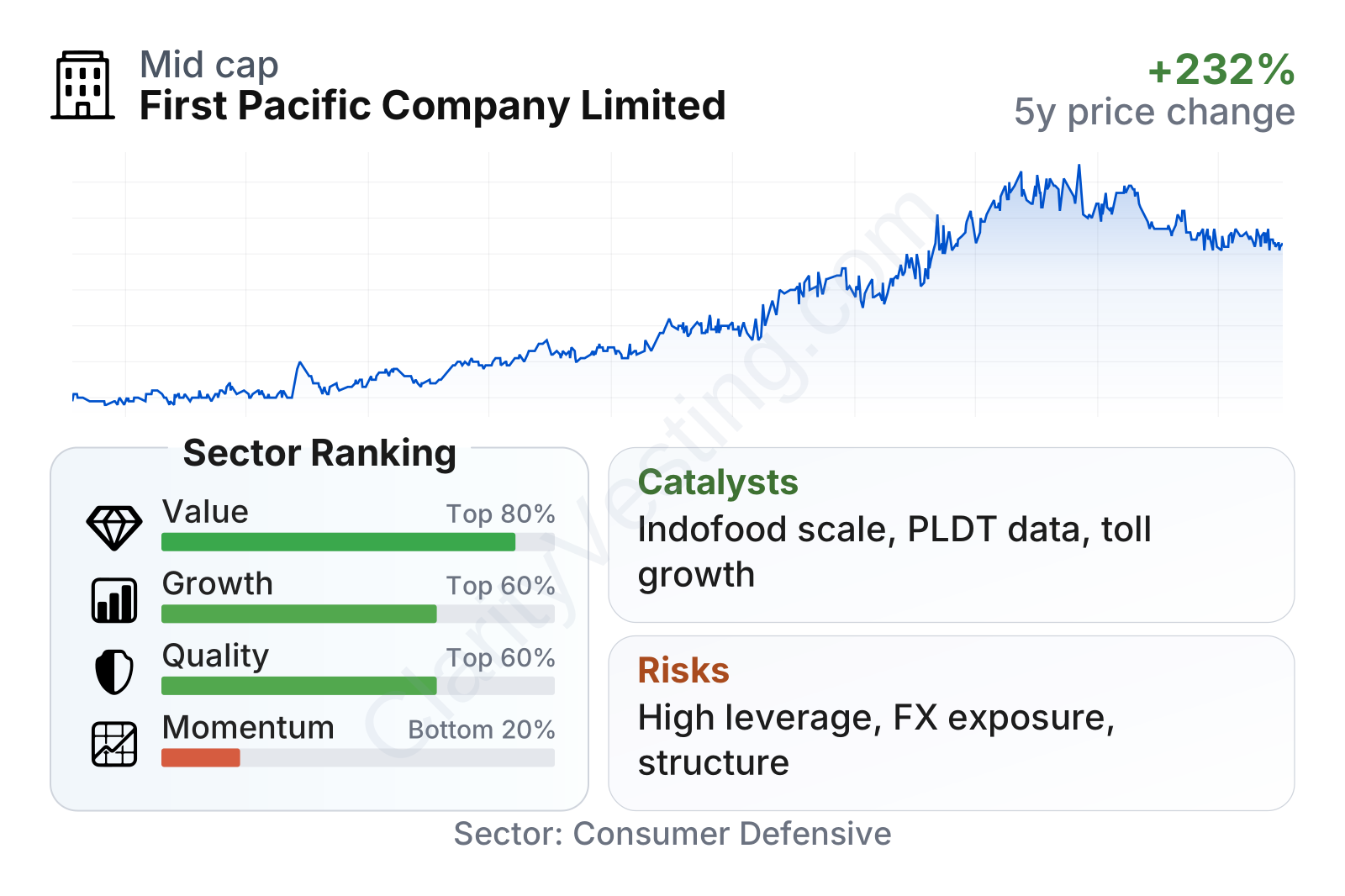
The market metrics point to a stock that screens as inexpensive relative to its sector on earnings, book value, cash flow, and enterprise value measures. Profitability is stronger than the sector median, especially at the operating margin level, and recent return on invested capital is solid. Growth is more mixed: recent revenue growth is respectable, margin progression has been favorable, and free cash flow has improved sharply, but the longer five-year revenue-per-share trend is slower than the sector median and earnings have been uneven over that period.
Balance-sheet quality is acceptable rather than pristine. Net debt relative to EBIT is close to sector norms on a trailing basis, but debt to equity is much higher than the median and interest coverage is noticeably weaker. In other words, the company’s cash generation looks strong, yet leverage still deserves attention. Share-price momentum has cooled after a strong multi-year run, which helps explain why valuation remains low even after a substantial rise from 2021 levels.
Growth
First Pacific operates in sectors that are generally supported by long-term demand rather than fast-changing technology cycles. Food demand in Indonesia and the Philippines tends to grow with population, urbanization, and rising household income. Telecommunications benefits from increasing mobile data use and fixed broadband penetration. Infrastructure demand is also supported by growing traffic, water consumption, electricity needs, and healthcare usage in dense urban areas. These are favorable structural markets for a long-duration business.
The company’s strategy also has a clear industrial logic. Instead of chasing one narrow theme, it owns controlling or significant positions in businesses tied to everyday consumption and national development. Indofood gives scale in staple and affordable food categories. PLDT brings exposure to digital connectivity. Metro Pacific adds toll roads, utilities, and hospitals, which tend to have recurring demand and, in some cases, regulated or contracted economics. That combination can produce steadier cash flows than a more cyclical conglomerate.
A meaningful catalyst is the continued build-out of Philippine infrastructure and digital services. Traffic recovery and capacity expansion can support toll-road volumes, while broadband and data usage can help telecom demand. In Indonesia, consumer staple categories remain attractive because affordability and distribution reach matter, and Indofood has long-established brands and logistics. If these core assets continue improving margins while keeping volume growth intact, group earnings can expand even without dramatic revenue growth.
Recent corporate developments also matter. First Pacific has continued to emphasize value creation at the subsidiary level, including capital discipline, cash generation, and dividends from major holdings. For a parent company of this type, upstream dividend flow is especially important because it supports debt service, shareholder distributions, and flexibility for new investments. That makes steady operating performance at PLDT, Metro Pacific, and Indofood a direct growth support for the parent.
Risks
This article is for informational purposes only and does not constitute financial advice. Some content is AI-generated. See Disclaimer


