Stock Analysis · Fosun International Ltd (FOSUF)
Overview
Fosun International Ltd is a China-based conglomerate that owns and operates a wide mix of businesses across consumer products, tourism, pharmaceuticals, insurance, and investment activities. The group describes its model as combining industrial operations with investment management, meaning it does not rely on a single product or market. Its best-known holdings have included Club Med in leisure, Fosun Pharma in healthcare, Yuyuan in consumer and retail, and insurance assets that help provide recurring cash generation.
Because Fosun is a holding company with many subsidiaries, revenue is spread across several business lines rather than coming from one dominant product. Based on recent annual reporting, the main sources of revenue are broadly ranked as follows:
- Health – approximately 35% to 40% of revenue. This includes pharmaceuticals, medical devices, diagnostics, and healthcare services, led mainly by Fosun Pharma and related healthcare operations.
- Happiness – approximately 25% to 30% of revenue. This covers tourism, leisure, fashion, branded consumer goods, restaurants, and lifestyle businesses, including Club Med and other consumer-facing brands.
- Wealth – approximately 20% to 25% of revenue. This includes insurance and asset-related operations, where earnings can come from premiums, investment income, and financial services activities.
- Intelligent Manufacturing and other operations – approximately 10% to 15% of revenue. This includes industrial businesses, materials, and other diversified holdings.
That diversification is both a strength and a complication. It reduces dependence on one sector, but it also makes Fosun harder to analyze than a pure-play pharmaceutical, insurer, or travel company. Over the last several years, management has emphasized “strategic focus,” asset disposals, and debt reduction, which suggests the group is shifting away from empire-building and toward balance-sheet repair and core business execution.
The overall pattern shows a large revenue base with meaningful gross profit, but also heavy operating costs and interest expense. Operating performance improved from the weak period around 2022, yet bottom-line earnings remained volatile, highlighting how financing costs, fair-value changes, and one-off items can strongly affect reported profit.
Key Figures
| Metric | Value | Sector ⓘ |
|---|---|---|
| Date | Oct 10, 2026 | |
| Context | ||
| Sector | Industrials | |
| Industry | Conglomerates | |
| Market Cap ⓘ | $5.44B | |
| Beta ⓘ | 0.51 | |
Value (Cheapness) | ||
| P/E Ratio ⓘ | N/A | 22.32 |
| P/B Ratio ⓘ | 0.06 | 1.98 |
| FCF Yield ⓘ | 789.57% | 6.34% |
| Dividend Yield ⓘ | N/A | 1.95% |
| EBIT / EV ⓘ | N/A | 4.71% |
| PEG ⓘ | N/A | |
Growth (Business expansion) | ||
| Revenue Growth ⓘ | -0.40% | 9.25% |
| RPS Growth (5Y CAGR) ⓘ | 1.88% | 7.75% |
| EPS Growth (5Y CAGR) ⓘ | N/A | -13.37% |
| BVPS Growth (5Y CAGR) ⓘ | -37.52% | 6.12% |
| Margin Growth (5Y Trend) ⓘ | 26.16% | 0.81% |
| FCF Growth (5Y CAGR) ⓘ | N/A | 11.01% |
| DPS Growth (5Y CAGR) ⓘ | -31.38% | 9.48% |
Quality (Business durability) | ||
| ROIC (Latest) ⓘ | N/A | 10.70% |
| ROA (Latest) ⓘ | -3.50% | 5.38% |
| ROIC (5Y Median) ⓘ | -0.33% | 9.26% |
| ROA (5Y Median) ⓘ | -0.10% | 4.94% |
| Net Debt / EBIT (Latest) ⓘ | N/A | 2.08 |
| Net Debt / EBIT (5Y Median) ⓘ | 7.68 | 2.29 |
| Net Debt / EBITDA (Latest) ⓘ | 2.24 | 1.43 |
| Net Debt / Assets ⓘ | 22.30% | 19.34% |
| EBITDA / Interest ⓘ | 3.60 | 9.54 |
| Operating Margin (Latest) ⓘ | N/A | 10.34% |
| Operating Margin (5Y Median) ⓘ | 6.80% | 10.29% |
| Debt to Equity (Latest) ⓘ | 231.16% | 65.52% |
| Profit Margin (Latest) ⓘ | -12.90% | 6.63% |
| Free Cash Flow (Latest) ⓘ | $42.99B | |
Momentum (Price trend) | ||
| 3Y Return ⓘ | +8.48% | +61.33% |
| 12M Return (excl. last month) ⓘ | +34.00% | +14.82% |
| 6M Return ⓘ | +55.81% | +3.53% |
| Price vs. 200-Day MA ⓘ | +38.60% | +0.88% |
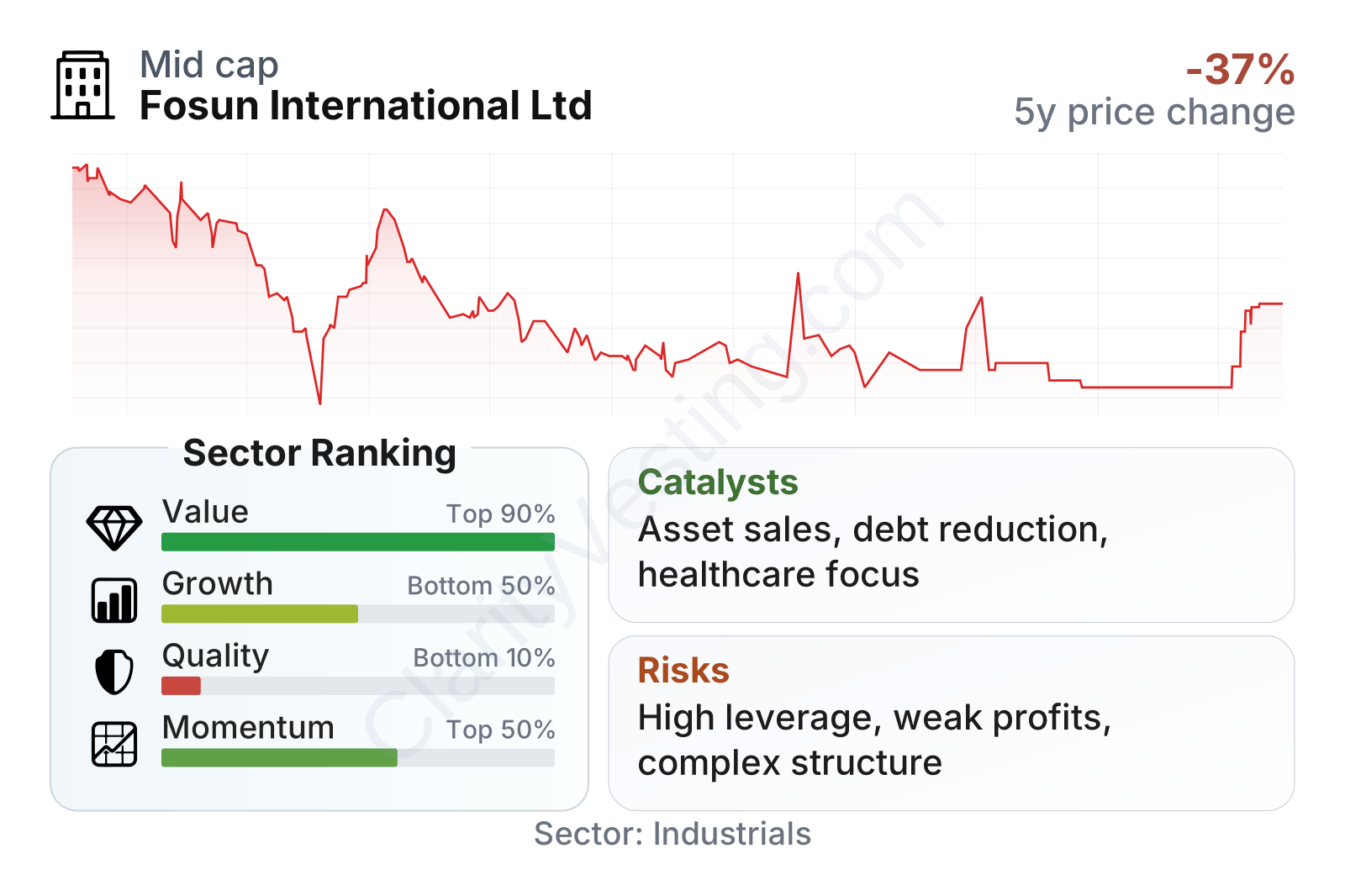
Fosun sits in the large-cap range but trades with unusually low valuation multiples relative to most industrial conglomerates. The table points to a stock that looks statistically cheap, with a very low price-to-book ratio and a free-cash-flow yield that stands well above sector norms. At the same time, quality indicators are weak: profitability trails the sector, returns on assets are negative, and leverage remains high. Growth signals are mixed, with recent operating margin improvement offset by soft revenue expansion and a sharp decline in book value per share over the past five years. Price momentum has improved noticeably in the shorter term, but that recovery follows a much weaker longer-term share-price record.
The stock-price history reflects this tension. The market has marked the shares down significantly from earlier levels and then stabilized at a much lower range. That usually means investors are waiting for clearer proof that debt reduction, portfolio simplification, and earnings normalization are durable rather than temporary.
Growth
Fosun is exposed to several sectors that still have long-term growth potential, especially healthcare, domestic consumption, premium leisure, and wealth management in China. Healthcare is the clearest structural growth area. Demand for drugs, medical devices, diagnostics, and healthcare services tends to benefit from aging populations, rising health spending, and ongoing innovation. If Fosun can keep its healthcare arm competitive, that part of the portfolio could remain one of the group’s more durable engines.
Tourism and lifestyle businesses also offer recovery and expansion potential. Club Med and related travel assets are linked to demand for premium vacations and outbound tourism, particularly from Chinese consumers as travel patterns normalize. These businesses can grow faster than the broader economy when consumer confidence is healthy, although they are naturally cyclical.
The most important strategic point is not simply sector growth, but whether Fosun’s current plan makes sense. Recent company communications have stressed shrinking non-core assets, improving cash collection, and lowering debt. For a highly leveraged conglomerate, that strategy is more credible than aggressive expansion. If management continues to sell assets at acceptable prices, reduce financing pressure, and concentrate on stronger businesses such as healthcare, insurance, and selected consumer brands, the group could become easier to value and financially more resilient.
A meaningful catalyst is the possibility of balance-sheet improvement translating into better market confidence. Conglomerates often trade at discounts when investors worry about complexity and debt. If Fosun keeps simplifying the portfolio and demonstrates steadier cash generation from core subsidiaries, that discount can narrow even without rapid revenue growth. Another positive angle is the recent improvement in shorter-term share performance, which suggests the market has become somewhat more constructive after a long period of skepticism.
Risks
This article is for informational purposes only and does not constitute financial advice. Some content is AI-generated. See Disclaimer


