Stock Analysis · Forestar Group Inc (FOR)
Overview
Forestar Group Inc is a residential lot developer. In simple terms, it buys raw land, obtains zoning and other approvals, installs infrastructure such as roads, utilities, and drainage, and then sells finished lots to homebuilders that construct houses on those sites. The company operates across many local markets in the United States and focuses on communities where population growth and housing demand can support steady lot absorption.
Its business model is more specialized than that of a traditional homebuilder. Forestar generally does not earn most of its money by building and selling houses to consumers. Instead, it sits earlier in the housing chain and supplies finished lots to builders. A major strategic feature is its relationship with D.R. Horton, which owns a controlling stake in Forestar and is also its largest customer. That link gives Forestar a large built-in outlet for lot sales, while still allowing it to sell to other builders.
The company’s revenue is heavily concentrated in one activity. Based on its filings, the main sources are approximately:
- Residential lot sales: about 97% to 99% of revenue. This includes finished lots sold to homebuilders, primarily for single-family housing communities.
- Land and other property sales: about 1% to 3% of revenue. This can include undeveloped land, commercial parcels, or other real-estate-related transactions that are not the core finished-lot business.
Over the last several years, revenue has stayed around the mid-$1 billion range, while profitability has moved with land costs, overhead, and the pace of lot deliveries. Gross profit improved in fiscal 2024 and remained solid in fiscal 2025, but selling and administrative costs also rose, which reduced some of that operating leverage.
The operating picture is straightforward: most of the money coming in is tied to land development and lot closings, and most of the spending goes into land acquisition, development costs, and community overhead. The recent pattern suggests a business that is still scaling, but with margins that can swing from year to year depending on project mix and timing.
Key Figures
| Metric | Value | Sector ⓘ |
|---|---|---|
| Date | Oct 17, 2026 | |
| Context | ||
| Sector | Real Estate | |
| Industry | Real Estate - Development | |
| Market Cap ⓘ | $1.26B | |
| Beta ⓘ | 1.40 | |
Value (Cheapness) | ||
| P/E Ratio ⓘ | 7.43 | 17.38 |
| P/B Ratio ⓘ | 0.71 | 0.85 |
| FCF Yield ⓘ | 22.42% | 7.38% |
| Dividend Yield ⓘ | N/A | 4.85% |
| EBIT / EV ⓘ | 12.35% | 3.78% |
| PEG ⓘ | 4.90 | |
Growth (Business expansion) | ||
| Revenue Growth ⓘ | 4.20% | 5.30% |
| RPS Growth (5Y CAGR) ⓘ | 4.80% | 6.02% |
| EPS Growth (5Y CAGR) ⓘ | -18.31% | -11.37% |
| BVPS Growth (5Y CAGR) ⓘ | 13.74% | 0.45% |
| Margin Growth (5Y Trend) ⓘ | 2.13% | -0.22% |
| FCF Growth (5Y CAGR) ⓘ | -10.00% | 5.40% |
| DPS Growth (5Y CAGR) ⓘ | N/A | 5.02% |
Quality (Business durability) | ||
| ROIC (Latest) ⓘ | 6.36% | 5.69% |
| ROE (Latest) ⓘ | 9.40% | 7.56% |
| ROA (Latest) ⓘ | 5.36% | 2.85% |
| ROIC (5Y Median) ⓘ | 7.77% | 4.22% |
| ROE (5Y Median) ⓘ | 13.00% | 6.03% |
| ROA (5Y Median) ⓘ | 6.93% | 2.44% |
| Net Debt / EBIT (Latest) ⓘ | 1.89 | 7.59 |
| Net Debt / EBIT (5Y Median) ⓘ | 1.87 | 8.40 |
| Net Debt / EBITDA (Latest) ⓘ | 1.86 | 5.27 |
| Net Debt / Assets ⓘ | 12.90% | 37.76% |
| EBITDA / Interest ⓘ | N/A | 4.10 |
| Operating Margin (Latest) ⓘ | 12.74% | 35.29% |
| Operating Margin (5Y Median) ⓘ | 14.25% | 37.31% |
| Debt to Equity (Latest) ⓘ | 43.61% | 88.87% |
| Profit Margin (Latest) ⓘ | 9.88% | 19.61% |
| Free Cash Flow (Latest) ⓘ | $282.90M | |
Momentum (Price trend) | ||
| 3Y Return ⓘ | +3.97% | +30.75% |
| 12M Return (excl. last month) ⓘ | -2.32% | +4.36% |
| 6M Return ⓘ | -2.58% | -2.52% |
| Price vs. 200-Day MA ⓘ | -6.38% | -2.34% |
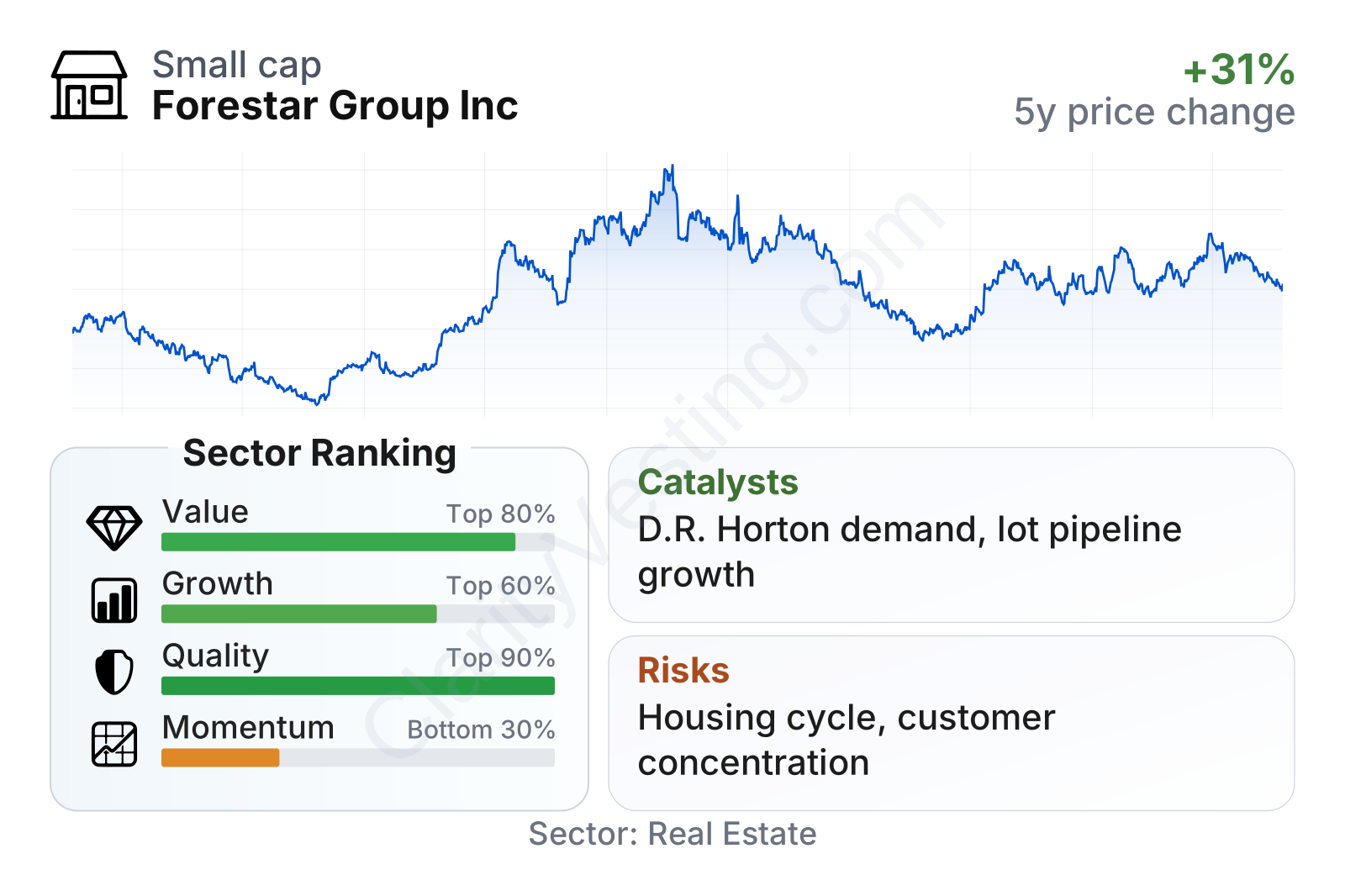
Forestar is a small-cap real estate company with above-average share-price volatility. On valuation, it screens cheaper than much of its sector, with a low earnings multiple and a price-to-book ratio below the sector median. Quality metrics are stronger: returns on assets, equity, and invested capital are all ahead of typical peers, while leverage remains clearly lower than the sector norm. Growth is more mixed, with revenue still expanding but not dramatically, and earnings over the last five years showing more pressure than the sector median. Market performance has also been uneven, with weaker multi-year returns than many real estate peers despite a rebound more recently.
Growth
Forestar operates in a sector with long-term relevance because the United States continues to need new housing supply, especially in markets with population inflows and constrained resale inventory. The company is positioned in land development rather than home construction, which can be attractive when builders want to conserve capital and rely more on external lot suppliers. That trend can support demand for finished lots over time, particularly from large national builders and regional operators that want shorter land pipelines.
The company’s strategy is logical for that backdrop. Management has emphasized a capital-light rotation model: acquire land, develop it, sell lots, and recycle the proceeds into new projects. Its relationship with D.R. Horton is especially important here. Forestar benefits from a dependable customer connection, development visibility, and market knowledge that many smaller land developers do not have. At the same time, the company keeps building relationships with third-party builders, which matters if it wants broader demand and less customer concentration over time.
Revenue per share has generally trended upward over the last few years, though not in a straight line. That matters because it suggests the business has been expanding its lot platform without excessive dilution. Book value per share growth has also been strong over five years, which indicates that retained earnings and land development activity have added to the company’s underlying asset base.
A meaningful catalyst is scale. As Forestar grows its community count and lot inventory, it can spread overhead across a wider platform and potentially improve returns on capital. Another catalyst is any environment where builders prefer to buy finished lots rather than tie up balance sheets with raw land and development risk. If mortgage rates stabilize and housing demand remains resilient in key Sun Belt and other growth markets, Forestar could have a larger runway than a simple reading of short-term home sales would suggest.
Recent company updates have also pointed to continued community expansion and a large owned-and-controlled lot position, which supports visibility into future deliveries. For a land developer, that pipeline matters because growth is tied less to one quarter’s sales and more to the inventory of projects moving through entitlement, development, and closing stages.
Risks
This article is for informational purposes only and does not constitute financial advice. Some content is AI-generated. See Disclaimer


