Stock Analysis · Fidelity National Financial Inc (FNF)
Overview
Fidelity National Financial is best known as a title insurance and transaction services company tied to residential and commercial real estate closings in the United States. In simple terms, when a home or property changes hands or is refinanced, title insurance helps protect buyers and lenders against legal problems linked to ownership records. FNF also provides escrow, closing, and other services that help complete those transactions. Alongside that core business, the company owns F&G, an insurance business focused on annuities and life insurance products.
This makes FNF a financial company with two major engines: a real-estate transaction business that tends to rise and fall with housing and mortgage activity, and an insurance business that earns from spread-based products and investment income. The combination gives the group more diversification than a pure title insurer, although title remains the defining franchise.
Based on recent company reporting, revenue is mainly generated from the following sources:
- F&G segment: approximately 55% to 65% of consolidated revenue in recent periods. This includes annuity and life insurance premiums and deposits, as well as investment-related income tied to those products.
- Title segment: approximately 35% to 45% of consolidated revenue. This includes title insurance premiums, escrow and other title-related fees, and transaction services for residential and commercial real estate.
- Corporate and other: typically a very small share of revenue and mainly reflects holding company activity rather than a major operating business.
Within title operations, the largest economic drivers are usually direct title premiums, agency title premiums, and escrow and closing fees. In practice, the title business depends heavily on home purchase volumes, refinance activity, commercial real estate transactions, and fee levels per file.
The flow of earnings over the last several years shows a business that can be highly cyclical. Revenue and profit were much stronger during the unusually active housing and mortgage period of 2021, weakened sharply as rates rose and transaction volumes slowed, and then partially recovered. Even so, the company has remained profitable and cash generative through a difficult cycle for housing-related financial services.
The long-term pattern shows how sensitive results are to real estate activity: profits compressed materially after 2021, then improved again as title volumes and overall revenue recovered from the trough. Operating costs have remained substantial, which means margins can swing meaningfully when transaction activity changes.
Key Figures
| Metric | Value | Sector ⓘ |
|---|---|---|
| Date | Oct 24, 2026 | |
| Context | ||
| Sector | Financial Services | |
| Industry | Insurance - Specialty | |
| Market Cap ⓘ | $10.89B | |
| Beta ⓘ | 0.99 | |
Value (Cheapness) | ||
| P/E Ratio ⓘ | 14.10 | 12.46 |
| P/B Ratio ⓘ | 1.81 | 1.25 |
| FCF Yield ⓘ | 53.17% | 9.82% |
| Dividend Yield ⓘ | 5.09% | 2.94% |
| EBIT / EV ⓘ | 16.98% | 8.11% |
| PEG ⓘ | 0.85 | |
Growth (Business expansion) | ||
| Revenue Growth ⓘ | 10.50% | 9.10% |
| RPS Growth (5Y CAGR) ⓘ | 0.39% | 12.31% |
| EPS Growth (5Y CAGR) ⓘ | -20.18% | -6.97% |
| BVPS Growth (5Y CAGR) ⓘ | -9.91% | 5.02% |
| Margin Growth (5Y Trend) ⓘ | -12.83% | -4.00% |
| FCF Growth (5Y CAGR) ⓘ | 12.65% | 4.71% |
| DPS Growth (5Y CAGR) ⓘ | 6.61% | 8.92% |
Quality (Business durability) | ||
| ROIC (Latest) ⓘ | 9.81% | 9.18% |
| ROE (Latest) ⓘ | 11.46% | 13.93% |
| ROA (Latest) ⓘ | 0.70% | 1.57% |
| ROIC (5Y Median) ⓘ | 12.93% | 7.80% |
| ROE (5Y Median) ⓘ | 27.27% | 12.15% |
| ROA (5Y Median) ⓘ | 1.44% | 1.28% |
| Net Debt / EBIT (Latest) ⓘ | 0.53 | 1.02 |
| Net Debt / EBIT (5Y Median) ⓘ | 0.87 | 0.72 |
| Net Debt / EBITDA (Latest) ⓘ | 0.38 | 0.88 |
| Operating Margin (Latest) ⓘ | 14.37% | 22.30% |
| Operating Margin (5Y Median) ⓘ | 14.61% | 24.50% |
| Debt to Equity (Latest) ⓘ | 63.63% | 59.34% |
| Profit Margin (Latest) ⓘ | 5.03% | 26.42% |
| Free Cash Flow (Latest) ⓘ | $5.79B | |
Momentum (Price trend) | ||
| 3Y Return ⓘ | +27.88% | +95.73% |
| 12M Return (excl. last month) ⓘ | -21.71% | +17.30% |
| 6M Return ⓘ | -16.38% | +6.07% |
| Price vs. 200-Day MA ⓘ | -12.82% | +5.36% |
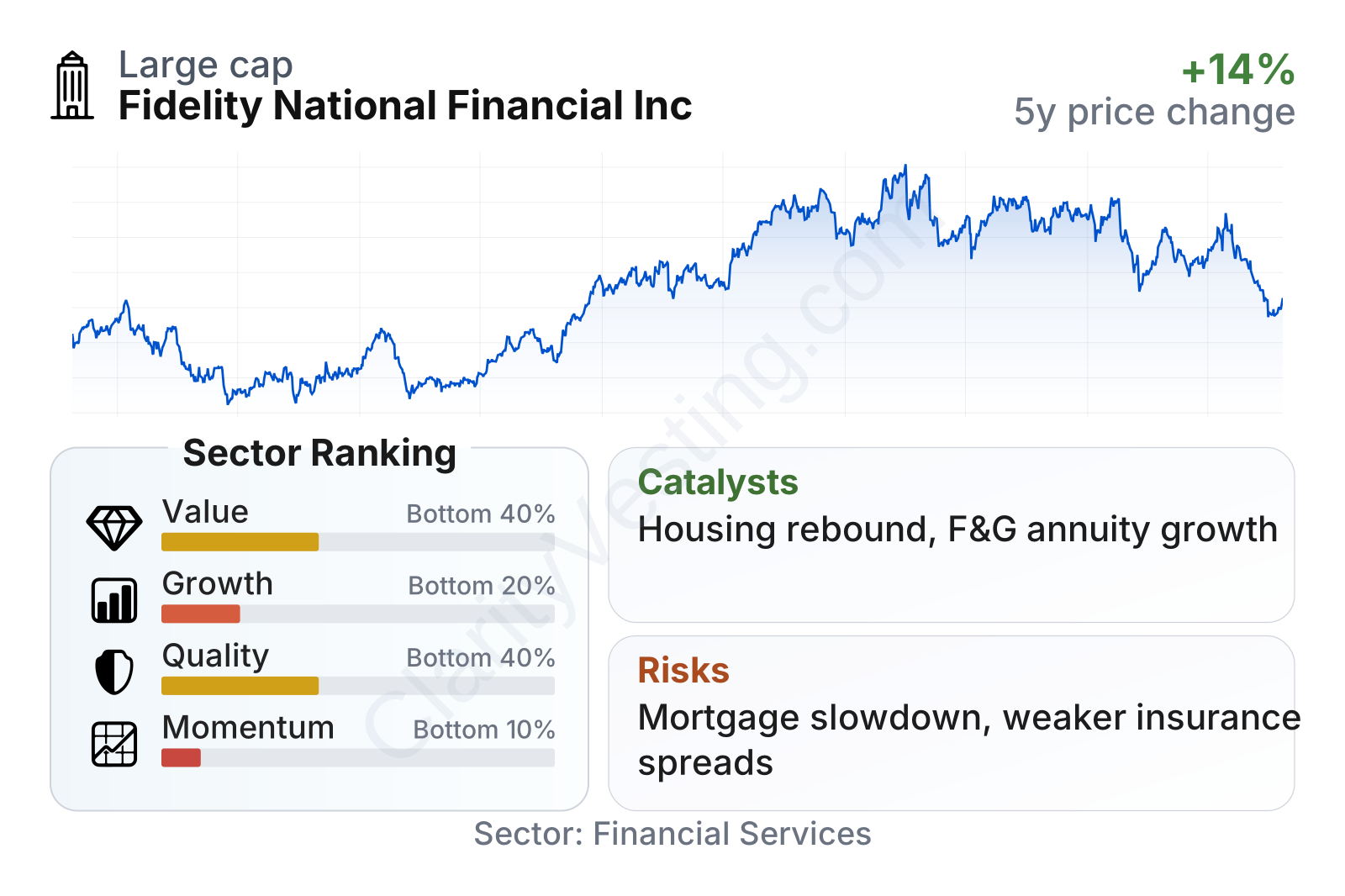
FNF sits in the large-cap range and its share-price volatility is close to the broader market, with a beta near 1. The factor mix is unusual: value metrics are mixed rather than outright cheap, quality is moderate, growth ranks weakly against the broader financial sector, and recent price momentum has been soft. At the same time, cash generation stands out, with free-cash-flow measures and dividend yield looking stronger than many sector peers. In other words, the market appears to be recognizing the company’s cash-producing ability while remaining cautious about its growth profile and cyclical exposure.
The stock-price history also reflects that pattern. Shares rose sharply into late 2024 and early 2025, then gave back part of that gain in 2026, which fits with a business still closely tied to changing expectations for housing, mortgage rates, and insurance profitability.
Growth
FNF operates in two sectors with very different growth characteristics. Title insurance is a mature industry, but it remains essential infrastructure for U.S. real estate transactions. That means long-term growth usually comes less from disruption and more from market share, pricing discipline, operating efficiency, and cyclical recovery when home sales and refinancing improve. F&G, by contrast, participates in retirement savings and income products, an area supported by aging demographics and persistent demand for annuities and wealth-preservation tools.
This combination gives the company a strategy that makes sense for future growth. The title segment offers scale, distribution, and recurring relevance in property transactions, while F&G adds exposure to retirement-focused insurance products that can expand even when mortgage refinancing is weak. For a company like FNF, one of the clearest catalysts is simply a healthier U.S. housing market. If mortgage rates ease or housing turnover improves, purchase and refinance volumes could support a stronger title earnings cycle.
Earnings per share illustrate the cycle clearly: profits were exceptionally strong in 2021, dropped sharply as real estate activity cooled, and then began to recover. That is not the pattern of a steady compounder, but it does show that the business can rebound meaningfully when conditions normalize.
Book value per share has been less consistent, which reduces the appearance of smooth long-term compounding. Still, the broader picture is that FNF is balancing cyclical title exposure with a more structurally supported insurance operation. Public company updates in 2026 have continued to emphasize expense management, commercial title opportunities, and the contribution from F&G as important levers. A significant opportunity for the group remains any broad recovery in U.S. housing affordability and transaction activity, especially after a prolonged period of elevated rates.
Risks
This article is for informational purposes only and does not constitute financial advice. Some content is AI-generated. See Disclaimer


