Stock Analysis · Covivio (FNCDY)
Overview
Covivio is a European real estate company organized as a REIT-like property owner and operator. Its business is built around owning buildings, collecting rent, developing or repositioning assets, and occasionally selling properties to recycle capital. The group is mainly exposed to offices, residential real estate in Germany, and hotels, with a geographic footprint centered on France, Germany, and Italy.
In practical terms, Covivio earns money from long-duration property income rather than from selling products. Its portfolio mixes traditional office buildings in large cities, residential units that generate recurring rent, and hotel real estate leased to operating partners. This combination gives the company several income streams, although all remain tied to property values, occupancy, and financing conditions.
Based on recent company reporting, revenue is broadly split as follows:
- Offices: approximately 45% to 50% of revenue. This includes office rents and related income from assets in major urban business districts, particularly in France and Italy.
- Hotels: approximately 25% to 30% of revenue. Covivio mainly owns hotel properties and leases them to operators, giving it exposure to travel and tourism activity without directly running hotels.
- Residential: approximately 20% to 25% of revenue. This is primarily German residential housing, a segment that tends to be more defensive than offices.
- Other activities: usually a small remaining share. This can include development services, asset management, and one-off items linked to portfolio rotation.
This revenue mix matters because it makes Covivio more diversified than a pure office landlord. The hotel and residential segments provide different economic drivers, which can help balance periods when office markets are weaker.
A useful pattern in the company’s recent financial profile is that revenue has generally moved upward over the last five years, while profitability has been much more volatile because real estate companies are heavily affected by changes in property valuations, asset sales, and financing costs. Interest expense rose sharply in 2023 and 2024 before easing in 2025, which is important in a debt-intensive sector like real estate.
The broad picture is a company with improving revenue scale and strong gross profitability, but with earnings that can swing materially from year to year as market conditions change.
Key Figures
| Metric | Value | Sector ⓘ |
|---|---|---|
| Date | Oct 03, 2026 | |
| Context | ||
| Sector | Real Estate | |
| Industry | REIT - Diversified | |
| Market Cap ⓘ | $6.49B | |
| Beta ⓘ | 1.12 | |
Value (Cheapness) | ||
| P/E Ratio ⓘ | 8.78 | 17.35 |
| P/B Ratio ⓘ | 0.38 | 0.86 |
| FCF Yield ⓘ | N/A | 7.47% |
| Dividend Yield ⓘ | 7.32% | 4.75% |
| EBIT / EV ⓘ | 4.52% | 3.81% |
| PEG ⓘ | N/A | |
Growth (Business expansion) | ||
| Revenue Growth ⓘ | 4.50% | 5.30% |
| RPS Growth (5Y CAGR) ⓘ | 8.23% | 5.96% |
| EPS Growth (5Y CAGR) ⓘ | -38.57% | -11.41% |
| BVPS Growth (5Y CAGR) ⓘ | -26.86% | 0.41% |
| Margin Growth (5Y Trend) ⓘ | 8.06% | 0.53% |
| FCF Growth (5Y CAGR) ⓘ | N/A | 5.40% |
| DPS Growth (5Y CAGR) ⓘ | -0.71% | 5.02% |
Quality (Business durability) | ||
| ROIC (Latest) ⓘ | N/A | 5.77% |
| ROE (Latest) ⓘ | N/A | 7.64% |
| ROA (Latest) ⓘ | N/A | 2.85% |
| ROIC (5Y Median) ⓘ | N/A | 4.20% |
| ROE (5Y Median) ⓘ | 3.11% | 6.03% |
| ROA (5Y Median) ⓘ | 1.25% | 2.45% |
| Net Debt / EBIT (Latest) ⓘ | N/A | 7.57 |
| Net Debt / EBIT (5Y Median) ⓘ | 7.69 | 8.41 |
| Net Debt / EBITDA (Latest) ⓘ | N/A | 5.12 |
| Net Debt / Assets ⓘ | 37.36% | 37.84% |
| EBITDA / Interest ⓘ | N/A | 4.11 |
| Operating Margin (Latest) ⓘ | N/A | 35.40% |
| Operating Margin (5Y Median) ⓘ | 79.79% | 36.59% |
| Debt to Equity (Latest) ⓘ | N/A | 89.06% |
| Profit Margin (Latest) ⓘ | 55.92% | 19.99% |
| Free Cash Flow (Latest) ⓘ | N/A | |
Momentum (Price trend) | ||
| 3Y Return ⓘ | +35.32% | +30.60% |
| 12M Return (excl. last month) ⓘ | -0.06% | +7.55% |
| 6M Return ⓘ | -8.31% | +0.69% |
| Price vs. 200-Day MA ⓘ | -5.84% | -2.30% |
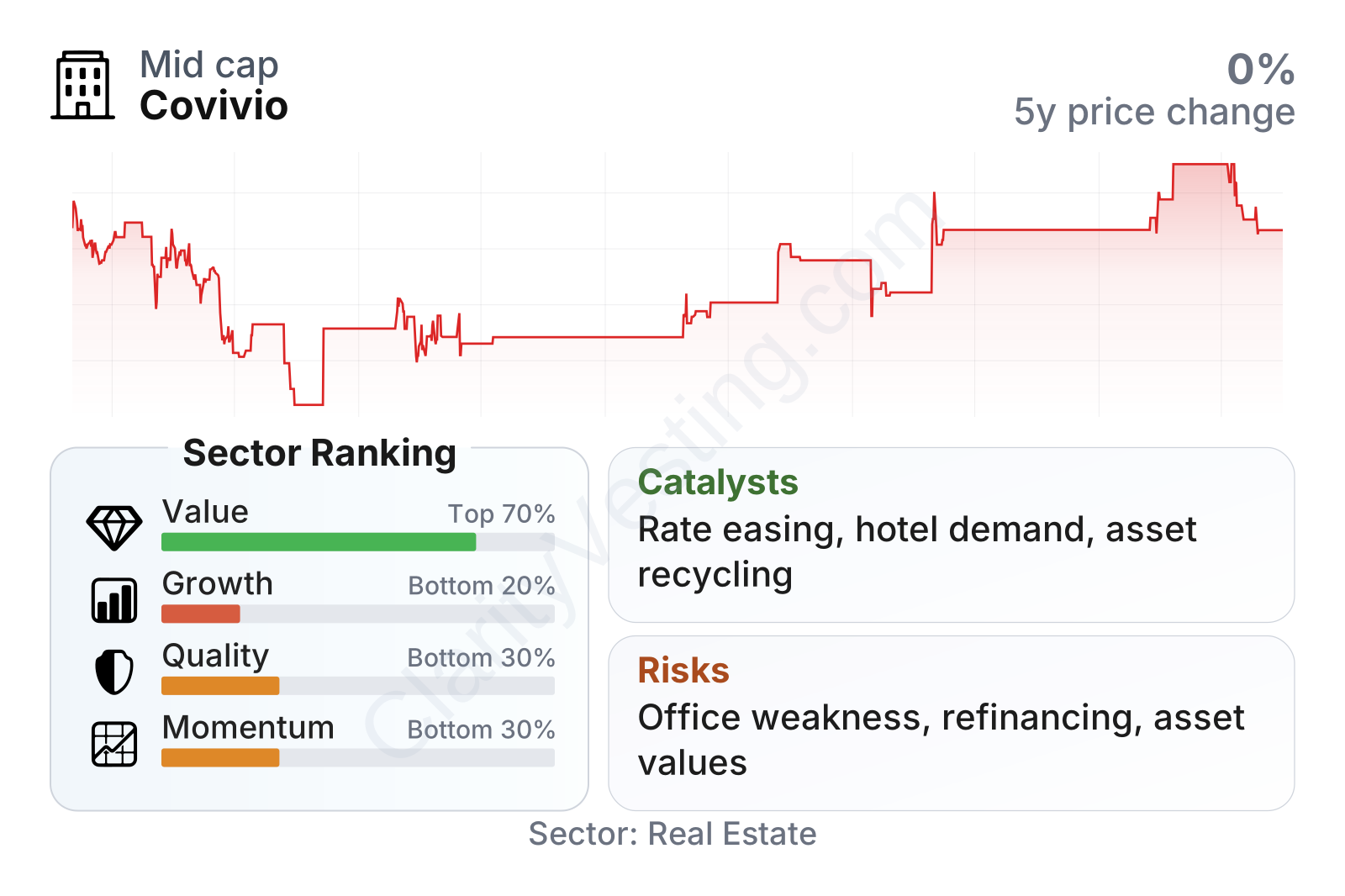
Covivio sits in the mid-to-large range within listed real estate, with a market value around the mid-single-digit billions of dollars and a share-price volatility close to the market average. On valuation measures, the stock appears cheaper than the sector median: its earnings multiple and price-to-book ratio are both well below typical diversified REIT levels, while its trailing dividend yield is clearly above the sector median.
That discount is not happening by accident. Growth metrics are mixed, with recent revenue still expanding but the broader growth profile ranking near the bottom of the sector because earnings and book value have been pressured over the last five years. Quality indicators also look uneven: profit margin is strong and leverage against assets is close to sector norms, but returns on equity and assets have lagged many peers. Price momentum is also softer than average, showing that the market has not fully re-rated the company despite the recovery from its lows.
The stock-price history reflects that tension. After a steep decline during the rate shock affecting European property stocks, the shares recovered meaningfully into 2025 and early 2026, then pulled back again. That pattern suggests the market is still weighing lower valuation multiples against persistent uncertainty around property values, office demand, and financing costs.
Growth
Covivio operates in a sector that is mature rather than fast-growing, but that does not mean growth is absent. Real estate can still expand through rent indexation, redevelopment projects, asset rotation, selective acquisitions, and recovery in property valuations after periods of stress. For Covivio, the main long-term question is less about explosive expansion and more about whether its portfolio is positioned in segments that can keep occupancy and rental income resilient over time.
Its strategy has a clear logic. The company is focused on large European cities, mixed exposure across offices, residential, and hotels, and active portfolio management. That matters because the best-located assets in major urban markets tend to remain more liquid and more attractive to tenants than secondary properties. The hotel portfolio also gives Covivio a way to benefit from travel demand and urban tourism, while the German residential business adds recurring income that is usually steadier than office rent.
Revenue per share has generally trended upward over the last five years, even with a dip in 2024. That indicates the company has been able to expand income generation per share over a full cycle, which is a more useful long-term sign than one year of headline earnings in real estate.
A major catalyst for future growth is the interest-rate backdrop. Property groups like Covivio are highly sensitive to borrowing costs and asset yields. If financing conditions continue to stabilize or improve, pressure on valuations and refinancing can ease, while transaction markets may become more active again. That would support both balance-sheet flexibility and the value of its underlying portfolio.
Another growth support is hotel normalization and urban asset reuse. Hotels have benefited from improving travel demand in Europe, and well-located office buildings can create value through refurbishment and repositioning, especially as tenants increasingly favor high-quality buildings in central locations. In this environment, owners of prime assets can sometimes outperform the broader office market even when the sector as a whole is under pressure.
The dividend path has been volatile rather than steadily rising, with a sharp cut followed by a strong rebound. That pattern fits a company adapting to a difficult property cycle. It also shows that cash distribution is closely tied to portfolio conditions and capital-allocation priorities, not simply to a smooth annual progression.
Recent company communications have also highlighted continued portfolio rotation, development discipline, and the use of disposals to manage leverage. In the current property market, that matters because growth increasingly comes from balance-sheet control and selective capital recycling rather than broad-based expansion.
Risks
This article is for informational purposes only and does not constitute financial advice. Some content is AI-generated. See Disclaimer


